Domain Rating Checker Guide: Use DR Without Fooling Yourself
How to use the Ahrefs-powered Domain Rating Checker for backlink research, competitor screening, and site due diligence without treating DR as a Google score.

A single authority number is attractive because it makes messy backlink research look sortable. That is also why it is easy to misuse. The Domain Rating Checker takes a bare domain and returns Ahrefs Domain Rating on a 0–100 logarithmic scale plus Ahrefs Rank for the previous day.
It is useful for quickly comparing backlink-profile strength, screening outreach prospects, and checking a site before a partnership or acquisition. It is not a Google metric, a traffic estimate, or proof that a link will improve rankings.
Key takeaway
- DR is Ahrefs’ estimate of backlink-profile strength, not a Google score.
- Compare similar sites and record the lookup date.
- Use DR to form questions, then inspect referring domains, relevance, traffic, and link placement.
- The live tool currently lists $0.08 per successful run; failed 4xx/5xx lookups are described as uncharged.
What the tool returns
The tool is backed by ahrefs/domain-rating. Its input is a target domain without protocol or path, plus a date. The page pre-fills the previous day’s date because the metric is not presented as an intraday live counter.
The output is intentionally narrow: Domain Rating and Ahrefs Rank. That narrowness is a feature if you keep the question narrow. “How strong does this domain’s backlink profile look in Ahrefs relative to comparable domains?” is appropriate. “Will this site rank my article?” is not.
Because DR is logarithmic, moving from 20 to 30 does not represent the same change as moving from 70 to 80. Avoid arithmetic such as “domain A is twice as authoritative as domain B” based only on the displayed values.
Three workflows that make sense
Link-prospect screening
Use DR as one column in a shortlist, not the acceptance rule. Add topical relevance, estimated organic traffic, editorial quality, outbound-link patterns, and whether the proposed placement is actually visible and contextual. A high-DR domain can still sell irrelevant or low-quality placements.
Competitor baselining
Choose direct competitors of similar size and market, run all lookups on the same date, and save the results. Repeat monthly or quarterly rather than daily. The useful signal is a sustained change combined with new referring-domain evidence, not a one-point movement.
Website due diligence
For a domain purchase, sponsorship, or partnership, DR can reveal whether a site deserves deeper backlink inspection. It cannot reveal penalties, ownership disputes, traffic quality, revenue, or the durability of rankings. Treat it as a filter before detailed due diligence.
A safer decision table
| Signal | What it may suggest | What to check next |
|---|---|---|
| High DR, relevant niche | Established backlink profile | Referring-domain quality and traffic |
| High DR, unrelated niche | Authority may not transfer to your topic | Placement context and audience overlap |
| Low DR, strong original content | New or specialized site | Growth trend and real readership |
| Sudden DR increase | New links or recalculation | Link velocity, sources, and spam patterns |
This is the point worth slowing down: DR compresses a graph into one number. Every compression discards context.
Input hygiene
Enter example.com, not https://example.com/page. Normalize www consistently across a comparison set. Record the date and result together. If a lookup fails, do not silently substitute a different domain variant and pretend the records are comparable.
For traffic questions, use a traffic-specific tool instead. The Website Traffic Checker guide explains estimated monthly visits and trend data; DR answers a backlink question, not an audience-size question.
Visual evidence from the live product
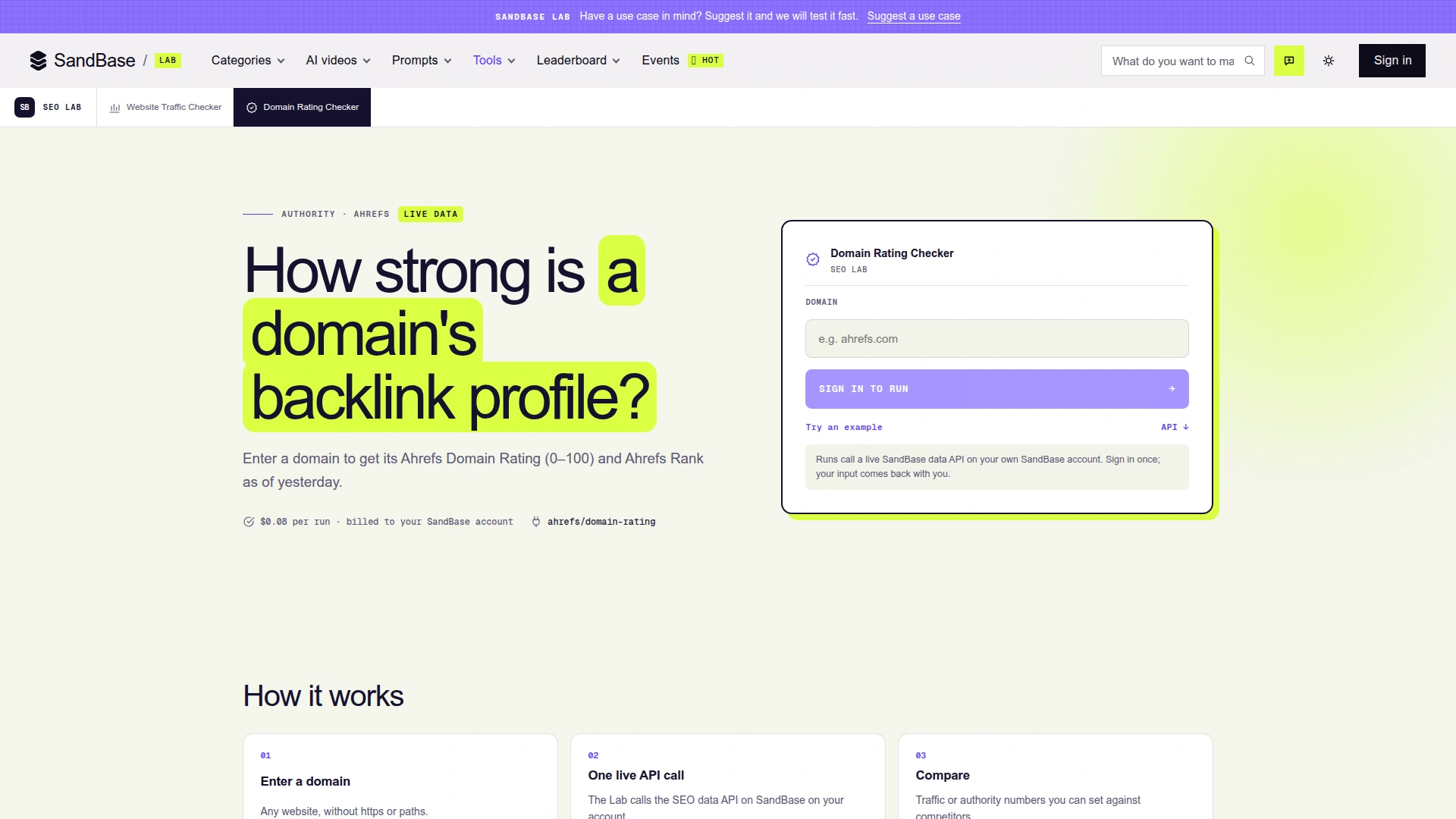 The tool accepts a domain without protocol or path and runs a dated Ahrefs lookup. Captured November 4, 2026.
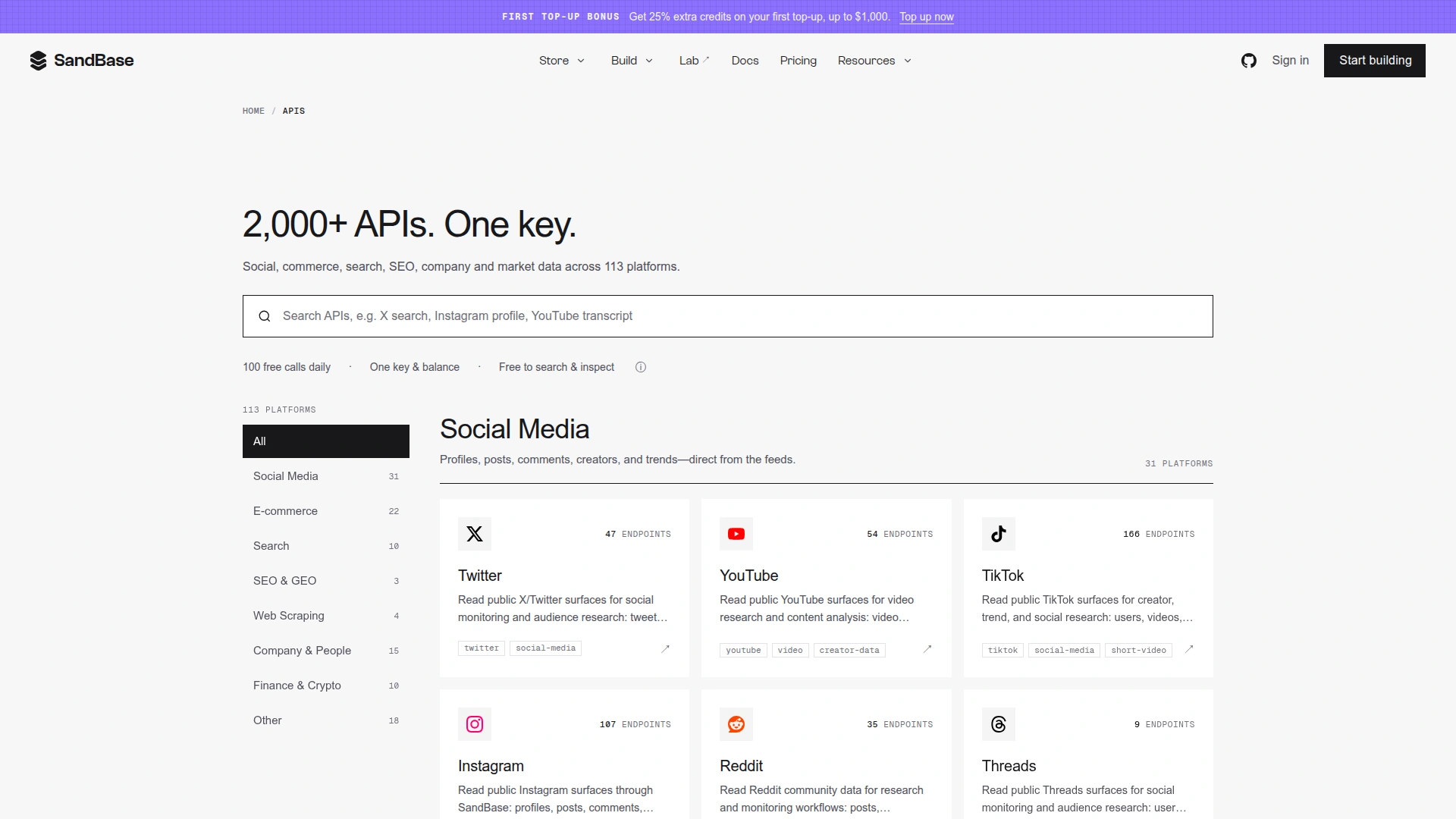 The API directory separates provider discovery from the narrower domain-rating workflow. Captured November 4, 2026.
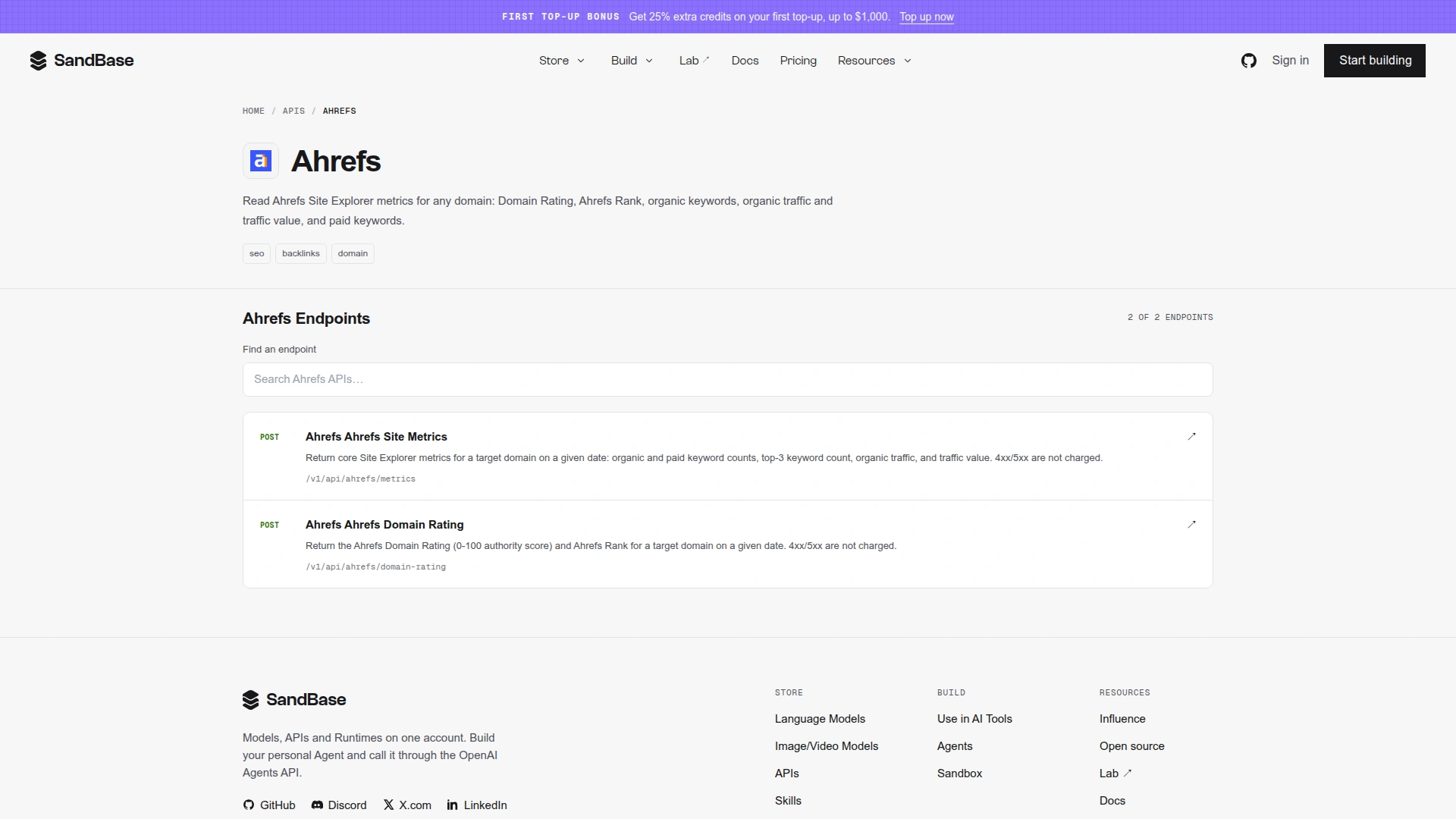 The provider catalog is the place to verify available Ahrefs endpoints and current terms; this guide covers only domain rating. Captured November 4, 2026.
Limits
- DR belongs to Ahrefs and depends on its crawl and calculation.
- It does not measure content quality, conversion, brand trust, or revenue.
- It is not a direct ranking factor published by Google.
- One domain-level number can hide strong and weak sections of the same site.
- Historical comparisons require consistent domain normalization and dates.
- Pricing and availability can change; verify the live API page before automating volume.
Build the comparison set before collecting scores
A raw DR value has little meaning without peers. A local service business, a specialist documentation site, a global publisher, and a venture-backed software company attract links through different mechanisms. Comparing them in one table mostly rewards scale and publicity.
Define the niche, geography, business model, and maturity stage first. Exclude obvious category mismatches. Normalize domains consistently, including the treatment of www, and run the set on the same date. This turns an attractive number into a repeatable observation rather than a screenshot selected to support a conclusion.
Use the same discipline over time. A score movement does not explain itself. It may reflect new links, lost links, redirects, a migration, an expired domain, or a change in the provider’s crawl and calculation. Keep an event log beside the monthly or quarterly series. Investigate the graph before writing the story.
What to inspect after DR
Sample the actual referring pages. Check topical alignment, editorial context, indexability, anchor patterns, sitewide links, redirects, and clusters of domains that appear to share ownership. Look at where links point: a strong domain-level score can coexist with a weak page-level environment or an old homepage that no longer supports the topic.
Compare authority with audience evidence. Estimated traffic is imperfect, but a site with a strong backlink profile and no visible topic-specific audience deserves a different review from one with stable demand. For paid placements, inspect disclosure, outbound-link density, permanence, and whether the proposed page remains accessible and useful after publication.
Write the decision in plain language. “Accept because DR is 72” is not defensible. A better record says: “Proceed to editorial review because the site is topically relevant, has a stable audience, and its sampled referring-domain pattern shows no obvious manipulation; DR is one supporting signal.”
Monitoring and automation
For a small portfolio, a monthly spreadsheet is enough. Store the normalized domain, lookup date, DR, Ahrefs Rank, notable events, and reviewer notes. Alert only on changes large enough to justify investigation; daily polling creates noise and unnecessary cost.
An automated workflow should preserve failed lookups instead of replacing them with zero. It should also record the API response time and price used for the run. The tool page currently says unsuccessful 4xx/5xx lookups are not charged, but production budgeting should rely on the current API page rather than an article snapshot.
Do not publish a leaderboard without explaining selection rules and dates. Domain metrics change, and a table can quickly look authoritative after its evidence has gone stale. If the comparison affects a purchase, partnership, or public claim, have a human inspect the underlying sites before the decision leaves the team.
For agencies, keep client permissions and confidentiality in mind. A public domain can be queried without exposing private analytics, but combining the result with internal revenue, migration, or acquisition data creates a sensitive record. Store that enriched dataset in the client’s approved system, not in a public report or a shared demo workspace.
The most important operational rule is simple: never let the score choose the action by itself. It can decide which domain receives the next ten minutes of research. It cannot decide which publisher deserves money, which acquisition is safe, or which SEO strategy will work.
FAQ
What is a good Domain Rating?
There is no universal threshold. A useful benchmark compares direct peers in the same niche, geography, and maturity stage.
Does a high DR guarantee a valuable backlink?
No. Relevance, page quality, placement, indexability, editorial control, and actual readership still matter.
Is DR the same as Domain Authority?
No. DR is an Ahrefs metric. Domain Authority is a different third-party metric with a different index and calculation.
How often should I check it?
Monthly or quarterly is usually enough for strategy. Check around a major migration, acquisition, or link campaign when there is a concrete reason.
Bottom line
Domain Rating Checker is useful because it makes one comparison fast. Keep the interpretation just as narrow: it estimates backlink-profile strength in Ahrefs. Use it to prioritize deeper research, never as a standalone verdict on SEO value.