Academic Paper Search Guide: Build a Better Literature-Review Shortlist
How to use Academic Paper Search to find papers by topic and year, interpret citation signals, and build a defensible literature-review shortlist.
The slow part of a literature review is rarely typing a query. It is deciding which results deserve attention, whether the search is biased toward famous older work, and when you have enough coverage to stop. Academic Paper Search gives researchers a compact starting surface: a topic, an optional publication-year floor, and ranked results with titles, authors, links, snippets, and citation counts when available.
It is useful for scoping a new topic, checking recent work before a design decision, and finding seed papers for citation chaining. It does not verify a paper’s claims, guarantee complete index coverage, or replace reading the paper.
Key takeaway
- Search with a narrow research question, not a whole field name.
- Use year filters to separate foundational work from the current frontier.
- Treat citation counts as context, not quality scores.
- Verify titles, authors, publication venues, and conclusions at the source.
How the tool works
The page maps to one SandBase data endpoint, scholar/search-scholar. The documented input is a required query plus optional maximum result count and lower/upper publication years. The live page currently lists the call inside the shared free daily quota, then $0.0036 per run; pricing can change.
In a bounded test on November 4, 2026, I searched for retrieval augmented generation evaluation, requested five results, and set the lower year to 2023. The observed payload contained titles, author lists, links, snippets, and citation counts. Those business fields are observed from that run and should not be treated as an immutable contract beyond the published API schema.
The first useful lesson was immediate: the result list mixed broad surveys with domain-specific evaluation work. That is not a flaw. It is a reminder that the query expresses a topic, while the researcher still has to define inclusion criteria.
A repeatable search workflow
1. Convert the topic into a question
“RAG evaluation” is broad. “How do recent papers separate retrieval quality from generation faithfulness in RAG systems?” gives the search a mechanism and a boundary. Write the question down before opening results.
2. Run two time windows
Start without a year floor to find foundational and highly cited work. Then run a recent window, such as the last two or three years, to surface newer methods that have not had time to accumulate citations. Keep the result sets separate.
3. Build a screening table
| Field | Why it matters | Verification step |
|---|---|---|
| Title and snippet | Fast relevance screen | Open the abstract |
| Authors and venue | Research context | Verify on publisher or repository |
| Year | Recency and chronology | Check the paper record |
| Citation count | Influence signal | Treat as dated and index-dependent |
| Link | Route to the source | Prefer DOI, publisher, arXiv, or proceedings |
Do not read citation count as a verdict. Older papers have had more time to collect citations; survey papers often attract more citations than narrow empirical work; and counts differ across indexes.
4. Record exclusion reasons
For each rejected result, use a short reason: wrong domain, commentary rather than empirical study, outside the date window, duplicated version, or no accessible full text. This produces a review trail and makes later updates faster.
5. Chain citations manually
Once two or three seed papers survive screening, inspect their references and “cited by” graph. Query-based retrieval and citation chaining find different things. The former helps discover vocabulary; the latter helps locate intellectual lineage and follow-up work.
Good use cases
Product research. Before implementing a technique, find surveys and benchmark papers that explain known failure modes. Product teams should still distinguish peer-reviewed evidence, preprints, and blog interpretations.
Student literature reviews. Use the tool to form a candidate set, then document inclusion criteria and read the actual sources. A ranked list is not a methodology section.
Research monitoring. Save a stable query and rerun it monthly with a recent-year filter. Compare new titles rather than treating citation-count movements as the primary signal.
Agent retrieval design. Developers can call the underlying API to build a paper-discovery step, but downstream agents should preserve source links, expose uncertainty, and never fabricate missing bibliographic data. The AI search API guide covers broader web-search choices; scholarly search is narrower and should remain its own retrieval lane.
Visual evidence from the live product
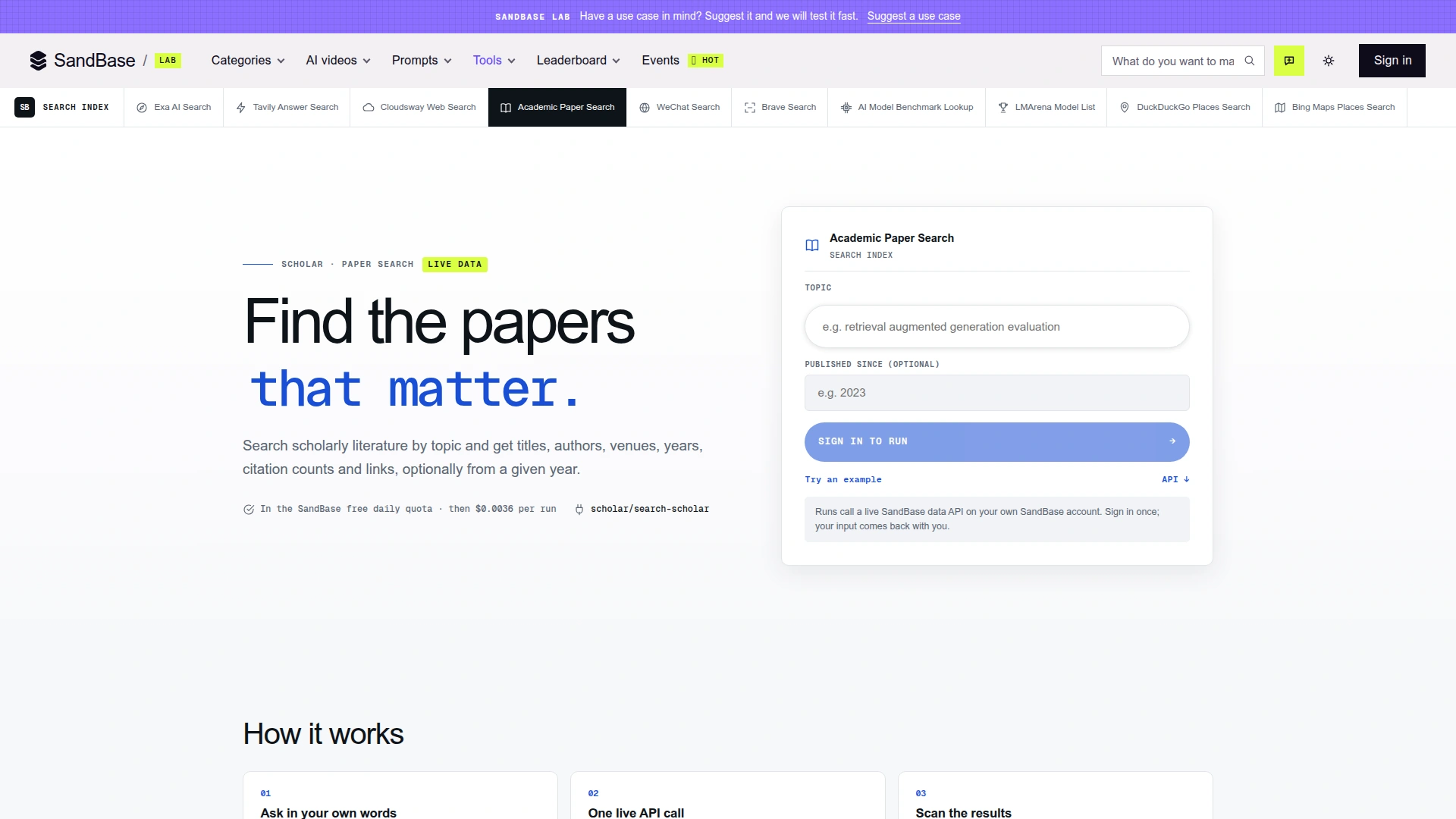 The tool accepts a topic and optional publication-year floor before running one scholarly-search call. Captured November 4, 2026.
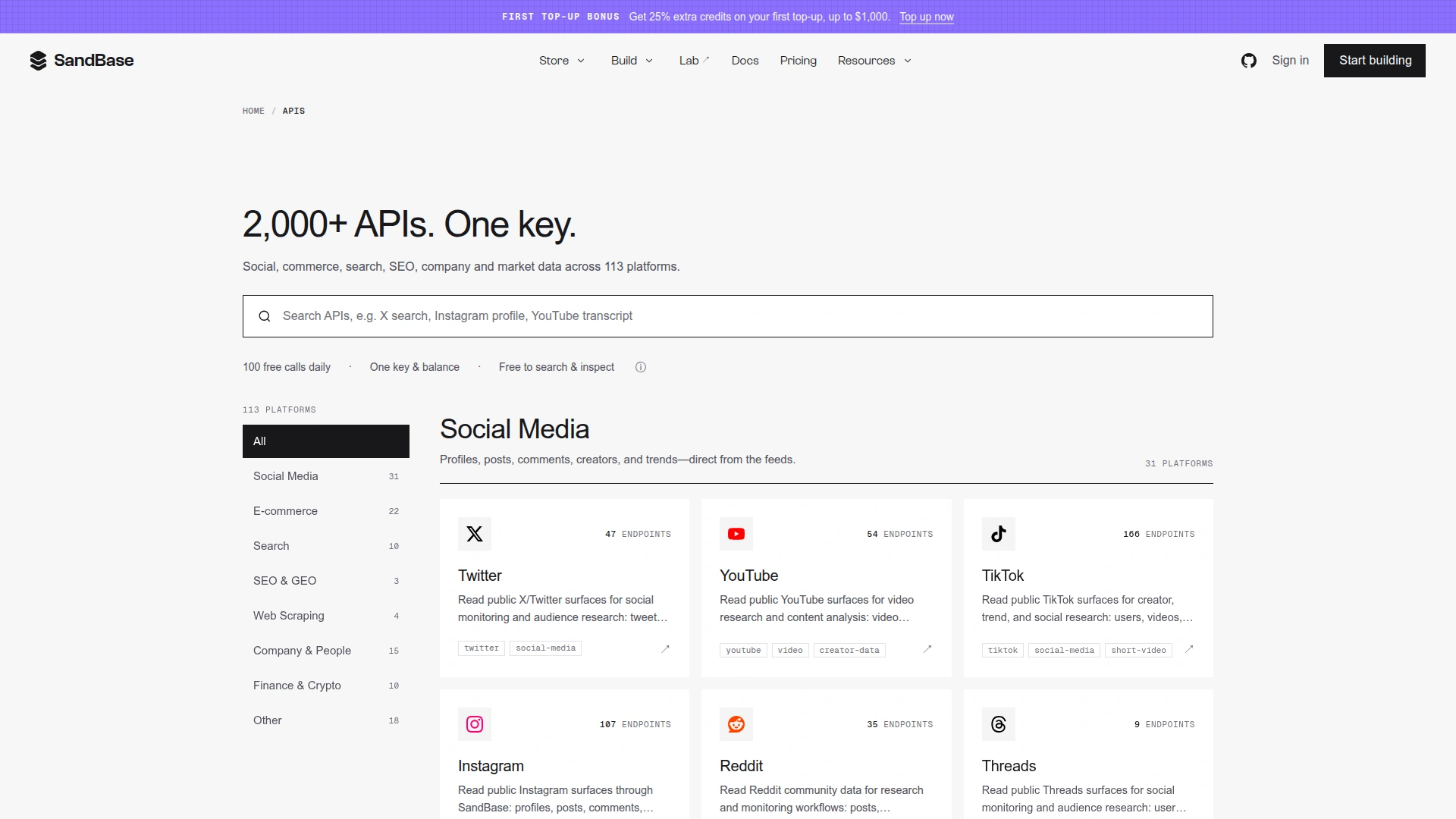 The API directory is the broader discovery layer; the paper-search workflow narrows it to scholarly retrieval. Captured November 4, 2026.
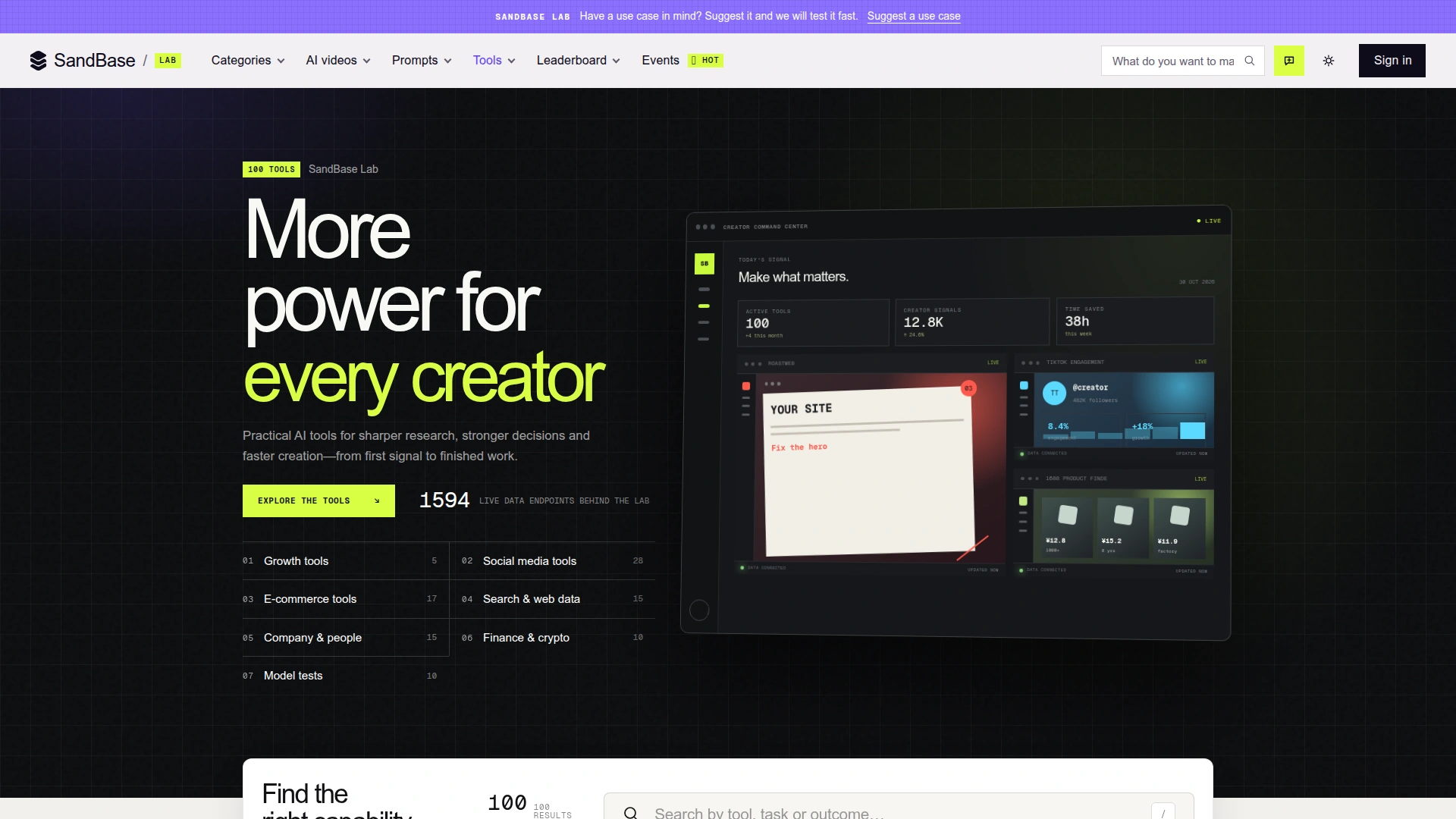 The directory category helps users find Academic Paper Search; it does not claim complete scholarly-index coverage. Captured November 4, 2026.
Failure modes
- A snippet can make a paper look more relevant than its actual methods or conclusions.
- Citation counts are delayed, incomplete, and index-specific.
- Author names can be truncated in compact results.
- A year filter can hide foundational work that defines the vocabulary used by newer papers.
- Search results do not establish peer-review status, replication quality, or causal validity.
From a result list to an evidence matrix
After screening, create a structured matrix. Useful columns include research question, dataset, population, method, baseline, evaluation metric, main finding, limitation, publication status, version, and source URL. Populate a claim only after reading the section that supports it. Abstracts are efficient for triage but often omit negative results, implementation details, and threats to validity.
Fast-moving AI research needs explicit version tracking. A preprint may gain new experiments, change author order, or later appear in conference proceedings. Record the version date and, when code matters, the repository commit used by the paper. Two links carrying the same title do not necessarily describe identical evidence.
Use a second reviewer for claims that will drive a costly product choice. The second pass does not need to repeat the whole search. It should verify the extraction against the paper and challenge whether the cited experiment actually matches the proposed workload. An LLM can help format notes, but it should not silently reconcile conflicting values or fill missing bibliographic fields.
Define a stopping rule as well. For exploratory product work, one foundational search, one recent search, and citation chaining from three seed papers may be enough. A stronger rule is to stop after two query reformulations and two citation-chaining rounds produce no new eligible concepts. Record the date, queries, filters, and sources checked so the review can be updated later.
Systematic reviews require more. They may need multiple databases, a registered protocol, duplicate screening, risk-of-bias assessment, and a PRISMA-style flow. Academic Paper Search can contribute candidates, but a convenient interface cannot supply that methodology automatically.
Keep inaccessible papers visible in the log rather than silently dropping them. Record that only the abstract was available, request the manuscript through legitimate channels when it matters, and avoid treating absence of full text as evidence against the research. This distinction keeps access constraints separate from relevance and quality judgments.
Interpreting the November 4 test
The five-result RAG-evaluation test returned broad surveys alongside domain-specific medical and healthcare work. That was valuable for vocabulary discovery, but it was not a coherent final evidence set. A general infrastructure review would likely keep the broad surveys and retrieval-quality paper while excluding the medical papers unless domain transfer was part of the question.
Observed citation counts varied substantially. I did not use them to declare a winner. A newer survey has had less time to accumulate citations, and surveys often receive attention differently from narrow empirical papers. The defensible conclusion is only that the call produced enough metadata to begin screening and that every shortlisted paper still required source verification.
FAQ
Can this generate a complete systematic review?
No. A systematic review needs a documented protocol, multiple databases where appropriate, deduplication, screening, and quality assessment.
Should I sort only by citations?
No. Citations measure accumulated attention, not necessarily methodological strength or relevance to your question.
Can developers use the same search in an agent?
Yes. The API page documents the endpoint and inputs. Preserve links and dates, validate the payload defensively, and keep a human review step for consequential research.
Bottom line
Academic Paper Search is a strong starting point when you treat it as candidate generation. Ask a precise question, split foundational and recent searches, record screening decisions, then verify every important claim in the source paper.