Best Gemini 4 Argon Examples: The 20 Most-Liked Creations
The 20 most-liked Gemini 4 Argon examples from launch week, grouped by what they show: physics sims, 3D scenes, math art, games and UI. Credits, likes and Lab links.
The most-liked Gemini 4 Argon video on X in launch week is a pelican on a bicycle drawn by spinning Fourier circles. The second is a gummy-bear physics test where the creator says Argon lost. That’s why this list exists: popular clips mix real technique, contests and good timing, and it helps to know which is which.
These are the best Gemini 4 Argon examples of 2026 by one measurable yardstick: the 20 most-liked posts in SandBase Lab’s 264-video Argon collection, grouped by what they demonstrate. Each entry credits the creator, links the X post and its Lab page, and says in a line what’s technically interesting. It’s for developers who want to see what people built in the two days after general availability on October 13 and pick what to try first.
Key takeaway
- The top 20 posts hold 24,654 of the collection’s 36,870 likes (66.9%). The median post in the 264-video set has 21 likes.
- 10 of the 20 are side-by-side comparisons against Claude Opus 5.5, GPT-6 Astra, Muse Wonder or others. In three, the creator says Argon lost or trailed.
- Only one of the 20 (@Adidotdev) points to a shared prompt; for the rest you infer the technique from the post text.
- The most technically dense posts are a pure-Python voice synthesizer (@fofrAI) and a fur shader with 60,000 instanced strands (@thebuggeddev), both creator-described and unverified by us.
- Likes measure reach, not quality.
How this list was picked
The source is the SandBase Lab Gemini 4 Argon collection: 264 videos from 209 creators, public X posts from October 13 and 14, 2026. SandBase curates it from X, so it isn’t a record of everything posted. All numbers come from the collection’s data file at the 2026-10-14 16:29 UTC sync; likes and views have moved since.
The ranking is by likes only; an editor’s “best” is a judgment you can’t check. What I added is grouping, because a pure likes sort tells you nothing about what Argon is good at.
Three rules for reading it:
- Likes are not quality. Posts travel on audience size, timing (19 of the 20 went up on launch day) or a spicy “vs” caption.
- Creator claims are claims. “Made by Argon”, “took 4 minutes”, “cost $22” are the creator’s statements. I reproduced none of these builds.
- A comparison clip is one run, one sample per model, judged by the poster. A data point, not a benchmark.
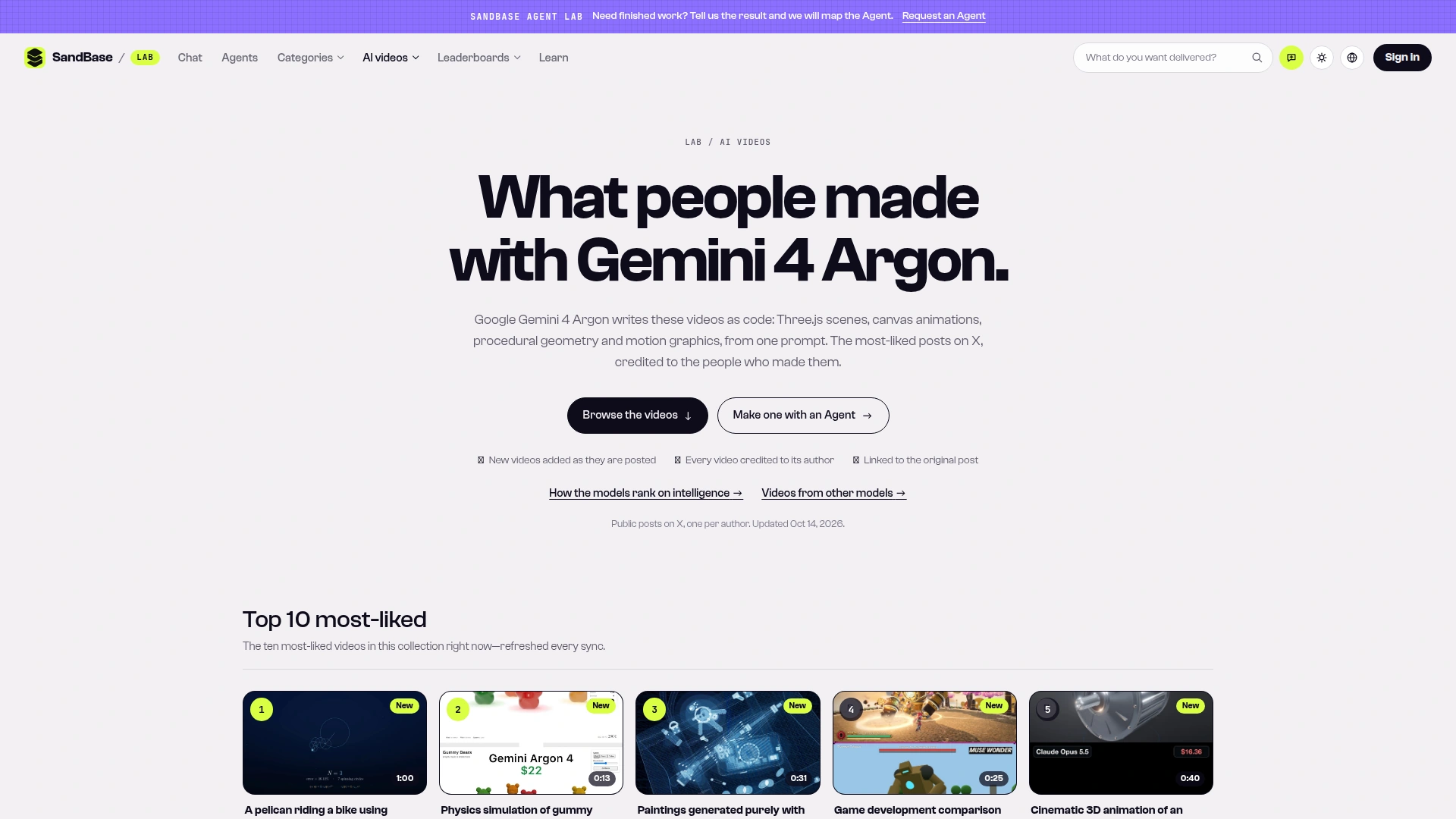
The SandBase Lab gallery for Gemini 4 Argon shows the same top five by likes that open the table below, and notes the posts are public X posts updated Oct 14, 2026 (captured 2026-10-15).
The top 20 Gemini 4 Argon examples at a glance
Rank is by likes at the sync. “Work” opens the Lab detail page (post text plus a “Try this prompt” panel); the handle opens the original X post.
#1 has 12x the likes of #20, and the curve keeps flattening: #21 has 362, and half the collection sits at 21 or fewer. The full distribution is in the launch-week data study.
Physics and simulation
Five entries are about simulated behavior: soft bodies, liquid, fur, water. They’re the most informative, because physics breaks visibly.
#2, gummy bears, @semichenkko. One prompt to Claude Opus 5.5 and Argon, then the same abuse for both: pull a paw, squash, throw, pour a bag on top. The creator’s verdict: Opus made jelly, Argon made “gummy statues” whose arms turned to sticks and bodies clipped through each other. Reported cost: Opus $7.2, Argon $22. Why it’s interesting: soft-body deformation is the hardest thing on this list to fake, and the #2 Argon post is one where the poster says Argon lost.
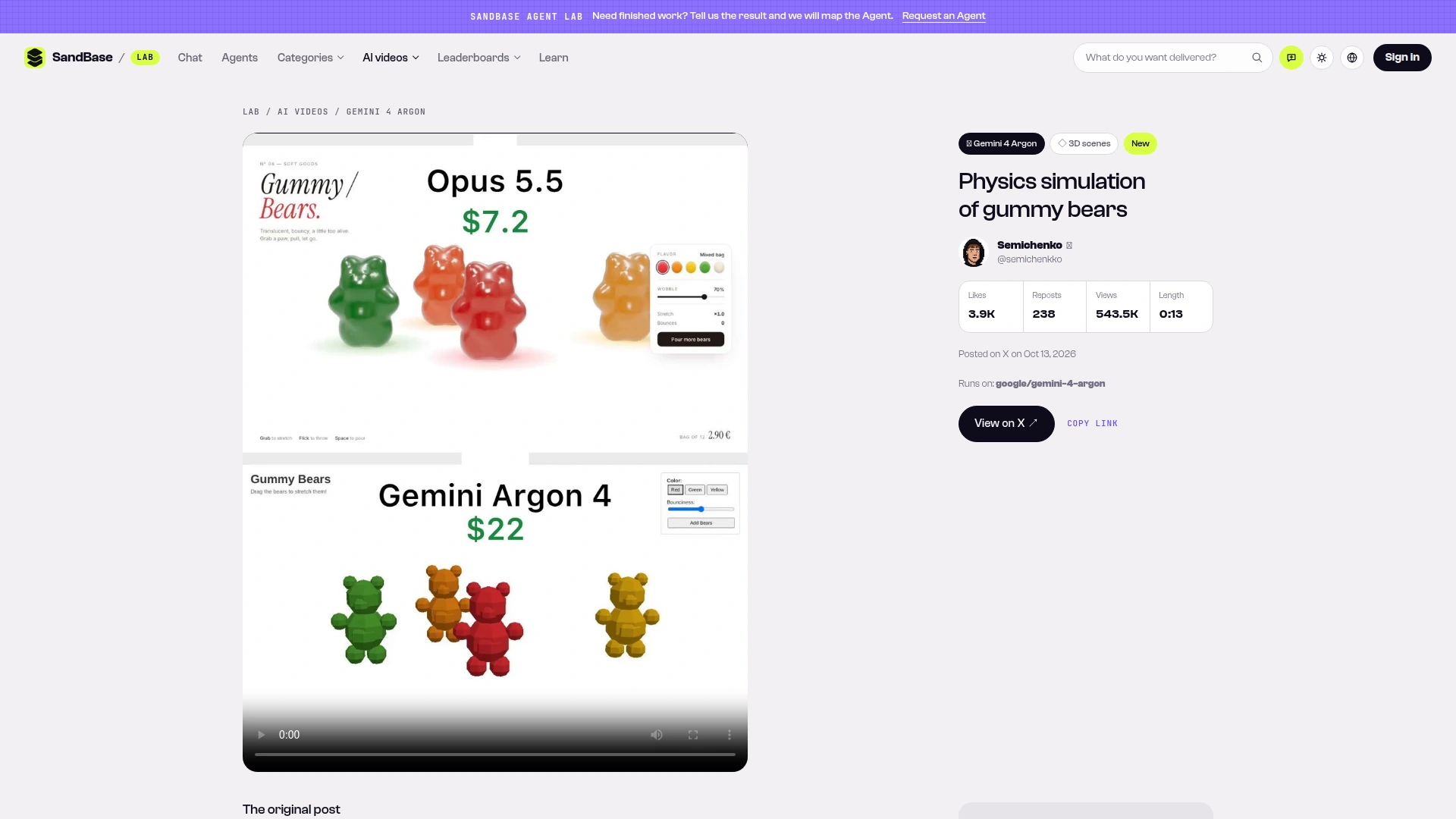
The Lab page for #2 shows the creator’s cost labels ($7.2 for Opus 5.5, $22 for Argon) and the stats in our table: 3.9K likes, 543.5K views, 0:13 (captured 2026-10-15). The costs are the creator’s figures.
#10, margarita sloshing, @ann_nnng. Argon, Muse Wonder, Opus 5.5 and GPT-6 Astra on one liquid-in-a-glass effect; the creator notes all four used Three.js with WebGL. A sloshing surface shows quickly whether a model wrote a simulation or a looping animation.
#12, drivable sailboat, @ai_for_success. An island, a hut and a sailboat you steer, from an early-access tester who says it “took a few prompts”. Water, boat physics and keyboard input in one scene, plus an honest note that good results are iterated.
#15, fluffy pumpkin, @thebuggeddev. The post describes a procedural GLB with 28 volumetric fur shells, 60,000 GPU-instanced strands and real-time “air-jet” physics in Three.js and GLSL. If accurate, that’s shell texturing plus instancing, a real-time fur technique from games, not a pre-made asset.
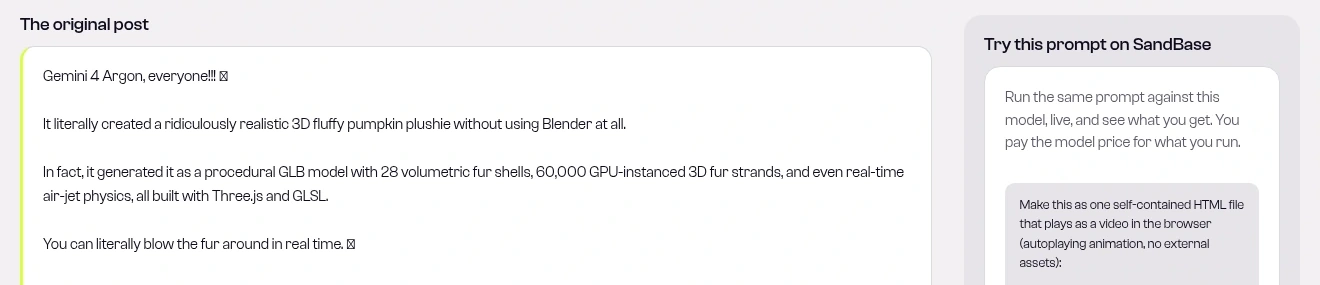
The Lab page for #15 keeps the creator’s technical description in full: 28 fur shells, 60,000 instanced strands, Three.js and GLSL (captured 2026-10-15, cropped to the post text). We haven’t inspected the code.
#16, “Island Jelly”, @Adidotdev. An island inside a translucent block, Argon vs Opus 5.5, with the prompt in the replies: the only top-20 post flagged as prompt-shared. Its timing and quota figures (Argon 10 minutes and ~1.5% of a weekly quota, Opus 15 minutes and 4%) are credited to another tester, so they’re second-hand.
3D scenes
Five entries are mainly about look. I’m keeping this short; the Gemini 4 Argon Three.js guide covers all 105 3D-scene posts and runs its own scene.
#7, battle helicopter, @thtbee_. A procedurally generated helicopter “made purely in three.js”. The creator says it came from a “multi round self iteration loop of Argon + Nano Banana”, so an image model was in the loop. Not a one-shot.
#8, The Space Train, @EnvolDev. The most useful comparison here, because the creator argues against his own headline. He reports Opus at 1h 53m and $23.46, Argon at 4m 20s and $3.40, then concedes Opus is ahead on clouds, locomotive mechanics and camera work. The claim is speed and cost per acceptable result, not peak quality.
#9, whale breaching, @Bhavani_00007. Argon, Opus 5.5, GPT-6 Astra and Kimi K3 on one scene; the creator rates Argon highest on photorealism. A breach stresses splash particles and lighting; the verdict is one person’s.
#11, island diorama, @Mr_Salio. Argon vs Opus 5.5; the Lab poster frame shows a floating island from each. The creator finds Opus “little bit better” with a small gap. Watch it next to #16.
#17, introduction film, @HarshithLucky3. A one-minute launch film the creator says Argon made about itself; the frames are a rendered 3D scene with a mascot. It shows how far “one prompt, one file, one film” stretches.
Math and code art
#1, Fourier pelican, @fofrAI. A drawing traced by chains of rotating circles, the classic Fourier-series visualization, with on-screen readouts of term count and error as the approximation refines. The creator says Argon made the video and prompted the time-synced Lyria 3.5 music.
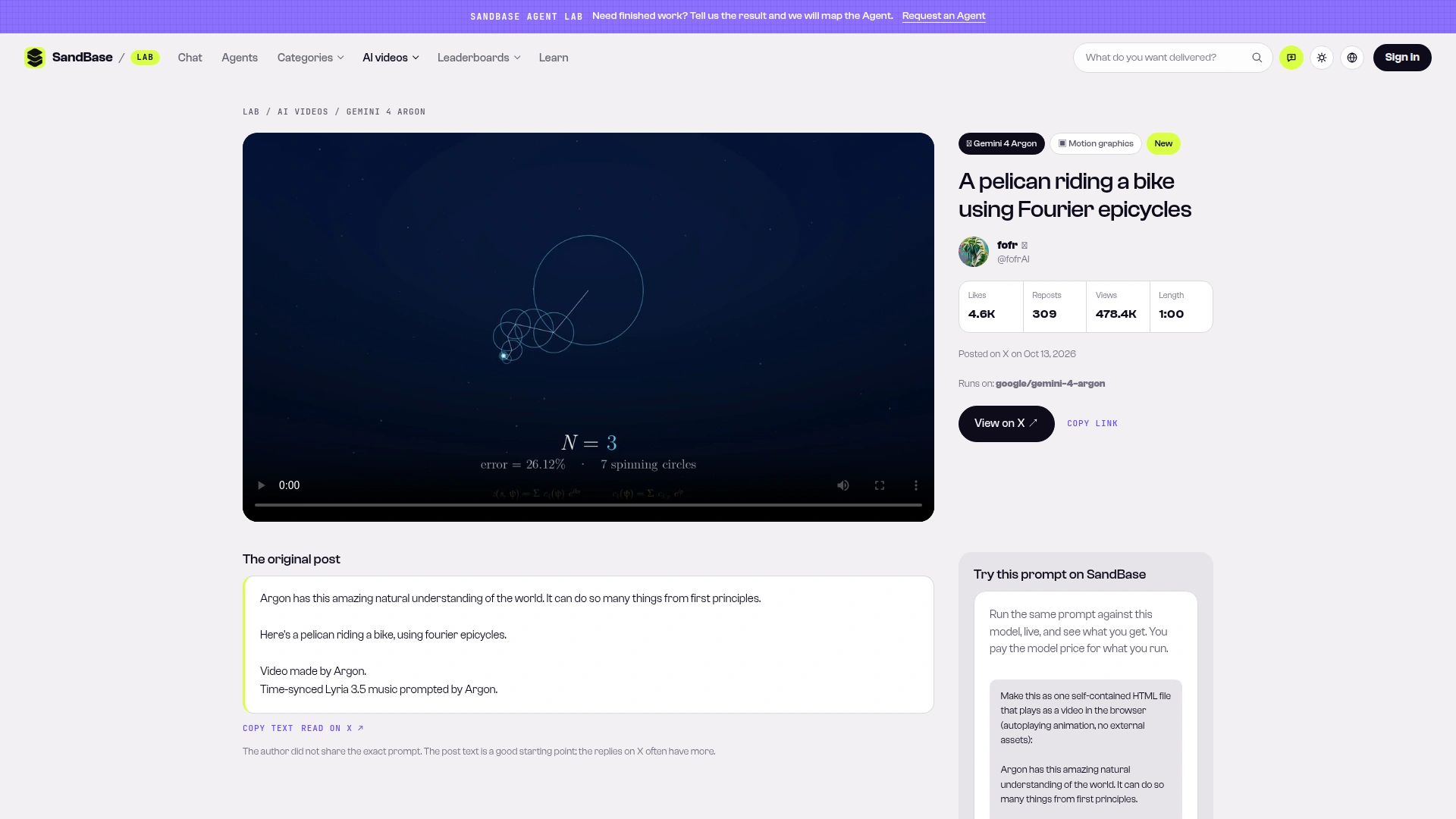
The Lab page for #1: the frame reads “N = 3, error = 26.12%, 7 spinning circles”, and the panel shows 4.6K likes, 478.4K views and “Runs on google/gemini-4-argon” (captured 2026-10-15). The page notes the author didn’t share the exact prompt.
#3, code paintings, @kickingkeys. Everything in the thread is code, says the creator, who promises the full code for 534 paintings. That count is the point: it’s a generator, not one lucky image.
#19, Frieren in SVG, @notjazii. An SVG of an anime character from a reference image, with music. The creator reports 1h 27m, about 26.35M tokens and $5.19 in Devin. A useful warning: an agent loop on a “simple” vector drawing can burn tens of millions of tokens.
Games and agents
Gameplay depth is the subject of the Gemini 4 Argon browser game test, which builds and plays one. The popular clips:
#4, vs Muse Wonder, @universalmodhq. Same prompt, “two completely different games”; the poster frame shows a third-person boss fight with health bars. In a follow-up (362 likes, just outside the top 20) the creator reports $3.45 for Muse Wonder and $29.71 for Argon.
#14, desk photo to racing game, @googledevs. Google’s own developer account, so read it as a product demo: Argon in Google Antigravity orchestrating subagents and using Nano Banana for assets. At 2:36 it’s the longest clip and the clearest view of a multi-agent build.
#20, first to the Nether, @fawnunwrap. Argon, Opus 5.5 and “Sol 6.1”, same place, same prompt, no time limit. One “made it… for about 25 seconds”. The post doesn’t say which or how the models were wired up, so treat it as entertainment.
UI, audio and explainers
#5, electric motor, @rubenssoto_ai. Opus 5.5 vs Argon on a cinematic 3D animation of how a Tesla-style motor works. Explainers need the mechanism right, not just pretty; the creator leaves the verdict to viewers.
#6, speed comparison, @jaimintf. The poster frame shows phone intro screens from Claude Fable 5.1, GPT-6 Astra and Argon. The only claim is that Argon “was the fastest of all”, with no times. Popular, and the least informative entry here.
#13, Jupiter/Moog synth, @maxescu. A playable synth in one HTML file, “in under 30 minutes” per the creator, with a link to play it. Dense control UI plus real-time audio code: a different skill from 3D.
#18, voice synthesis, @fofrAI. The most technical post text in the top 20: a source-filter model, the Liljencrants-Fant glottal flow equation, five vocal tract chambers, 18 ms stop bursts, minimum-jerk pitch curves, all in library-free Python. Creator-described, but specific enough to check if the code is published.
What the top 20 have in common
| Pattern | Count in top 20 | What it means for you |
|---|---|---|
| Side-by-side with another model | 10 | Half the attention went to contests. Watch the Argon half yourself. |
| Creator says Argon lost or trailed | 3 (#2, #8, #11) | Popular doesn’t mean Argon won. |
| Prompt shared | 1 (#16) | You’ll mostly rebuild prompts from post text. |
| Posted on launch day | 19 | Early posts had more runway. |
Reported costs swing from $3.40 (space train) to $29.71 (game), measured in different tools and none metered by us. The Gemini 4 Argon pricing guide has the rates, and the prompt guide works through the 52 posts that shared prompts.
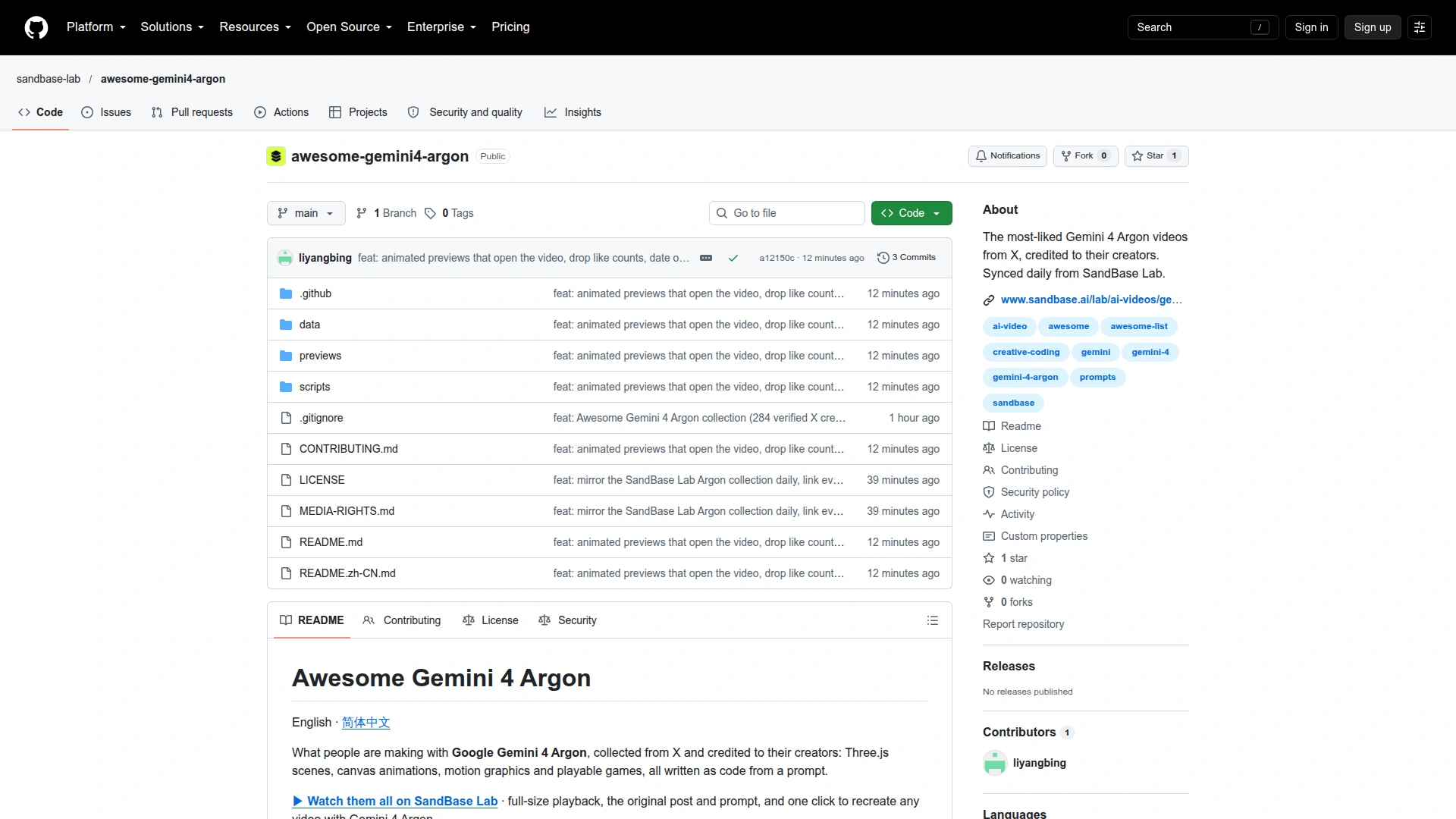
The awesome-gemini4-argon repository on GitHub mirrors the Lab collection with credits and links to each original post, for readers who’d rather browse a README by category (captured 2026-10-15).
Browse the rest or recreate one
The full set is in the SandBase Lab gallery, each with a “Try this prompt” panel that runs on google/gemini-4-argon, and on GitHub as awesome-gemini4-argon. Videos and prompts belong to their creators.
The Gemini 4 Argon model page on SandBase lists $4 input / $20 output per million tokens, 1M context and a 65.5K max output per response. That’s Google’s standard rate after November 30 and twice Google’s direct introductory $2 / $10, per Google’s announcement. A single-file scene fits under 65.5K output tokens; an agent loop like #19 adds up fast. For pre-GA background, see our earlier Argon API access note.
FAQ
What is the best Gemini 4 Argon example?
By likes, @fofrAI’s Fourier-epicycle pelican: 4,600 likes and 478,424 views at the 2026-10-14 sync. By technical density, @fofrAI’s pure-Python voice synthesizer or @thebuggeddev’s fur shader.
Were these videos really made by Gemini 4 Argon?
That’s what the creators say; we verified none. Some name other tools in the loop, such as Nano Banana (#7, #14) or Devin (#19).
Is Gemini 4 Argon better than Claude Opus 5.5 for 3D and physics?
These clips can’t settle it. Each comparison is one run judged by its creator, and verdicts split: #9 favors Argon; #2, #8 and #11 favor Opus on quality.
Where can I find the prompts?
Only #16 in the top 20 shares one. Across the collection, 52 of 264 posts do; each Lab detail page says whether the author shared a prompt.
Limits of this list
It’s a popularity ranking inside a two-day collection SandBase curated from X, not a census. Likes are frozen at one sync and favor launch-day posts and large accounts. Every capability, time and cost claim is the creator’s; we ran no builds for this article and inspected no code.