Best Polymarket Data API Alternatives in 2027
Best Polymarket data API alternatives in 2027: official docs expose public market data, and SandBase bills 59 Polymarket cards per call beside Kalshi.
Polymarket already publishes public market-data documentation. A research notebook that can call those docs directly does not need a second vendor to read a market list. SandBase, on the 18 Nov 2026 catalog check (Asia/Shanghai), listed 59 Polymarket-branded endpoints and bills them per call, on the same key as the rest of a 2,247-endpoint data catalog. The reason to pay that meter is convenience beside other APIs, including four Kalshi cards on a shared prediction-markets page. The reason to stay official is that you can integrate the docs yourself, or you need trading, real-time, NEX, or perps surfaces this hub does not establish. Official per-request prices and trading fees are Unknown. SandBase is not an official trading API.
Key takeaway
- docs.polymarket.com returned a public overview on 18 Nov 2026, with market-data navigation plus trading and exchange items. Official fees were not extracted.
- SandBase listed 59 Polymarket endpoints. Example list prices were $0.00044 and $0.012 per call on named cards, not a single rate for every card.
- The prediction-markets category listed 63 items and includes Kalshi’s four cards plus Polymarket.
- Teams that can call the official market-data APIs directly have a real reason to skip the per-call meter.
- Speed is Unknown. This page does not claim SandBase is cheaper than official data.
What the Polymarket docs surface shows
The documentation root titled “Overview - Polymarket Documentation” was available on 18 Nov 2026. Navigation included Getting Started, Markets and Events, Positions and Tokens, Prices and Orderbook, and Market Data, with entries for discovering markets, market details, prices and order books, analytics, and real-time data. SDKs and APIs are in the nav as well. Trading and exchange items appear too, including “Meet NEX, Polymarket’s new exchange” and Perps. A docs index file was also available. The consumer site titled “Polymarket | The World’s Largest Prediction Market™” is a product homepage, not an API price card.
Official per-request prices were not on the overview we used. Official market-data fees stay Unknown. Official trading fees stay Unknown. If public market data is free on Polymarket’s side, this article cannot say so, because no fetched page stated a fee schedule. Until that figure exists, “SandBase is cheaper” is not a sentence this page will use.
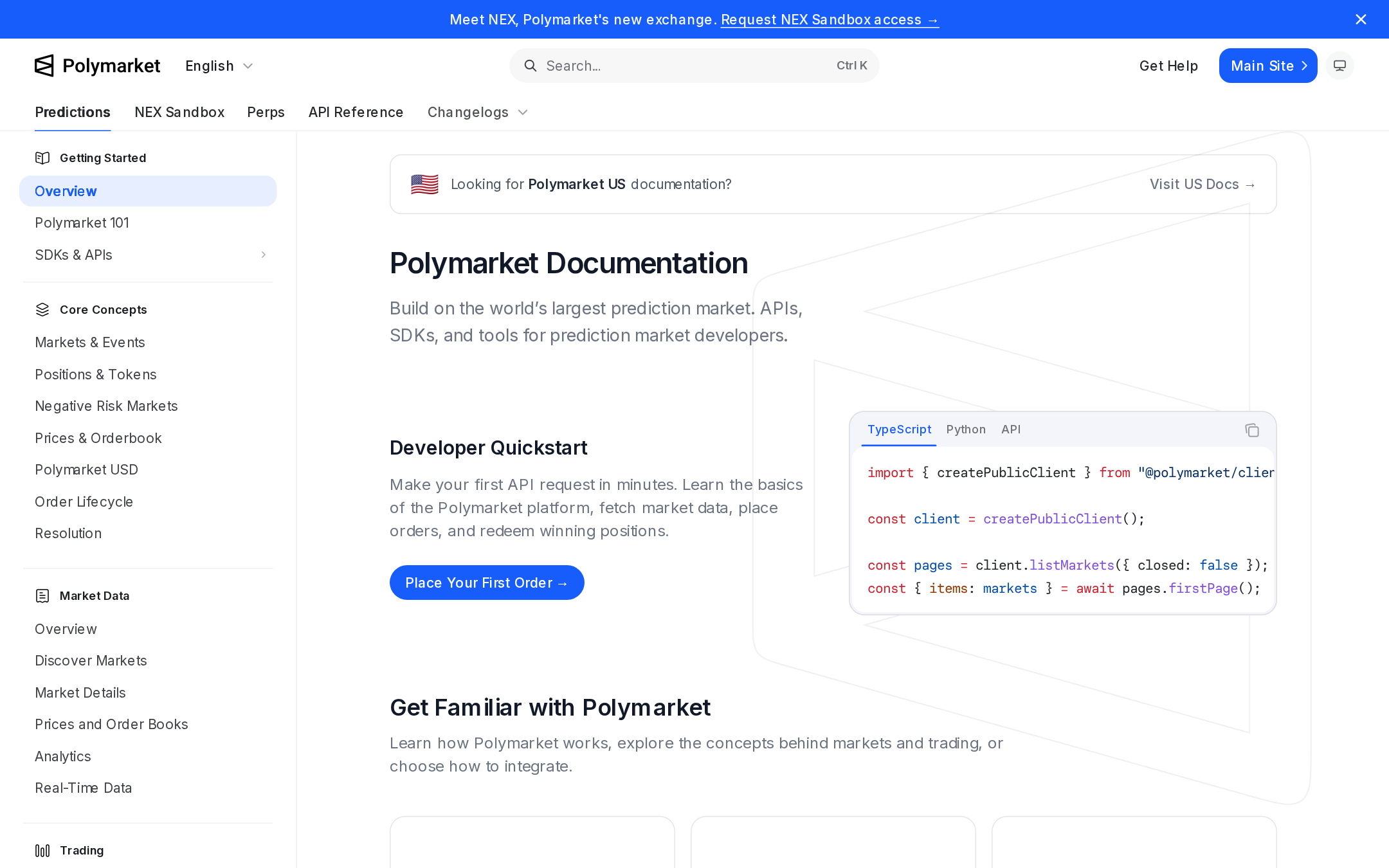
Official Polymarket documentation at docs.polymarket.com, captured 18 Nov 2026, Asia/Shanghai. The page is a docs overview with market-data and trading navigation. It is not a public per-request price card. Official fees remained Unknown in this check.
Fifty-nine cards, two example rates
The SandBase hub title on that check was “Polymarket APIs: Prediction Markets, Prices and Positions,” with 59 endpoints and a blurb aimed at market research and wallet analysis. Browse them at the Polymarket hub. The same day’s data APIs page reported 2,247 endpoints from 182 providers and carries no date stamp, so the count can change. Do not substitute llms.txt’s combined “2,777 models and APIs.” The providers page is a curated short list, not a census of 182.
List prices from the hub Markdown are SandBase prices, and they are not uniform. Several cards described as returning “the official Polymarket API response unchanged” listed $0.00044 per call. The examples named in that band were list events, comments, and get event by id. Other cards listed $0.012 per call, including wallet activity, order-book summary, builders volume, closed positions, and CLOB parameters. Those names are the examples. They are not a claim that every one of the 59 sits on one of those two numbers. The markets card, titled “Polymarket Markets API: List Markets with Prices,” was live at the markets endpoint. Its own list price was not in that pair of examples, so read the card rather than assigning it $0.00044 or $0.012 by resemblance.
Two Polymarket endpoints also appear in the pricing page’s sample of the daily free allowance. The sample is not a complete roster. Inspect the live card anyway.
At the printed rates, 100 calls on a $0.00044 card are $0.044, and 100 calls on a $0.012 card are $1.20, if each call is billed at that list price. That arithmetic is not an invoice, not a latency test, and not a comparison with official Polymarket, whose fee is Unknown. A card described as passing an official response through unchanged is still a SandBase call with a SandBase price.
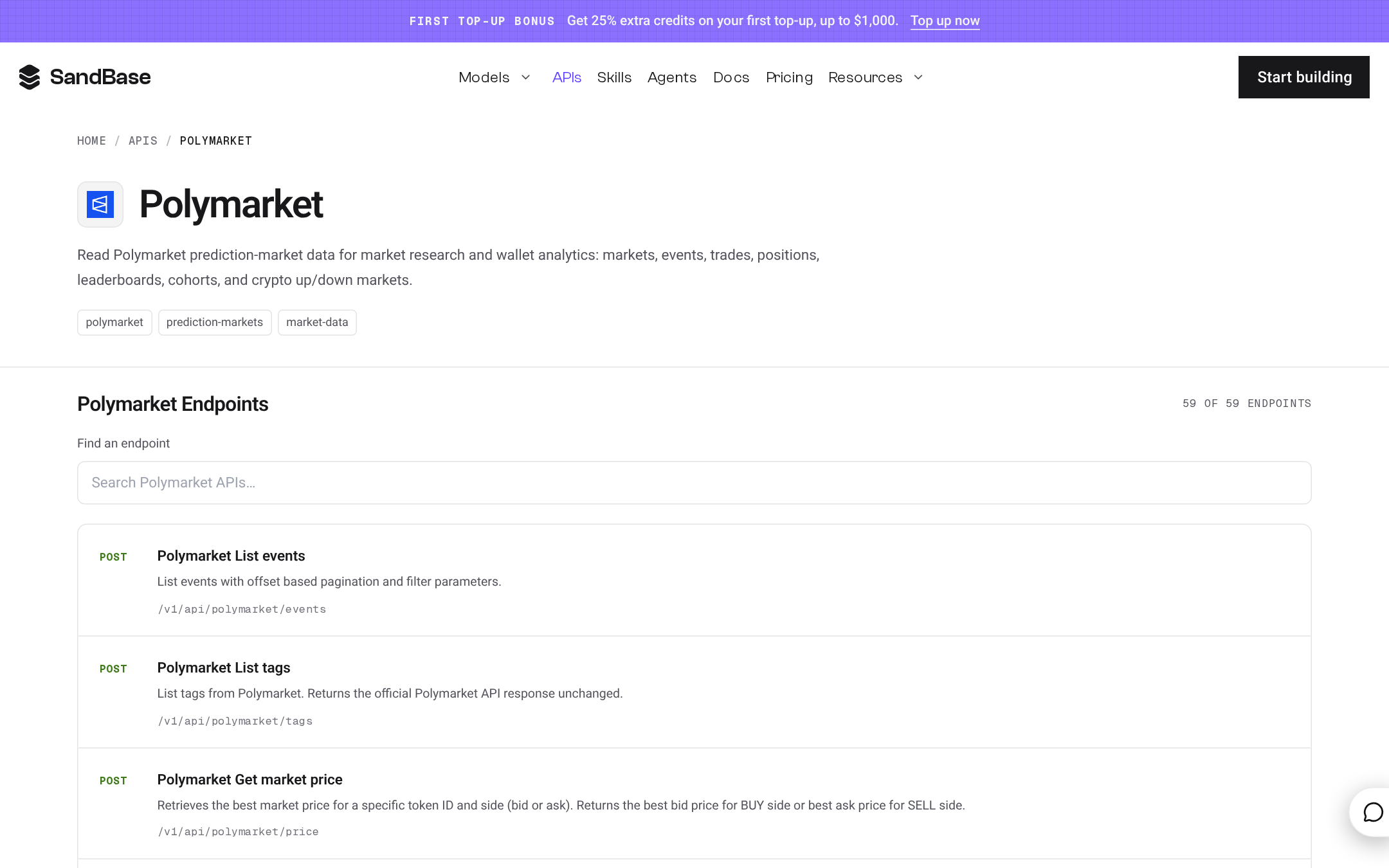
SandBase Polymarket hub, logged out, light theme, 18 Nov 2026, Asia/Shanghai. The catalog check listed 59 endpoints for prediction markets, prices, and positions. The capture shows the banner “FIRST TOP-UP BONUS Get 25% extra credits on your first top-up, up to $1,000.” Confirm current promotions on the pricing page.
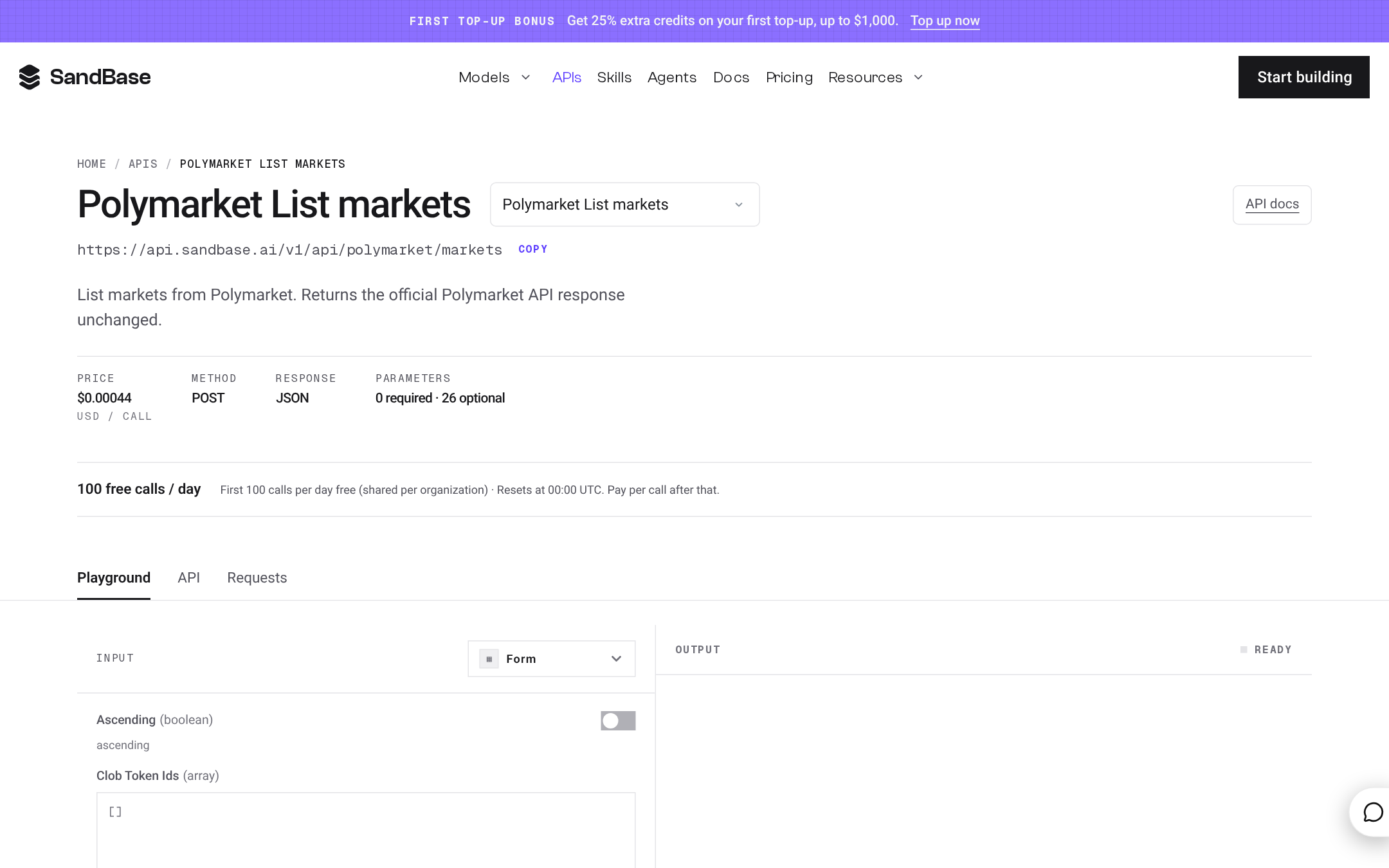
SandBase Polymarket markets card, logged out, light theme, 18 Nov 2026, Asia/Shanghai. The page title on that check was “Polymarket Markets API: List Markets with Prices.” The list price for this specific card was not one of the $0.00044 or $0.012 examples, so read the card. The capture shows the banner “FIRST TOP-UP BONUS Get 25% extra credits on your first top-up, up to $1,000.” Confirm current promotions on the pricing page.
Kalshi sits on the same category page
The prediction-markets category was titled “Prediction Market APIs: Polymarket and Kalshi Data” and listed 63 items. The count matches the 59 Polymarket endpoints plus the four Kalshi cards. Kalshi on SandBase is a separate, smaller surface: four market-data endpoints, not Polymarket’s 59. Read Best Kalshi API Alternatives in 2027 when the venue is Kalshi’s event-contract data. This post stays on Polymarket.
Equities, filings, and macro series are a different shelf. Best Financial Market Data API Alternatives in 2027 covers Nasdaq, MarketBeat, FRED, Yahoo Finance, and SEC cards. Do not treat that post as a Polymarket guide. Best Data API Providers in 2027 is the cluster map and is not a ranking.
| Choice | What you get | Price this check can cite |
|---|---|---|
| Official Polymarket docs | Public market-data navigation, plus trading, real-time, NEX, and perps items in the docs | Official per-request and trading fees: Unknown |
| SandBase Polymarket cards | 59 per-call endpoints for markets, prices, positions, and wallet-style reads | Examples at $0.00044 and $0.012, not every card |
| SandBase prediction-markets category | Polymarket plus four Kalshi cards, 63 items | Kalshi cards are priced in the Kalshi article |
| Direct official integration | The docs, without a SandBase bill | Unknown official fee, plus your own engineering time |
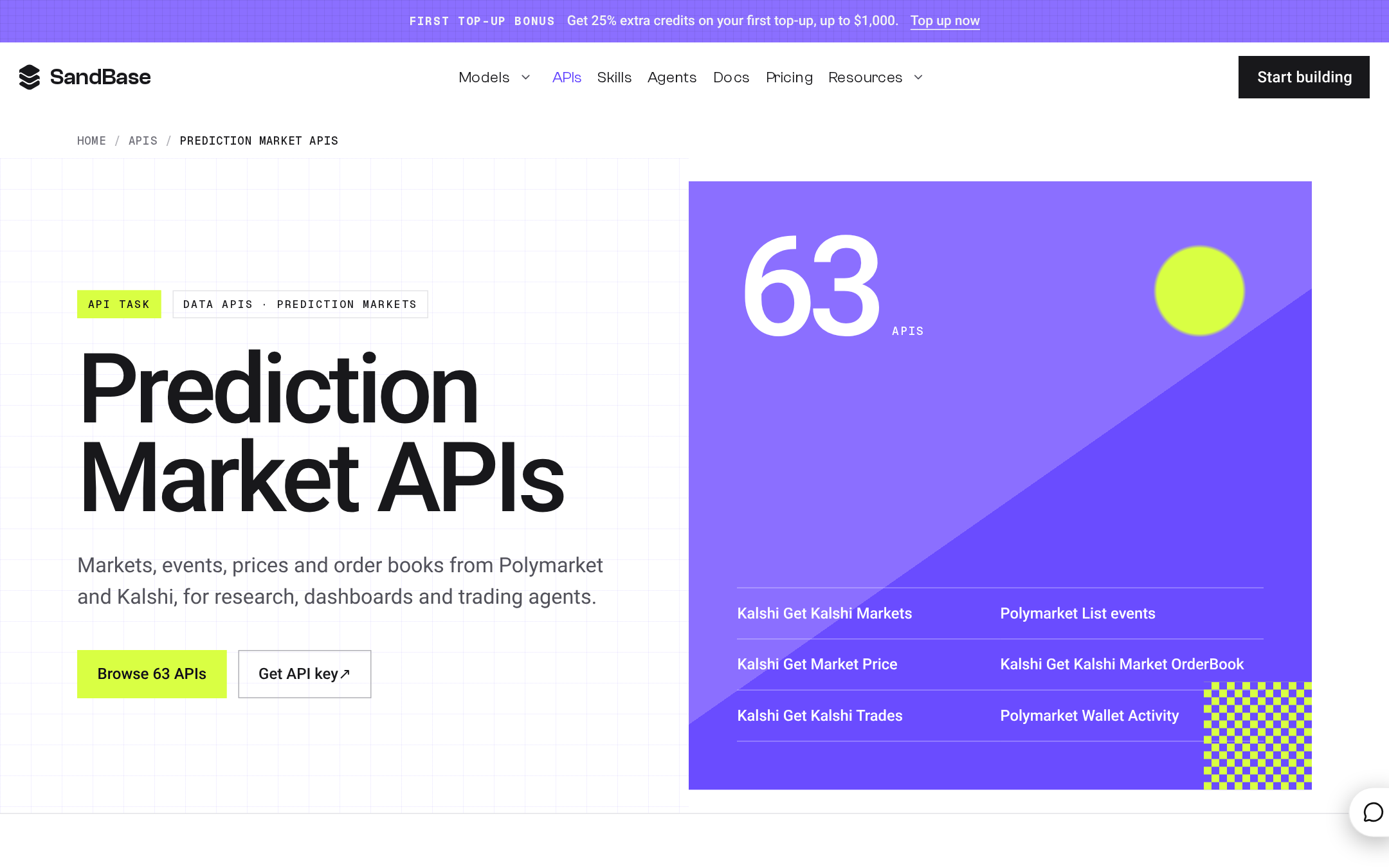
SandBase prediction-markets category, logged out, light theme, 18 Nov 2026, Asia/Shanghai. The catalog check titled it for Polymarket and Kalshi and listed 63 items. The capture shows the banner “FIRST TOP-UP BONUS Get 25% extra credits on your first top-up, up to $1,000.” Confirm current promotions on the pricing page.
Request shape for a markets card
Submit data APIs with POST /v1/api/{vendor}/{upstream_path}, Bearer auth, and a JSON object. The passthrough reference, checked 18 Nov 2026, is the contract. Omit model. The URL identifies the call. Do not send readers to a chat-completions tutorial for this.
No new paid call was run for this comparison, so business fields are not listed. An empty object is allowed when you are only inspecting the route. A useful call copies the fields from the live card. Open Markets next to the passthrough doc before you replace the payload. Read outputs[0].data and treat inner names as undocumented until your own response shows them. An asynchronous capability may be polled with GET /v1/run/{id}. That GET is not the data-API submit path.
import os
import requests

payload = {}  # replace with the fields shown on the live tool card before sending

response = requests.post(
    "https://api.sandbase.ai/v1/api/polymarket/markets",
    headers={
        "Authorization": f"Bearer {os.environ['SANDBASE_API_KEY']}",
        "Content-Type": "application/json",
    },
    json=payload,
    timeout=90,
)
response.raise_for_status()
body = response.json()
outputs = body.get("outputs") or []
if body.get("status") != "completed" or not outputs or not isinstance(outputs[0], dict):
    raise RuntimeError(f"SandBase call did not complete: {body.get('status')} {body.get('error')}")
data = outputs[0].get("data")
Allowance rules before a cheap call is treated as free
The 18 Nov 2026 billing guide and pricing page give every organization 100 free data API calls per UTC day for eligible search, social, scraping, e-commerce, and finance tools. The pool is shared across eligible data APIs and across every key in the org. It resets at 00:00 UTC. Unused calls do not carry over. Language models and media models are outside it.
Pricier or formula-priced tools are billed from the first call. Named examples include some batch endpoints, crawl endpoints, Xiaohongshu Pugongying (PGY), and the Douyin Xingtu kol-* routes. Eligibility is pricing.free_quota on the live card via sandbase_inspect. No field means always billed. The card wins over this article. Past the 100th eligible call, requests still complete and are billed. They are not rejected. A zero balance can still spend leftover allowance. The pricing page sample is incomplete. Missing from the sample does not prove a tool is ineligible, and appearing in the sample does not replace a look at the card.
Two Polymarket endpoints are in that sample. Check those cards, and check the markets card, before you count them against the 100. Plans remain pay per call with no subscription: Start ($0), Build (Metered), Scale (Custom). Catalog search and reading schema or price is $0. Failed calls are not charged. Agent sandboxes are free for now, with fair-use caps possible and pricing to be announced before any change.
A $0.00044 list price is small. It is still a billed call when the card has no free-quota field, and it still consumes the shared daily pool when the card is eligible. Do not spread one hub’s sample mention across all 59 names.
When not to switch: call Polymarket directly
Call the official APIs when your team can integrate them and does not need Polymarket data on the same key as the rest of the SandBase catalog. That is a normal outcome, not a fallback. Public docs already expose market data.
Call them when you need trading, websocket or other real-time streams, NEX, or perps. Those items show up in the official navigation. This article does not assume they exist among the 59 SandBase data cards. SandBase is not an official trading API and not an exchange-participant gateway.
Call them when you need official SLAs or exchange access this catalog does not offer. Call them when speed is the criterion. Latency and throughput were not measured. Speed is Unknown.
Use the Kalshi article when the contract is a Kalshi event contract. Use the financial-market article when the series is a quote, a filing, or a FRED series. Volume that looks cheap at $0.00044 can still be the wrong product if the field you need is a trading or real-time feature the hub never listed.
Unknowns worth leaving blank
Official market-data fees: Unknown. Official trading fees: Unknown. Whether each of the 59 cards is eligible for the daily allowance: check the card. The markets card’s list price: read the card. Response field names: not listed, because no new paid call was run. Whether NEX, perps, and real-time docs pages have SandBase twins: not established. Do not fill those blanks to make a cleaner comparison.
FAQ
Do I need SandBase to read Polymarket markets?
No. The official docs are public market-data APIs, with a wider trading and exchange navigation beside them. SandBase is a per-call catalog on one key. It is optional convenience, not a gate in front of Polymarket.
What does a SandBase Polymarket call cost?
The 18 Nov 2026 Markdown showed $0.00044 per call on examples such as list events, comments, and get event by id, and $0.012 per call on examples such as wallet activity, order-book summary, builders volume, closed positions, and CLOB parameters. Other cards can differ. The markets card’s price was not in those examples.
Does the prediction-markets hub include Kalshi?
Yes. The category check listed 63 items and the title names Polymarket and Kalshi. Four of those items are the Kalshi cards. The other post in this cluster covers that four-endpoint surface. Official Kalshi trading is outside both SandBase hubs.
Related reading
Best Kalshi API Alternatives in 2027 is the event-contract companion. Best Financial Market Data API Alternatives in 2027 is quotes, filings, and FRED, not prediction markets. Best Data API Providers in 2027 is the unranked map.
Open the Polymarket hub, then the markets card beside the passthrough reference. If Kalshi belongs in the same job, use the prediction-markets category. Check pricing before a loop. Signup currently redirects to sign-in.
Found this useful? Share it