Best Kalshi API Alternatives in 2027
Best Kalshi API alternatives in 2027: official docs cover event-contract trading, REST, WebSocket, FIX, and perps, while SandBase lists four market-data cards at $0.02.
Yes and no bids for one Kalshi ticker, plus recent trades, are four reads. Placing an order, opening a websocket, speaking FIX, or trading perps is the exchange API. On 18 Nov 2026 Kalshi’s docs described that exchange API for real-time market data and trade execution: event-contract markets and perpetual futures, over REST, WebSocket, and FIX. The SandBase hub that day listed four market-data endpoints at $0.02 per call. Use the four when one key beside Polymarket is enough. Use the docs for trading, streaming, FIX, or perps. Official fees are Unknown. The marketing site was not usable in this check.
Key takeaway
- Official docs describe event-contract markets over REST, WebSocket, and FIX, plus perps on the same three transports, and they bind API use to the Developer Agreement.
- SandBase listed exactly four Kalshi cards, each at $0.02 per call: markets, price by ticker, order book, and trades.
- Those cards are market data. They are not a trading API, a WebSocket, a FIX session, or a perps product.
- The prediction-markets category includes these four cards beside a much larger Polymarket set. The Polymarket post is a different keyword.
- Official Kalshi fees are Unknown. Speed is Unknown. The marketing site was not usable in this check.
What the docs site describes
The docs root redirects to a welcome page titled “Introduction - API Documentation.” The copy says the documentation covers the Kalshi Exchange API for real-time market data and trade execution, and that using the API binds the reader to the Developer Agreement. Predictions APIs are defined there as event-contract markets, offered over REST, WebSocket, and FIX. Perps APIs are defined as perpetual futures on margin, also over REST, WebSocket, and FIX. The navigation also includes Quick Start, API Keys, a Demo Environment, an MCP connector, and Rate Limits described as “Token budgets, tiers, and bursting.” A docs index was available. Specific tier numbers and any official per-call fee were not extracted. Official fees stay Unknown.
The marketing site was not usable in this check, so it is not a source here and it is not screenshotted. The welcome page below is the official page this article relies on.
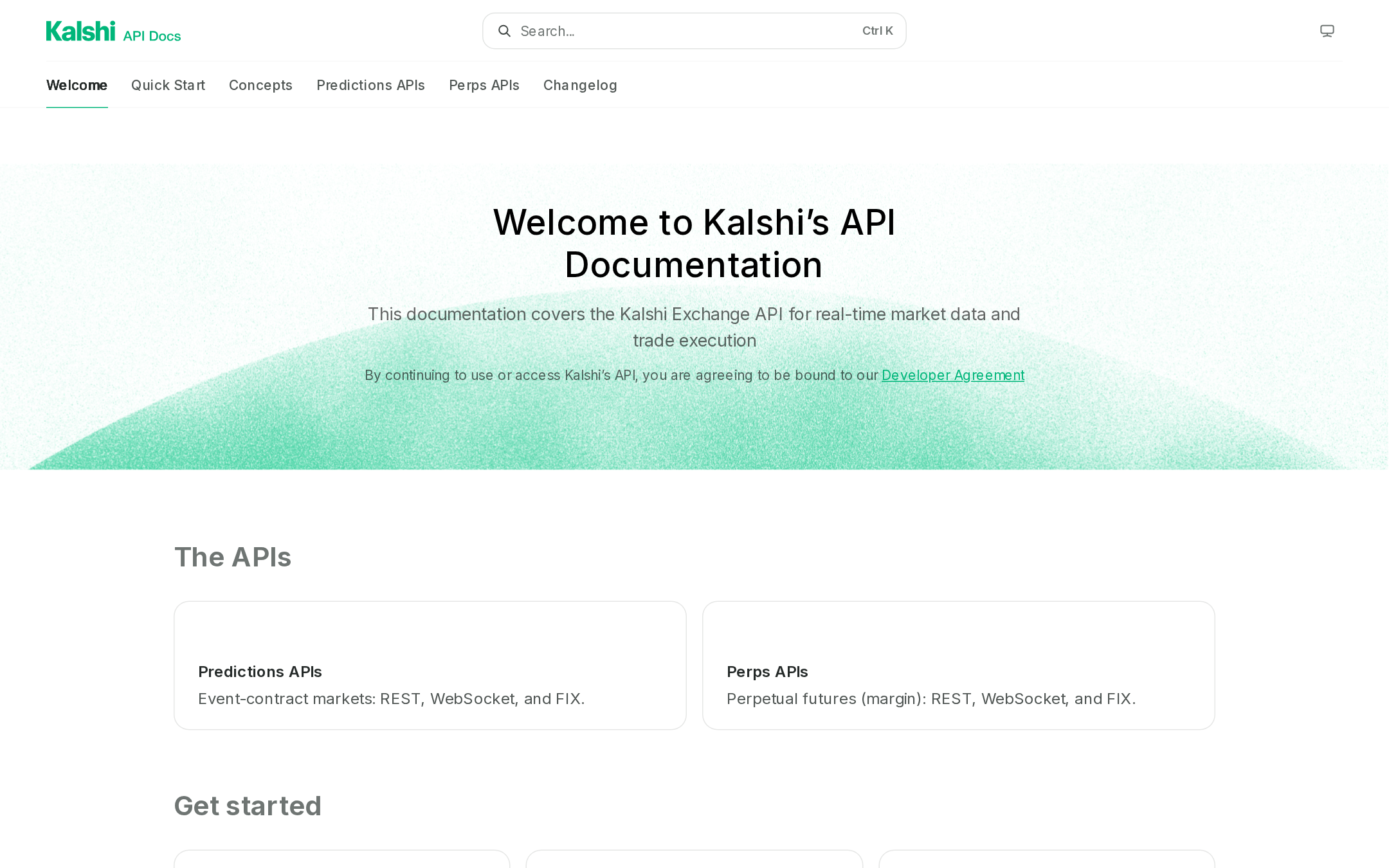
Official Kalshi API documentation welcome page, captured 18 Nov 2026, Asia/Shanghai, from the docs site. It introduces the exchange API for real-time market data and trade execution. Official per-call fees were not extracted from this check.
Four endpoints, one list price
The SandBase hub was titled “Kalshi APIs: Prediction Markets, Order Books and Trades” and listed four endpoints. Each one carried a SandBase list price of $0.02 per call on the 18 Nov 2026 catalog check. The prediction-markets Markdown described these cards as returning “the official Kalshi API response unchanged.” That is catalog wording for the response shape they claim to pass through. It does not add trading, WebSocket, FIX, or perps to the hub.
| Card | Page title on that check | List price |
|---|---|---|
| Markets | Kalshi Markets API: List Prediction Markets and Prices | $0.02 per call |
| Price by ticker | Kalshi Market API: Price and Status by Ticker | $0.02 per call |
| Order book | Kalshi Order Book API: Yes and No Bids by Ticker | $0.02 per call |
| Trades | Kalshi Trades API: Recent Executions Across Markets | $0.02 per call |
Start at the Kalshi hub and confirm these four names still cover the read you want. The same day’s data APIs catalog reported 2,247 endpoints from 182 providers, with no date stamp, so counts can change. Do not mix that figure with llms.txt’s combined “2,777 models and APIs.” The providers page is a curated short list, not the census.
Fifty billed markets calls at $0.02 are $1.00. A loop that lists markets, then fetches an order book and a trade page for 20 tickers, is 1 + 40 = 41 calls, or $0.82 at the list price, if none of them is covered by remaining free allowance. That sketch is arithmetic on the list price. It is not a measured bill, and it says nothing about official Kalshi fees, which are Unknown. It also assumes you only needed those reads. An order submission is a different product, and it is not on this hub.
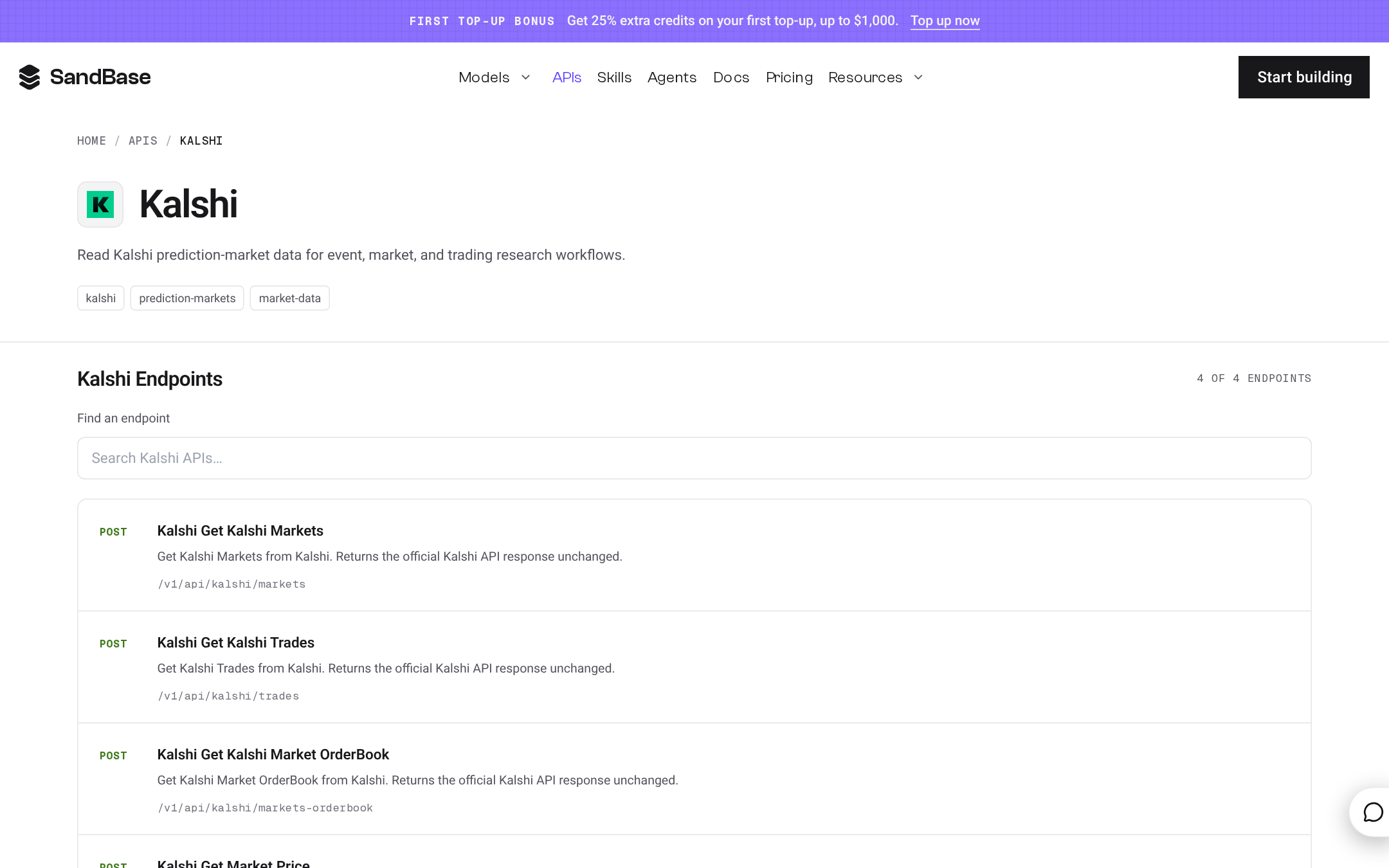
SandBase Kalshi hub, logged out, light theme, 18 Nov 2026, Asia/Shanghai. The catalog check of this URL listed four market-data endpoints. The capture shows the banner “FIRST TOP-UP BONUS Get 25% extra credits on your first top-up, up to $1,000.” Confirm current promotions on the pricing page.
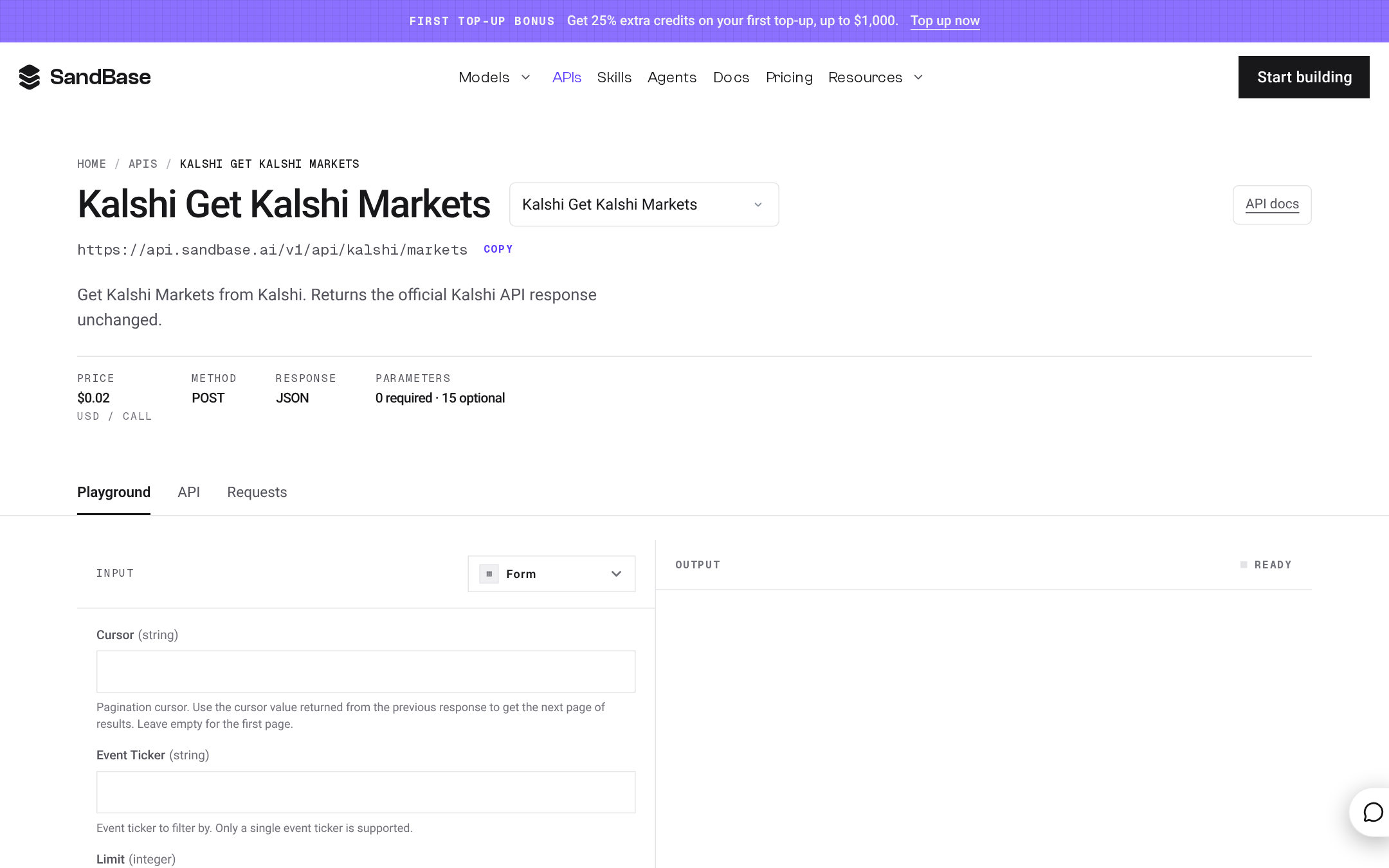
SandBase Kalshi markets card, logged out, light theme, 18 Nov 2026, Asia/Shanghai. The check titled it “Kalshi Markets API: List Prediction Markets and Prices” at $0.02 per call. The capture shows the banner “FIRST TOP-UP BONUS Get 25% extra credits on your first top-up, up to $1,000.” Confirm current promotions on the pricing page.
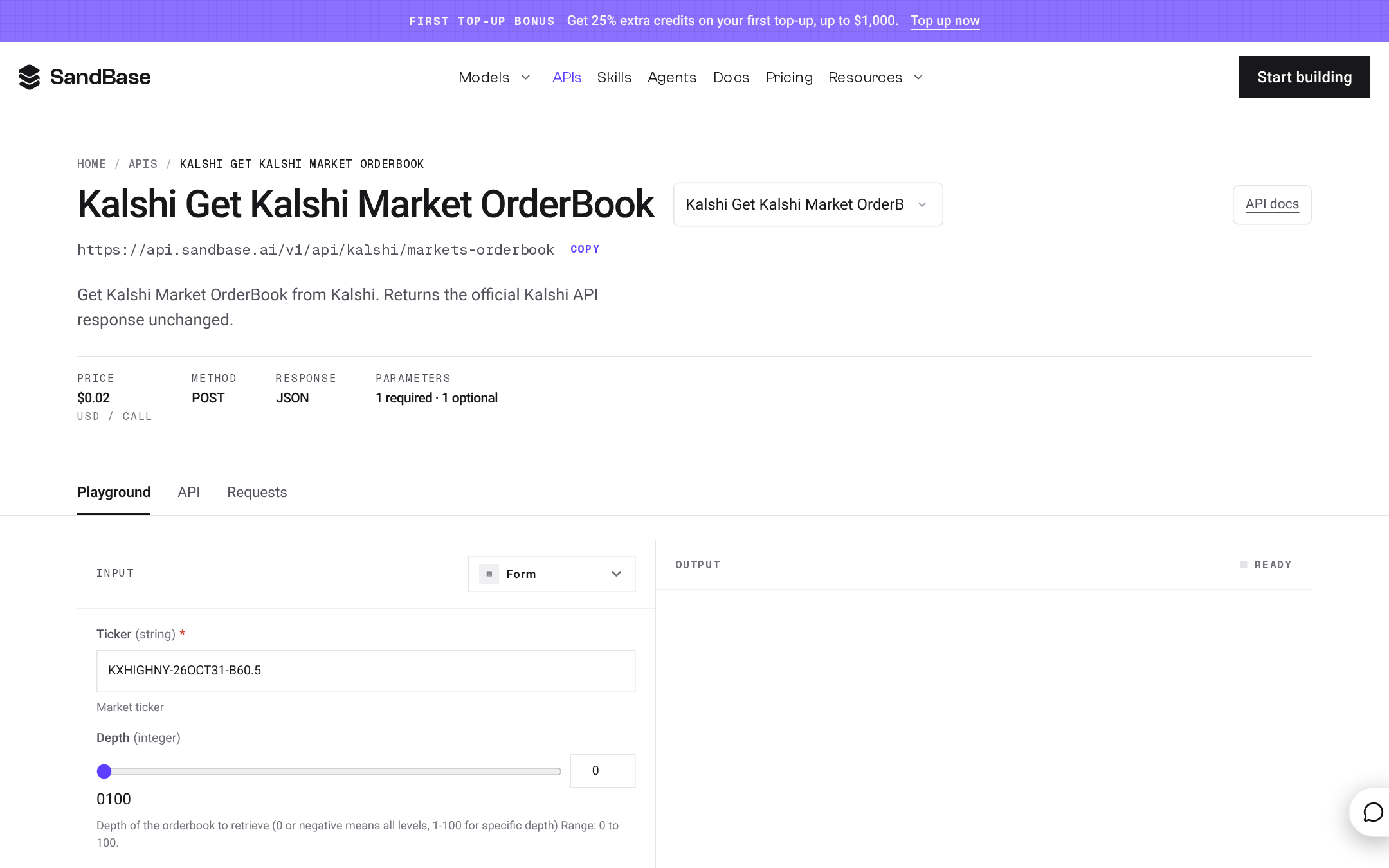
SandBase Kalshi order book card, logged out, light theme, 18 Nov 2026, Asia/Shanghai. The check titled it for yes and no bids by ticker at $0.02 per call. It is a data card, not an order-entry session. The capture shows the banner “FIRST TOP-UP BONUS Get 25% extra credits on your first top-up, up to $1,000.” Confirm current promotions on the pricing page.
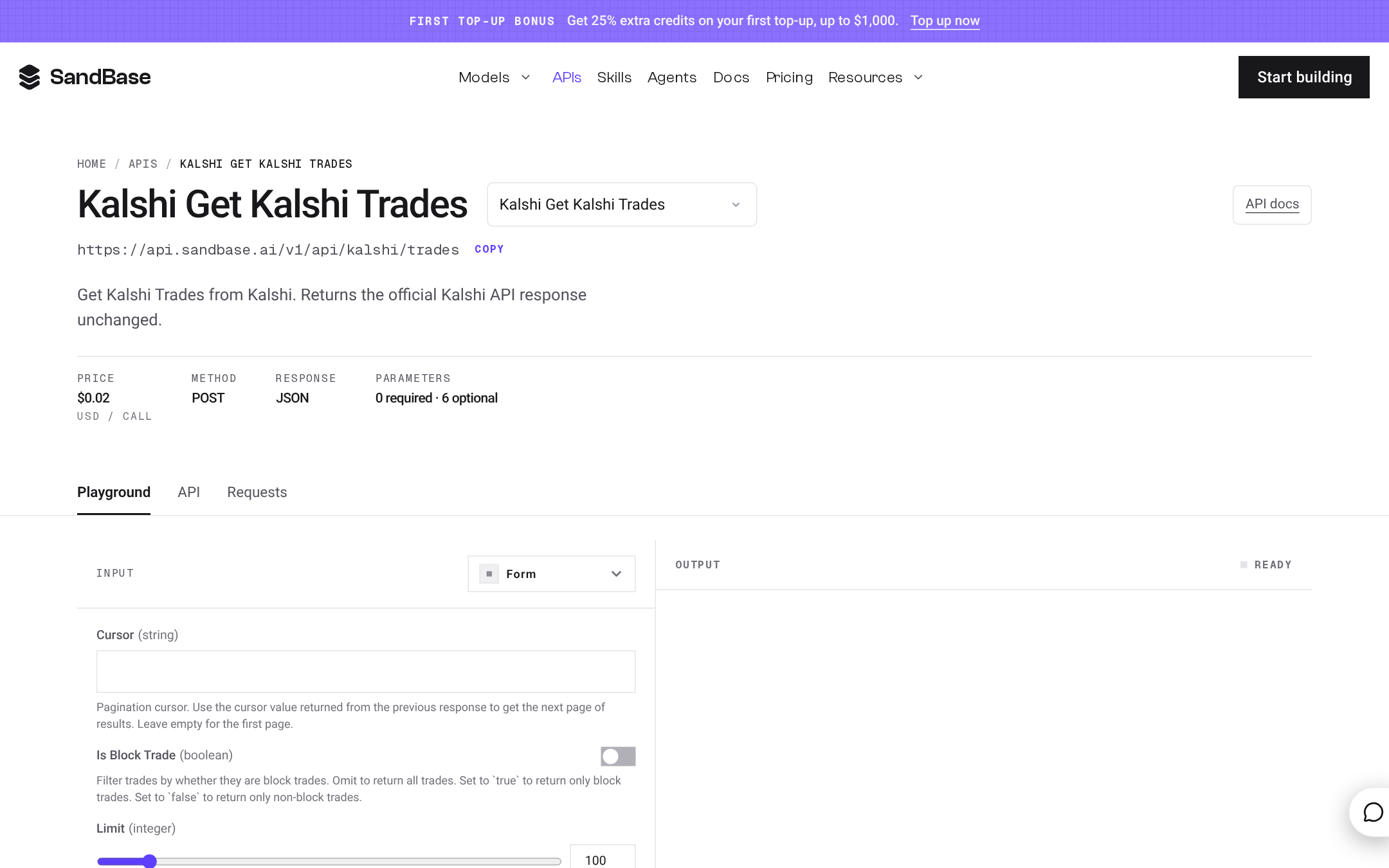
SandBase Kalshi trades card, logged out, light theme, 18 Nov 2026, Asia/Shanghai. The check titled it “Kalshi Trades API: Recent Executions Across Markets” at $0.02 per call. Reading recent executions is not the same as submitting a trade. The capture shows the banner “FIRST TOP-UP BONUS Get 25% extra credits on your first top-up, up to $1,000.” Confirm current promotions on the pricing page.
Where these four sit next to Polymarket
The prediction-markets category is titled for Polymarket and Kalshi together. On this check it listed 63 items: the Polymarket hub’s 59 endpoints plus these four Kalshi cards, the Kalshi ones at $0.02 and described with the “official response unchanged” line. Polymarket’s SandBase prices are a different band, discussed in Best Polymarket Data API Alternatives in 2027. Use that post for Polymarket’s public market-data docs versus a 59-card meter. Use this post when the question is Kalshi event-contract market data and whether four cards are enough.
A reader who wants both venues on one key can stay inside the category page and still keep the jobs apart: Polymarket cards for Polymarket markets, Kalshi cards for Kalshi markets, books, and trades. Neither hub is the official trading surface of its venue. Best Data API Providers in 2027 places this category in the wider catalog and does not rank it. Quotes, earnings, and filings live in Best Financial Market Data API Alternatives in 2027, which is a different dataset.
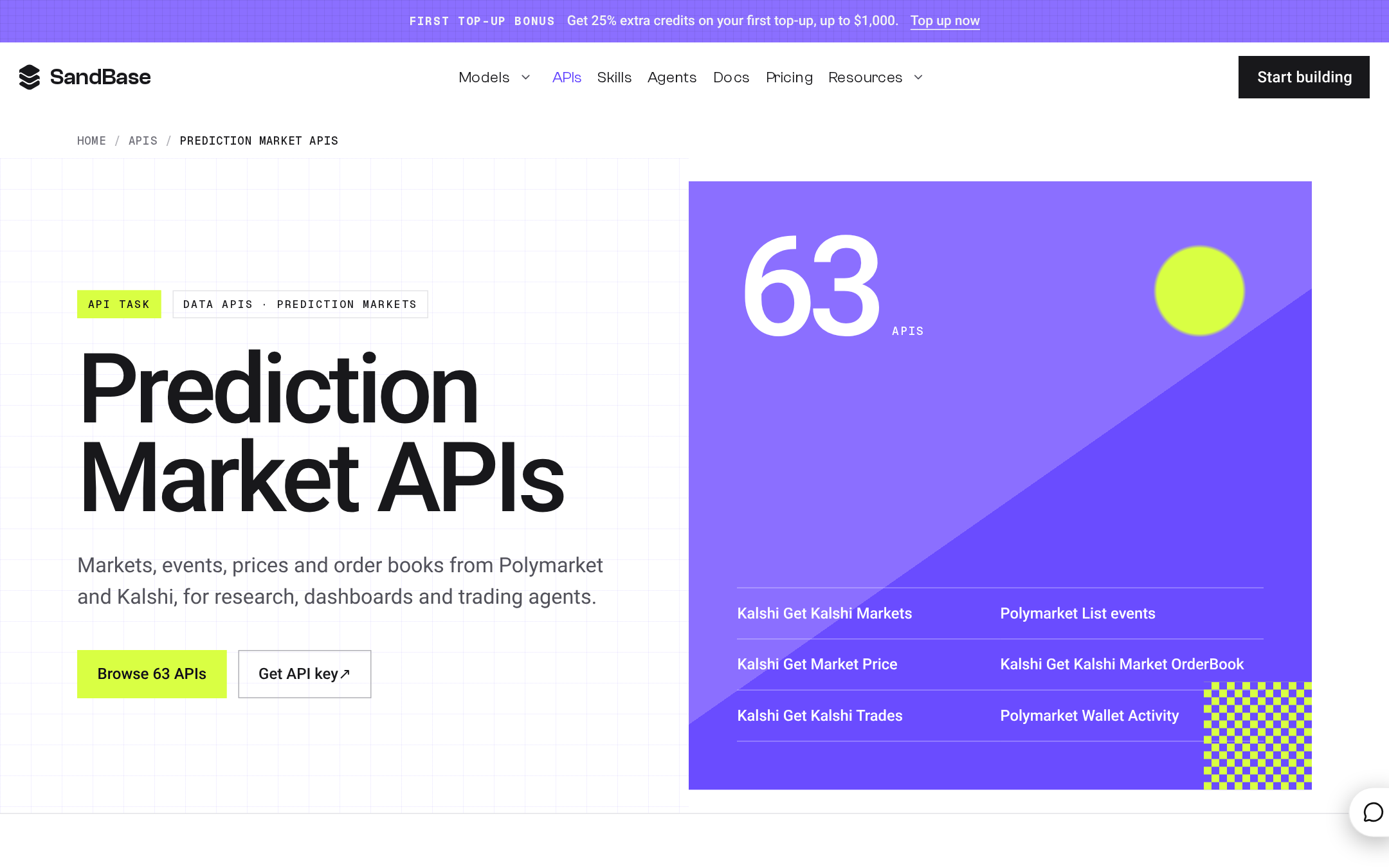
SandBase prediction-markets category, logged out, light theme, 18 Nov 2026, Asia/Shanghai. The check listed 63 items and includes the four Kalshi cards beside Polymarket. The capture shows the banner “FIRST TOP-UP BONUS Get 25% extra credits on your first top-up, up to $1,000.” Confirm current promotions on the pricing page.
| Need | Where it lived on 18 Nov 2026 |
|---|---|
| List Kalshi markets and prices | SandBase markets card, $0.02, or official REST as documented |
| Yes and no bids for a ticker | SandBase order book card, $0.02 |
| Recent executions | SandBase trades card, $0.02 |
| Submit an order, stream a book, use FIX, or trade perps | Official predictions or perps APIs. Not these four cards |
| Polymarket event prices on the same key | Polymarket hub, covered in the other cluster post |
| Official rate-limit tiers or the demo environment | Docs navigation. Tier numbers were not extracted |
Posting to the markets card
The data-API submit path is POST /v1/api/{vendor}/{upstream_path} with Bearer auth and a JSON object. Checked on 18 Nov 2026, the passthrough reference documents that, plus an optional model field you should omit because the URL is the identity. The Firecrawl body on that page is not a Kalshi body.
This comparison did not run a new paid call, so the business fields are not listed. An empty object is what the passthrough page allows for an inspection of the route. Put the live card’s fields in before a real call. Open Markets beside the doc. Read outputs[0].data, and treat names inside it as undocumented until a response you ran shows them. If the capability is asynchronous, GET /v1/run/{id} can poll. That poll is not how a data API is submitted.
import os
import requests

payload = {}  # replace with the fields shown on the live tool card before sending

response = requests.post(
    "https://api.sandbase.ai/v1/api/kalshi/markets",
    headers={
        "Authorization": f"Bearer {os.environ['SANDBASE_API_KEY']}",
        "Content-Type": "application/json",
    },
    json=payload,
    timeout=90,
)
response.raise_for_status()
body = response.json()
outputs = body.get("outputs") or []
if body.get("status") != "completed" or not outputs or not isinstance(outputs[0], dict):
    raise RuntimeError(f"SandBase call did not complete: {body.get('status')} {body.get('error')}")
data = outputs[0].get("data")
Price by ticker, the order book, and trades swap only the path, after you read each card. There is no fifth Kalshi path to invent.
The daily allowance, applied to a $0.02 card
As of the 18 Nov 2026 billing page and pricing page, every organization receives 100 free data API calls per UTC day for eligible search, social, scraping, e-commerce, and finance tools. Eligible tools share one pool, and every key in the organization draws from it. Reset is 00:00 UTC. Leftover calls expire. Language models and media models are not in the pool.
Some data APIs bill from the first call. The guide points at pricier or formula-priced examples: some batch endpoints, crawl endpoints, Xiaohongshu Pugongying (PGY), and Douyin Xingtu kol-* routes. The test is pricing.free_quota on the live card (sandbase_inspect). Absent that field, the tool is always billed. After the 100th eligible call, the call still runs and the price on the card applies. Nothing in the guide says the call is rejected for using up the allowance. A zero balance can still use allowance that remains. The pricing page’s sample list is a sample. Absence is not proof of ineligibility.
Whether these four $0.02 cards carry pricing.free_quota was not established by a line on the captures used here. Check each card. Plans are pay per call and have no subscription: Start ($0), Build (Metered), Scale (Custom). Looking up a tool and reading its schema and price is $0. Failed calls are not charged. Agent sandboxes are free for now. Fair-use caps may apply, and pricing will be announced before that changes. A $0.02 list price does not, by itself, answer the eligibility question.
When not to switch: the official Kalshi API
Choose the docs when you must submit orders, stream a book, maintain a FIX session, or use the perps APIs. The SandBase hub stops at markets, a ticker price, an order book snapshot, and recent trades.
Choose the docs when four endpoints are too small. The official surface includes REST, WebSocket, and FIX for event contracts, the same three for perps, a demo environment, an MCP connector, API keys, and a rate-limit section about token budgets, tiers, and bursting. This article did not extract the tier numbers. It also did not find those extra surfaces as SandBase routes, and it will not invent them.
Choose the docs when you need those official rate-limit tiers or a direct developer relationship with Kalshi. The docs say using the Kalshi API binds you to the Developer Agreement. A SandBase card does not replace reading that agreement if your workflow depends on official access.
Choose the docs when you can call them directly and do not need Kalshi reads on the same key as Polymarket or the wider catalog. Choose them when latency is the reason you are comparing vendors. Speed is Unknown.
Gaps that should stay empty
Only four SandBase endpoints, against official REST, WebSocket, FIX, and perps. Official fees Unknown. Marketing-site claims Unknown, because that site was not usable in this check. Free-quota eligibility of the four cards Unknown until the live card shows the field. Response field names Unknown until you call. No additional Kalshi routes are implied by the hub title “order books and trades.” Those words match the four cards, not a trading session.
FAQ
Can I place a Kalshi trade through this SandBase hub?
The hub is four market-data endpoints: list markets, price and status by ticker, yes and no bids, and recent executions. Order entry, WebSocket streaming, FIX, and perps are on the official docs. They are not a fifth card.
What does SandBase charge for those four?
Each listed $0.02 per call on the 18 Nov 2026 check. Fifty billed calls are $1.00 at that list price. Whether any of the four is inside the daily free allowance depends on pricing.free_quota on the live card. This article did not see that line recorded for these cards.
What is the official Kalshi API fee?
Unknown. The welcome page describes the exchange API, the Developer Agreement, predictions and perps transports, and a rate-limit section. It did not yield a public per-call dollar fee for this article. The marketing site was not usable in this check, so it contributes no price either.
Related reading
Best Polymarket Data API Alternatives in 2027 is the other prediction-market keyword: public Polymarket docs versus 59 per-call cards. Best Data API Providers in 2027 is the catalog map. Best Financial Market Data API Alternatives in 2027 is equities, filings, and FRED, not event contracts.
Open the Kalshi hub and confirm the four cards. Call Markets using the passthrough reference. For both venues, the prediction-markets category is the combined shelf. Review pricing, then sign up, which currently redirects to sign-in.
Found this useful? Share it