Ouroboros: A Self-Developing Coding Agent
Ouroboros can modify its own harness through reviewed Git commits. We examine its memory, evolution loop, benchmark claims, and safety boundaries.
Ouroboros: A Self-Developing Coding Agent
Most “self-improving agents” save a memory note or rewrite a prompt. Ouroboros lets an agent propose changes to the harness that will run its future tasks: application code, tools, prompts, context assembly, dependencies, and parts of its own operating model. Accepted changes become Git commits and later runs execute the modified system.
That is a much stronger claim than reflection. It also creates a harder engineering question: after 30 self-directed changes, what exactly guarantees that the reviewer, sandbox, identity, and rollback path still mean what they meant at the beginning?
TL;DR
- Ouroboros is an MIT-licensed, local-first agent runtime for desktop and headless use.
- It supports recursive and experience-driven changes to its own harness, with reviewed commits as the persistence mechanism.
- Identity and memory survive restarts, while Git provides an inspectable implementation history.
- The paper reports leading Terminal-Bench 2.1, OSWorld-Verified, and CL-Bench results, but those are author-reported results from frozen snapshots, not proof that every live evolution improves the agent.
- Self-modification is only defensible when protected surfaces, independent review, bounded budgets, restart tests, and rollback remain outside the component being changed.
What evolves, and what does not
The official repository describes an editable surface wider than ordinary coding agents. Ouroboros can change code, architecture, prompts, tools, and dependencies. Reflection can update how it represents its identity and accumulated experience.
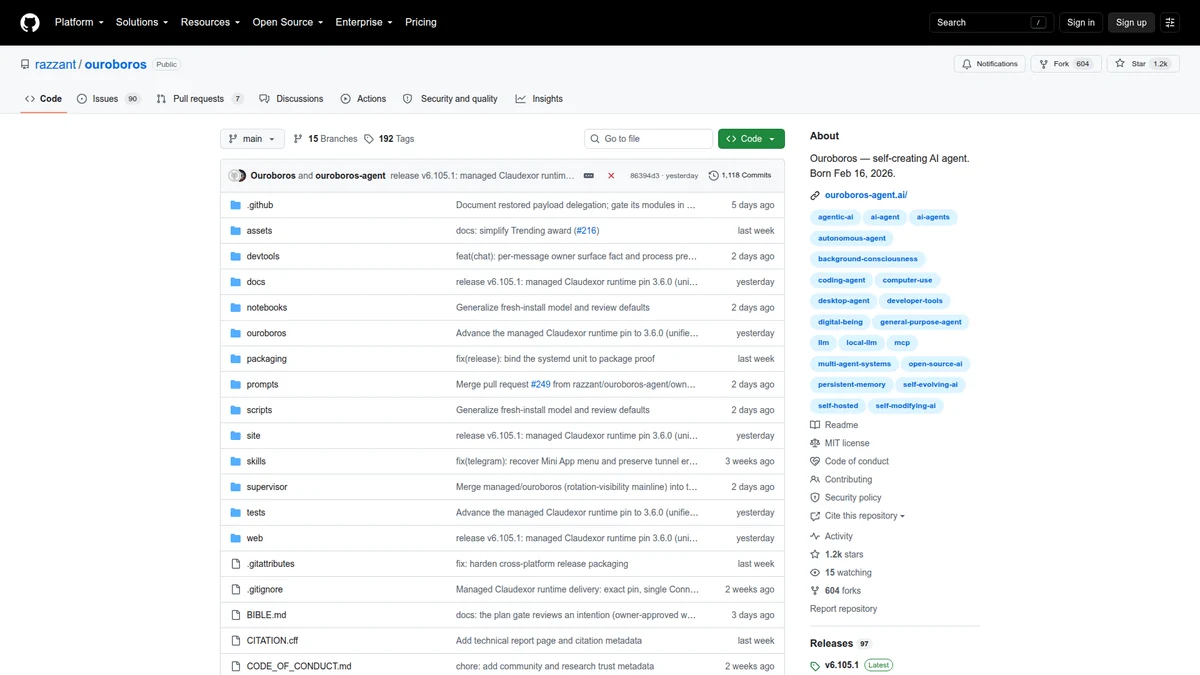 The project positions self-modification, durable memory, and reviewed evolution as one runtime rather than separate demos. Source: Ouroboros on GitHub.
It also defines protected surfaces. BIBLE.md acts as the constitutional source of truth, while architecture and development documents specify the current operational boundaries. The README says implementation changes remain traceable through Git, with explicit protected paths and restart checks.
This distinction matters. A system that can rewrite every rule, including the rule requiring review, has no durable governance. “Self-developing” needs a non-self-editable root of authority, even if the project describes that root in philosophical language.
Two evolution loops
The August 2026 Ouroboros paper describes two paths for core evolution.
Recursive free evolution
Improvement itself is the task. The agent identifies a structural change, implements it, gathers review evidence, and may schedule the next cycle. This is the visually dramatic mode, but it is also the easiest one to optimize toward internal preferences rather than user outcomes.
Experience-driven evolution
Normal work exposes repeated friction: a brittle tool, wasteful context construction, a recurring crash, or review that keeps rejecting the same pattern. Those observations enter an improvement backlog and can later become scoped changes.
The second mode is more convincing for production. It starts from observed failure rather than an abstract instruction to become better. A useful improvement record should contain the triggering tasks, failed invariant, proposed mechanism, evaluation, and rollback condition.
task evidence
  -> improvement backlog
  -> scoped change proposal
  -> isolated implementation
  -> independent review
  -> tests + restart check
  -> reviewed Git commit
  -> later runtime
The Git commit is not just storage. It is the handoff between “agent evaluating a candidate” and “system that future agents inherit.”
Identity is a data-model problem
Ouroboros uses “continuous being” language, but the implementation question is more concrete. The runtime stores its self-modifying repository, state and budget data, memory, chat history, events, uploads, and version history under a persistent local data layout.
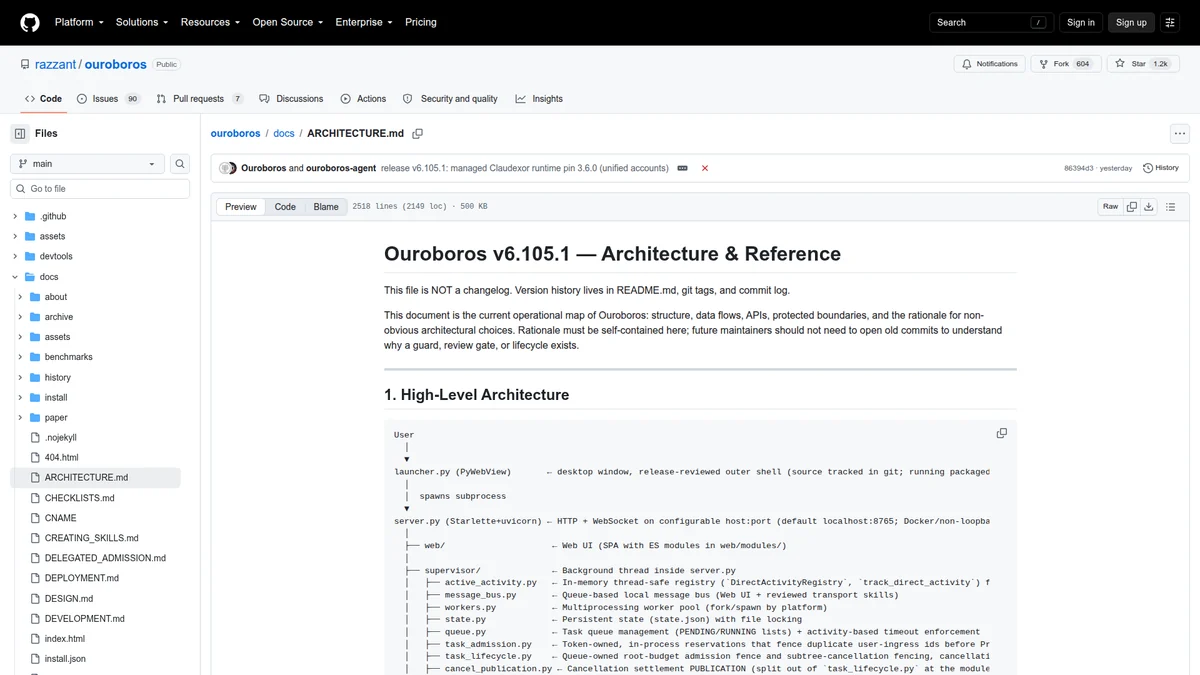 Continuity is implemented through durable files and version history. The metaphysics are optional; the data lifecycle is not.
| Continuity layer | What must persist | Main failure mode |
|---|---|---|
| Identity | Stable principles and self-description | Silent personality drift |
| Memory | Provenance, scope, confidence, expiry | Old inference becomes “fact” |
| Implementation | Reviewed Git history | Unreviewed code becomes runtime |
| Tasks | Inputs, actions, outputs, status | Ghost or duplicated work after restart |
| Budget | Spend and remaining limits | Restart resets the meter |
The hardest part is memory provenance. A reflection is not the same as an externally verified fact. If both become plain text in one knowledge file, repeated self-reference can turn speculation into identity. Candidate identity changes should require stronger review than an ordinary working-memory update.
The benchmark claims need careful reading
The paper reports 86.74% on Terminal-Bench 2.1 with Opus 5, 90.69% on OSWorld-Verified, and normalized reward 0.2301 on a five-rollout CL-Bench campaign. The authors describe these as the strongest results reported on those evaluations.
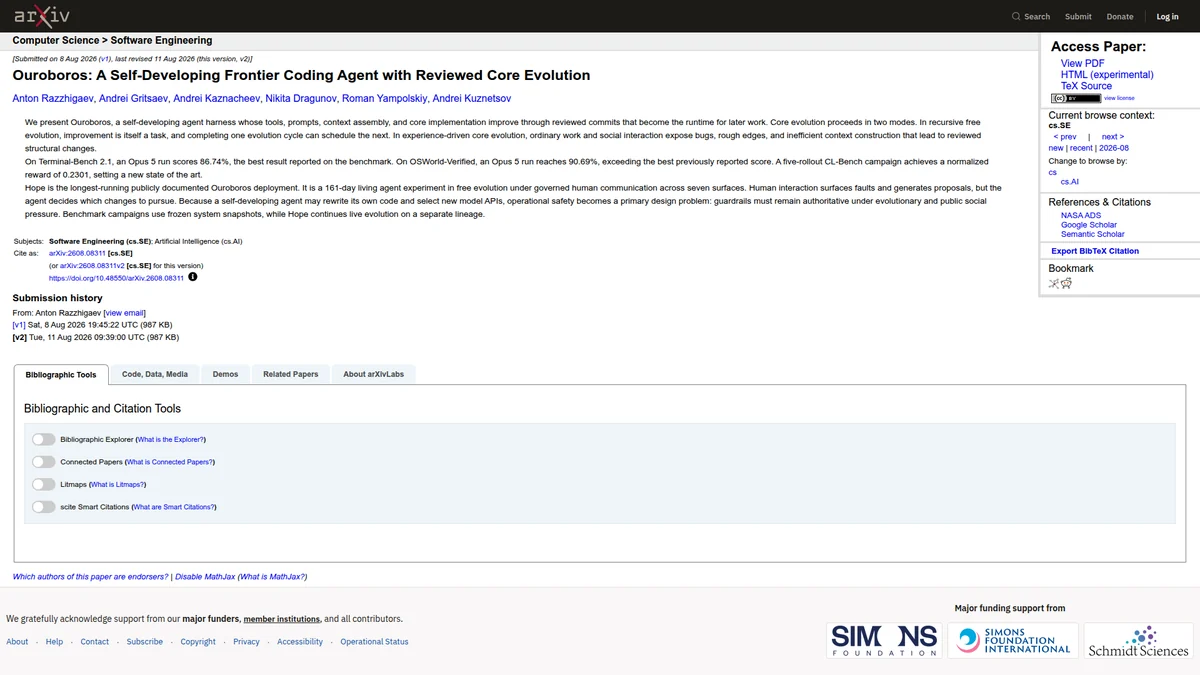 The paper evaluates frozen snapshots while the long-running Hope deployment evolves on a separate lineage. Source: arXiv:2608.08311.
Those numbers are worth investigating, not repeating without qualifiers.
- They are reported by the project authors in a new preprint.
- A strong base model contributes substantially to the result.
- Benchmark campaigns use frozen snapshots; the live agent does not change itself mid-evaluation.
- A high final score does not isolate how much gain came from self-evolution versus harness design, model choice, or evaluation configuration.
- “Best reported” is not equivalent to an independently reproduced leaderboard result.
The frozen-snapshot rule is correct. Allowing a system to alter its evaluator-facing code during a benchmark would make comparison nearly meaningless. But it also means the benchmark measures a product of prior evolution, not the safety or monotonic quality of the evolution process itself.
The missing chart I would most like to see plots every accepted core change against a fixed regression suite, task quality, cost, and rollback rate. One impressive endpoint cannot tell us whether the path contained ten regressions that human reviewers repaired.
Self-review is not independent review
Ouroboros can use multiple model roles for planning, code, lightweight safety checks, and deep review. Diversity helps, but three calls to the same model family do not create true independence. Shared blind spots remain shared.
| Review layer | Catches | Cannot guarantee |
|---|---|---|
| Author-agent critique | Obvious implementation errors | Independence from its own plan |
| Separate model review | Different reasoning path | Different training blind spots |
| Deterministic tests | Known invariants and regressions | Unknown unsafe behavior |
| Human approval | Scope and organizational judgment | Exhaustive technical correctness |
| Runtime policy | Forbidden actions at execution | That allowed actions are wise |
For core evolution, require at least one reviewer that cannot be edited by the candidate patch. Run tests from a clean external harness. Sign the approval record and candidate commit. After restart, verify the running revision and protected-file hashes before accepting work.
A safe evolution transaction
Treat each self-change as a database migration, not a chat response.
- Snapshot: record repository revision, memory manifest, runtime configuration, and budget.
- Scope: list editable paths and invariants that must survive.
- Fork: implement in a disposable workspace without production credentials.
- Evaluate: run targeted tests plus a stable regression suite.
- Review: gather model and human evidence from outside the candidate runtime.
- Commit: sign the exact tree that passed review.
- Restart: boot the candidate with restricted credentials and verify health.
- Promote: make it current only after the restart check.
- Observe: retain the previous revision and automatically roll back on defined signals.
The promotion step is where many agent systems cut corners. Passing tests in a development process does not prove the packaged runtime boots, reads old memory correctly, or respects the same protected paths.
SandBase-style disposable environments are a good fit for the fork and evaluation stages. Keep the promotion credential outside the sandbox, so generated code cannot approve itself.
Where Ouroboros is genuinely interesting
The project combines several ideas that are often presented separately: durable identity, task persistence, multi-agent work, background reflection, self-modification, Git history, and a protected constitution. That integrated system is more useful to study than another loop that edits its prompt until a benchmark passes.
It is still an experiment, not evidence that autonomous evolution is generally safe or reliably cumulative. The project README makes strong first-person and “living agent” claims that are part product philosophy and part system design. Engineers should inspect BIBLE.md, docs/ARCHITECTURE.md, protected-path enforcement, and release history before granting it access to valuable repositories.
For related production patterns, see self-correcting agents with reflection and our comparison of agent memory architectures.
Verdict
Ouroboros is interesting because its self-improvement claim reaches the runtime and leaves a reviewable Git trail. Its most important contribution may not be a benchmark score. It is the insistence that self-change needs a transaction: proposal, evidence, protected surfaces, review, commit, restart, and rollback.
I would run it in an isolated research workspace with synthetic secrets and replaceable repositories. I would not give a self-modifying agent broad production credentials until an external controller can prove which revision is running, which invariants survived, and how to revert it without asking the agent for help.
FAQ
Is Ouroboros open source?
Yes. The official repository publishes the project under the MIT License.
Does Ouroboros retrain its model weights?
Not in the core evolution described here. It modifies the harness, code, prompts, tools, context, memory, and model selection around external or local models.
Can Ouroboros run fully locally?
The runtime and state are local, and local GGUF inference is supported. Capability depends on the selected local model; remote providers are optional.
Are the benchmark results independently verified?
The cited results are author-reported in a recent arXiv preprint. Treat independent reproduction as pending unless a benchmark authority publishes it separately.
What is the biggest safety risk?
The central risk is governance erosion: a self-change weakens review, protected paths, monitoring, or rollback and then becomes the runtime used to judge later changes.