MiniMax M3.1 Flash vs DeepSeek V4.1 Flash: Price, Tests, Fit
MiniMax M3.1 Flash vs DeepSeek V4.1 Flash: list prices, peak-hour billing, vendor benchmarks, open weights, and 36 live API calls on code, tools and extraction.
Both models cost $0.15 per million input tokens and $0.60 per million output. For DeepSeek V4.1 Flash, that is only true outside peak hours. During two weekday windows the price doubles. That one footnote decides more MiniMax M3.1 Flash vs DeepSeek V4.1 Flash comparisons than any benchmark row.
This comparison is for developers choosing a cheap default model for coding agents, tool-calling workflows or document extraction. It uses each vendor’s documentation as checked on October 21, 2026, MiniMax’s own benchmark table, and 36 calls we ran through SandBase on the same day. The short version: M3.1 Flash is the steadier price and the stronger business-workflow agent on paper. DeepSeek V4.1 Flash 1017 leads on coding benchmarks, lets you switch thinking off, and has open weights you can download today.
MiniMax M3.1 Flash vs DeepSeek V4.1 Flash: Key takeaway
- Price: M3.1 Flash is a flat $0.15 / $0.60. DeepSeek is $0.15 / $0.60 off-peak and $0.30 / $1.20 during peak hours (01:00–04:00 and 06:00–10:00 UTC, weekdays).
- Coding: in MiniMax’s own table, DeepSeek V4.1 Flash 1017 beats M3.1 Flash on DeepSWE (77.0 vs 73.7), Terminal Bench 4.0 (42.3 vs 38.1) and NL2Repo (68.2 vs 61.2).
- Agents: M3.1 Flash leads Automation-Bench v1.0.6 (62.2 vs 60.5); DeepSeek reports 35.4 on Agents’ Last Exam against MiniMax’s 29.6. The two vendors pick different headline benchmarks.
- Control: DeepSeek supports a non-thinking mode. M3.1 Flash rejects any attempt to disable thinking.
- Our run: both models passed all 9 checks on our three small tasks. M3.1 Flash had the lower median latency (3.3 s vs 4.3 s).
Side-by-side specs
| MiniMax M3.1 Flash | DeepSeek V4.1 Flash (1017) | |
|---|---|---|
| Released | Oct 19, 2026 | Sep 10, 2026; 1017 checkpoint Oct 17 |
| Official API model name | MiniMax-M3.1-Flash | deepseek-flash |
| Context window | 1,000,000 tokens | 1M tokens |
| Max output | 512K (SandBase listing) | 384K |
| Thinking | Always on; 5 effort levels | Thinking (default) or non-thinking |
| Image input | Yes | Yes |
| List price, input / output per 1M | $0.15 / $0.60 flat | $0.15 / $0.60 off-peak; $0.30 / $1.20 peak |
| Cache read per 1M | $0.015 | $0.003 off-peak; $0.006 peak |
| Parameters | 428B / ~23B active (reported) | 552B; 8B active for input, 16B for output (per SandBase listing) |
| Open weights | ”Later”; no license yet | On Hugging Face, MIT |
| SandBase model ID | minimax/minimax-m3.1-flash | deepseek/deepseek-v4.1-flash |
Sources: MiniMax’s invocation guide, launch post and pricing page; DeepSeek’s Models & Pricing and change log; the DeepSeek-V4.1-Flash model card on Hugging Face. MiniMax’s parameter count comes from press reports (SiliconANGLE for 428B, MarkTechPost for ~23B active). We could not find it on a current MiniMax page.
Pricing: same sticker, different clock
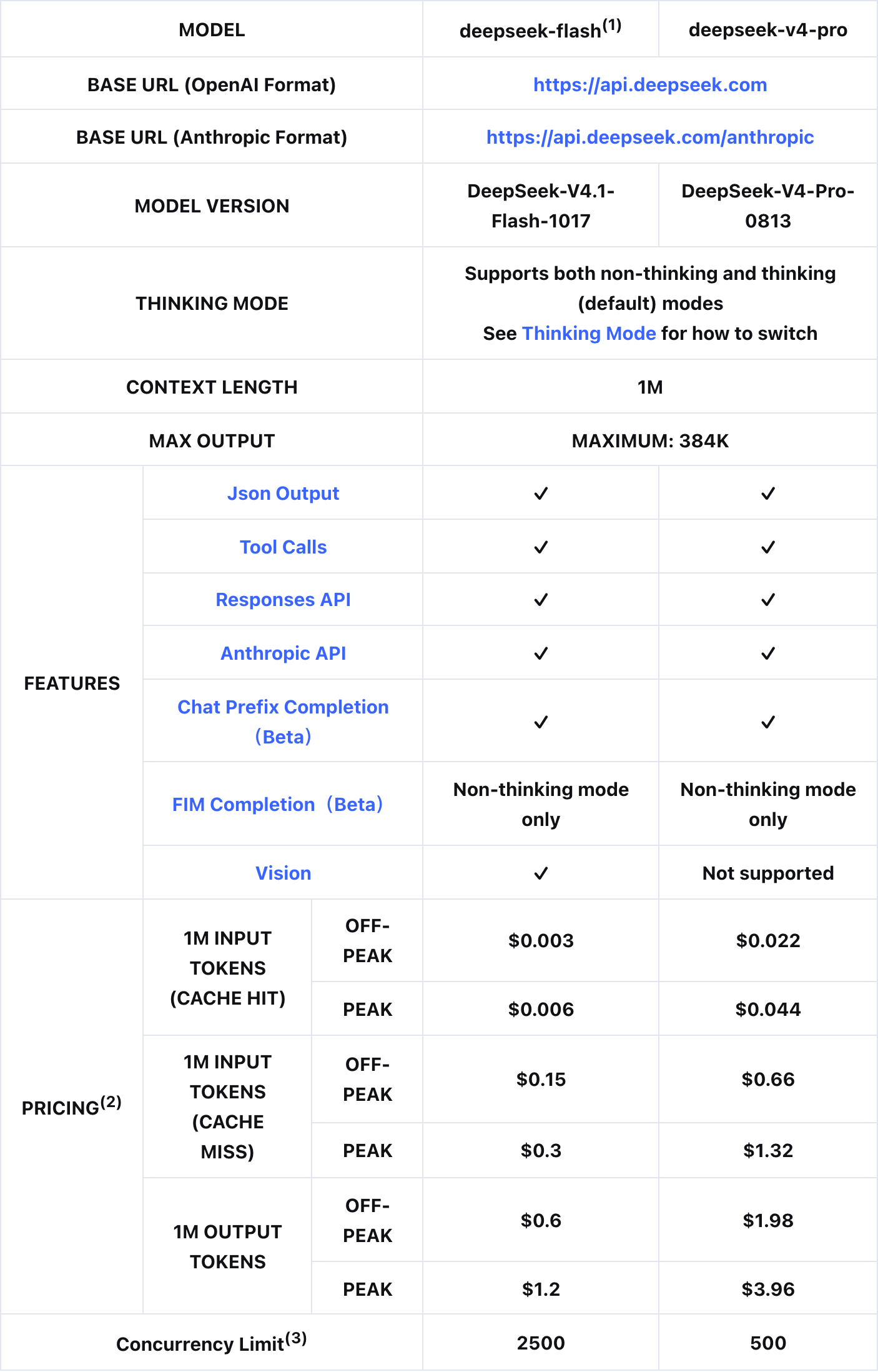 DeepSeek Models & Pricing, captured 2026-10-21:
deepseek-flash serves V4.1-Flash-1017, supports both thinking modes and vision, and lists separate off-peak and peak rates.
DeepSeek’s peak windows are 01:00–04:00 and 06:00–10:00 UTC, Monday to Friday, excluding Chinese public holidays. That is 09:00–12:00 and 14:00–18:00 in Beijing, which overlaps the European morning. A support agent serving Asia or Europe during working hours will pay peak rates for a large share of its traffic. A nightly batch job will almost never pay them.
A worked example: an agent workload that bills 50M input and 10M output tokens a month, with no cache hits.
| Scenario | M3.1 Flash | DeepSeek V4.1 Flash |
|---|---|---|
| All traffic off-peak | $13.50 | $13.50 |
| 40% of traffic in peak windows | $13.50 | $18.90 |
| All traffic in peak windows | $13.50 | $27.00 |
These are list-price calculations from the two pricing pages, not invoices. Caching shifts the balance the other way, because DeepSeek’s cache-hit rate is 5× cheaper than MiniMax’s ($0.003 vs $0.015 off-peak). An agent that resends a large, stable system prompt may find DeepSeek cheaper even with some peak traffic.
Token counts matter as much as rates. DeepSeek counts its own tokens, MiniMax its own, and in our runs the same prompt was billed differently, as shown below.
Through SandBase, prices are per route. On October 21 the DeepSeek V4.1 Flash page showed a 25% promotional price of $0.22 / $0.90 (list $0.30 / $1.20), and M3.1 Flash showed $0.15 / $0.60. The SandBase DeepSeek route lists one rate with no time-of-day schedule.
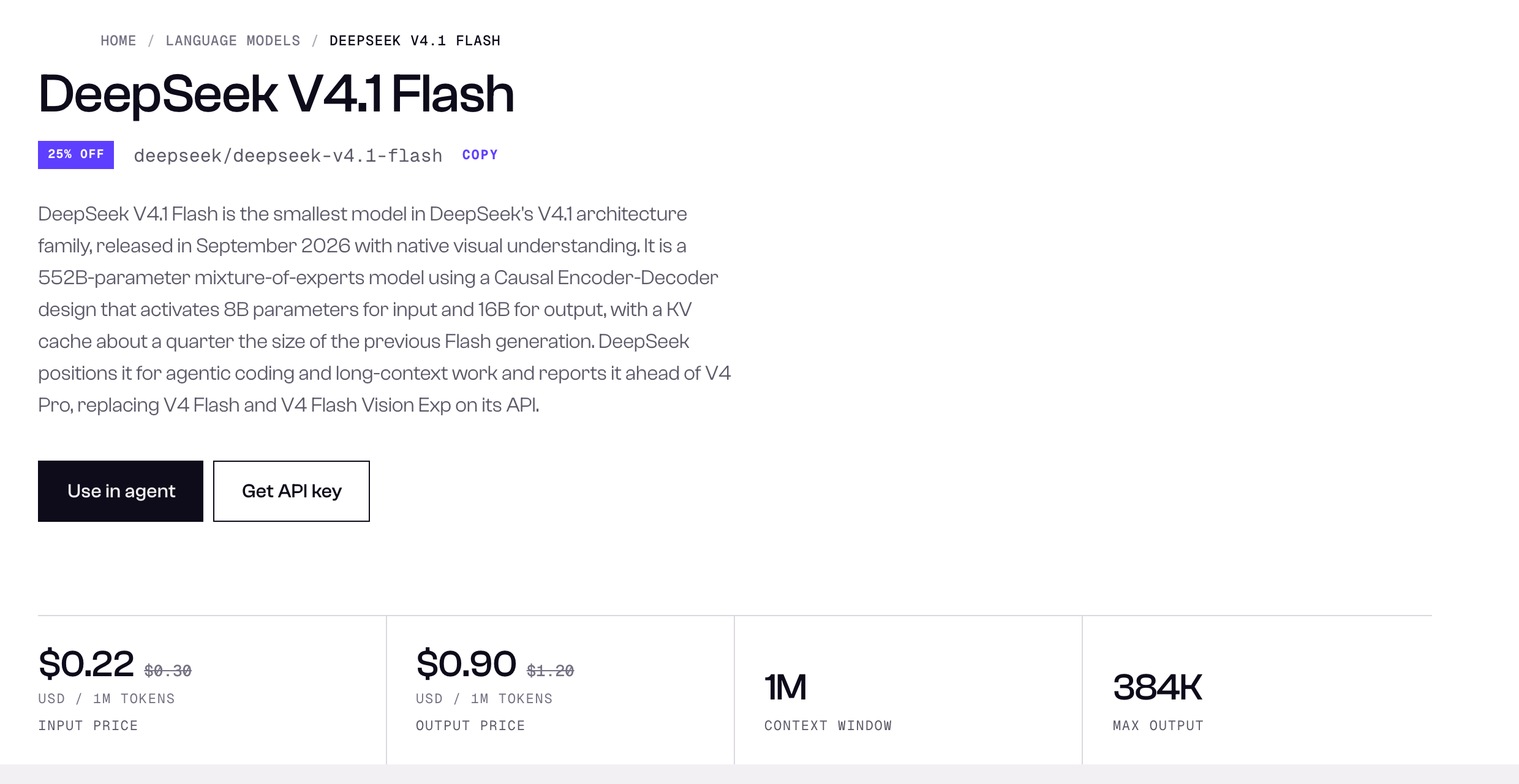 SandBase listing for
deepseek/deepseek-v4.1-flash, captured 2026-10-21: a 25% promotional rate over the $0.30 / $1.20 list, 1M context and 384K max output.
Benchmarks: read whose table you are reading
MiniMax’s launch table includes both DeepSeek V4.1 Flash and the newer 1017 checkpoint. For the 1017 column, MiniMax’s figures match DeepSeek’s own October 17 change log on five of the six rows both publish: DeepSWE 77.0, Terminal Bench 4.0 42.3, NL2Repo 68.2, Automation-Bench 60.5, BabyVision 92.5. That agreement is useful: on those rows, one vendor is not quietly lowballing the other. HLE is the exception, covered below the table.
| Benchmark (vendor-reported) | M3.1 Flash | DeepSeek V4.1 Flash 1017 | Leader |
|---|---|---|---|
| Automation-Bench v1.0.6 | 62.2 | 60.5 | MiniMax |
| DeepSWE v1.1 | 73.7 | 77.0 | DeepSeek |
| Terminal Bench 4.0 | 38.1 | 42.3 | DeepSeek |
| NL2Repo-Bench | 61.2 | 68.2 | DeepSeek |
| BabyVision (with tools) | 91.0 | 92.5 | DeepSeek |
| HLE (no tools) | 43.4 | 42.6 / 44.0† | Unclear† |
| Agents’ Last Exam | 29.6 | 35.4* | DeepSeek* |
†MiniMax’s HLE row is restricted to the 2,158 text-only questions. DeepSeek’s change log lists 42.6 for HLE without tools and 44.0 on the text-only subset. If the text-subset figures are the like-for-like pair, DeepSeek leads 44.0 to 43.4.
*MiniMax leaves DeepSeek’s ALE cell blank because it only counts full-set results from the official leaderboard. The 35.4 is DeepSeek’s own figure, so the two ALE numbers may not be measured the same way.
Harnesses differ by row. MiniMax ran Terminal Bench with Codex 0.149.1. DeepSeek says it used Claude Code for Terminal Bench and “Mini-SWE-V2” for DeepSWE. A gap of one or two points should not drive a decision. A seven-point gap on NL2Repo is harder to wave away.
On independent data, the Artificial Analysis snapshot SandBase keeps (Intelligence Index v4.3, data fetched 2026-10-19) lists “DeepSeek V4.1 Flash 1017 (Max)” at 45.1. That is one composite score (methodology), not a coding verdict. M3.1 Flash is not in it yet, so we cannot put the two side by side on that index.
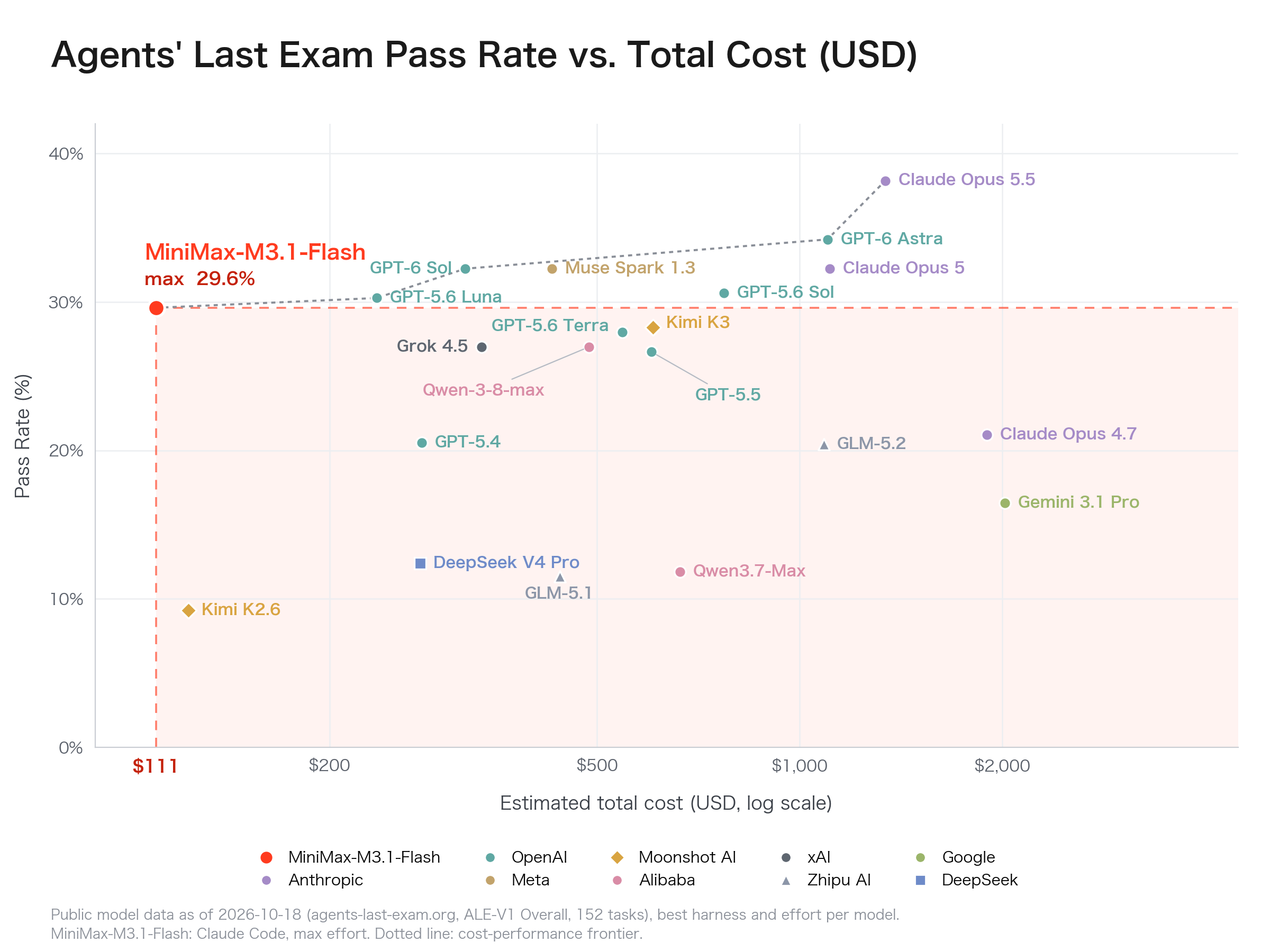 MiniMax’s own ALE cost chart from the launch post: M3.1 Flash at 29.6% for an estimated $111 across 152 tasks. DeepSeek V4.1 Flash is not plotted, which is part of why the ALE comparison stays open.
MiniMax’s strongest argument is not raw score. It is cost per completed task. Its chart puts a full 152-task ALE run at about $111. Our DeepSeek V4.1 Flash 1017 update coverage makes a similar efficiency claim for DeepSeek, which says the 1017 checkpoint writes shorter outputs. Neither vendor publishes per-task bills you can reproduce, so treat both as directional.
What our 36 live calls showed
We wrote a small harness and ran it through SandBase’s Chat Completions endpoint on October 21. Three tasks, each scored by code rather than by eye:
- code-fix: repair an off-by-one bug in
median(); the returned function must pass four unit tests. - tool-call: “order A-1043 was charged twice, refund the duplicate”. The first call must be
get_order("A-1043"), not a prematureissue_refund. - invoice-json: extract vendor, invoice number, total including tax, and a due date that requires adding 30 days to the issue date.
Each task ran three times on M3.1 Flash at default (max) effort, M3.1 Flash at low effort, DeepSeek V4.1 Flash at its default, and MiniMax M3 as a baseline.
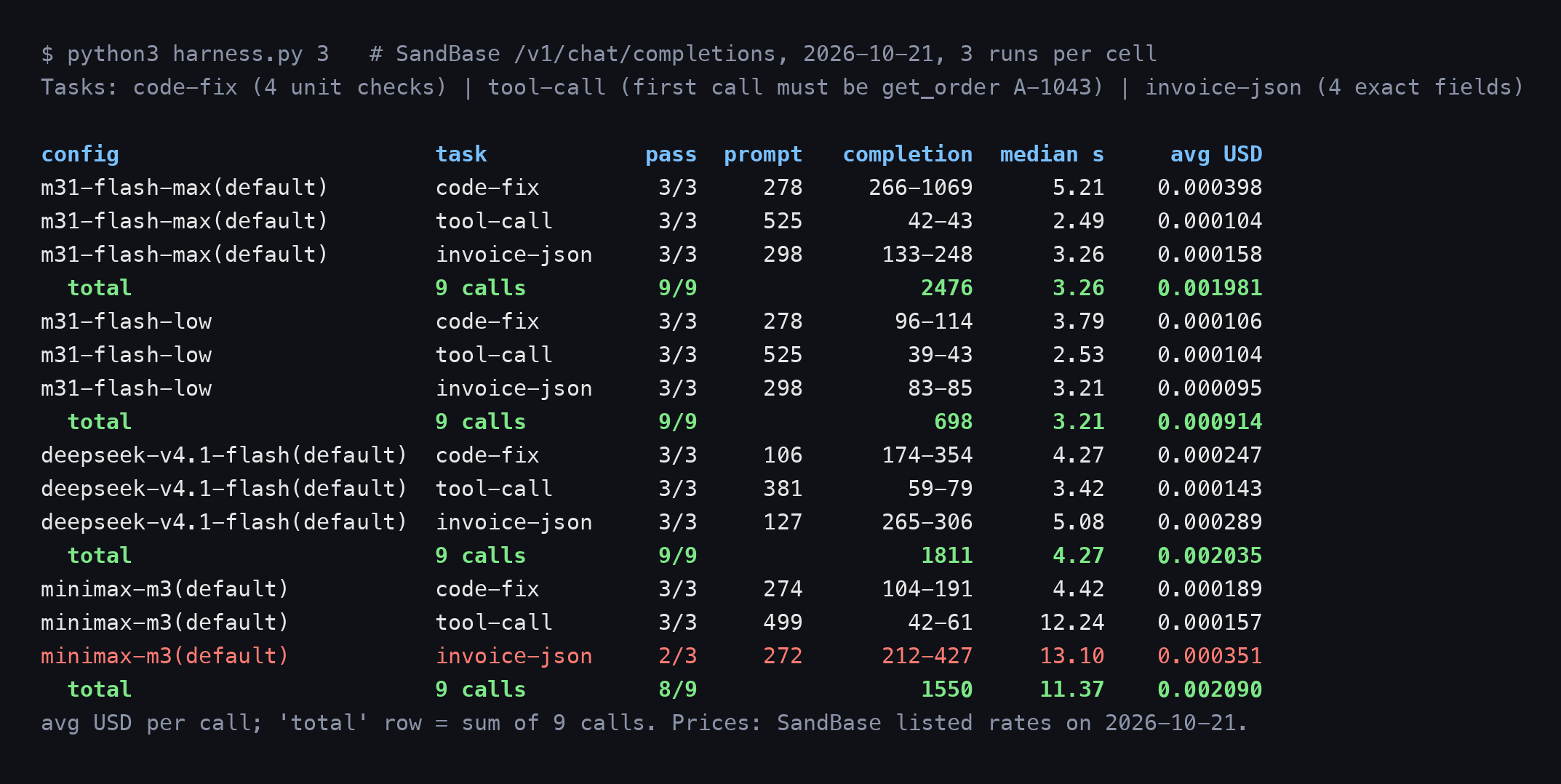 Harness summary rendered from the raw JSONL log, 2026-10-21. Costs use the SandBase rates shown on the model pages that day ($0.15 / $0.60 for M3.1 Flash, $0.22 / $0.90 for DeepSeek). M3’s one miss was a wrong due date.
The pass rates tie, which is the honest result: these tasks are too easy to separate the two Flash models on quality. The differences show up elsewhere.
Latency. M3.1 Flash’s median was 3.26 s at max effort and 3.21 s at low, against 4.27 s for DeepSeek. Tool calls were the clearest case: M3.1 Flash returned the get_order call in about 2.5 s and spent zero reasoning tokens doing it, even at max effort. DeepSeek took about 3.4 s.
Prompt token counts. The same code-fix prompt was billed as 278 prompt tokens on M3.1 Flash and 106 on DeepSeek. With tools attached, it was 525 vs 381. Part of that is tokenizer difference. Most of it looks like fixed overhead on the MiniMax route; our M3.1 Flash guide logs a one-sentence prompt counted as 219 tokens. For short, high-frequency calls this narrows MiniMax’s price edge.
Cost. For the 9 calls, M3.1 Flash cost $0.00198 at max effort and $0.00091 at low. DeepSeek cost $0.00204 at SandBase’s promotional rate. Re-pricing DeepSeek’s tokens at its own off-peak list rate gives about $0.00136, cheaper than M3.1 Flash at max. At peak it gives about $0.00273. The cheapest configuration in the whole run was M3.1 Flash at low effort, because DeepSeek’s default thinking spent 174–354 completion tokens on code-fix where M3.1 Flash low spent 96–114.
We also gave both models MiniMax’s benchmark-table image and asked for three pairs of scores as JSON. Both returned all six values correctly, twice each: five scores plus the blank Opus 5 CyberGym cell as null. M3.1 Flash counted the image as 4,103 prompt tokens against DeepSeek’s 1,087, a difference to keep in mind for screenshot-heavy agents.
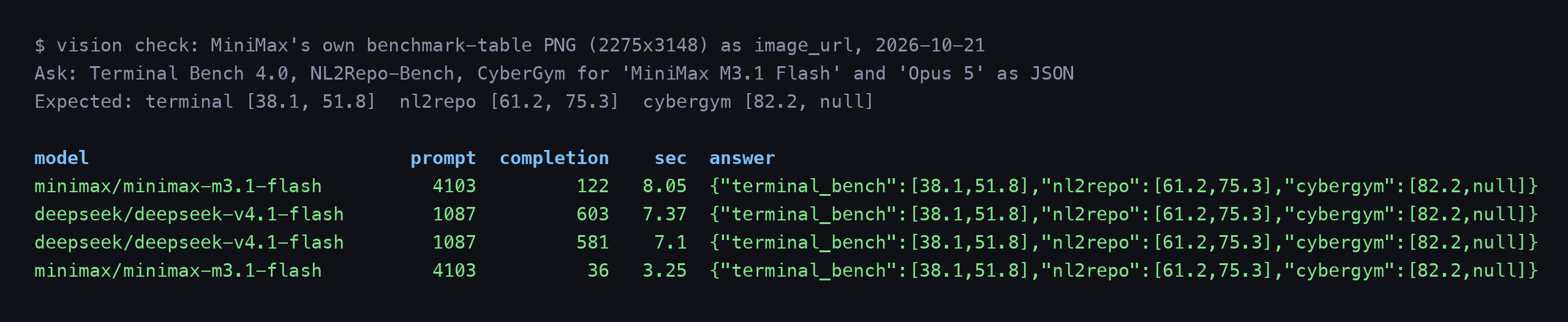 Vision check, 2026-10-21: four calls, all correct. The image cost M3.1 Flash about 3.8× more prompt tokens than DeepSeek.
What this test does not show: hard coding, long multi-step agents, million-token context, throughput under load, or error rates over days. It is 36 short calls on one afternoon. It rules out gross integration problems and exposes token accounting differences. It does not pick a quality winner.
How to choose
Choose MiniMax M3.1 Flash when:
- Your agents work in structured business systems (CRM, finance, ticketing), where its vendor-reported Automation-Bench and BankerToolBench scores are strongest.
- Traffic runs during Asian or European working hours and you want one predictable rate with no peak windows.
- You need very long outputs; SandBase lists a 512K maximum versus DeepSeek’s 384K.
- You want fast tool-call turns. In our run its tool calls came back quicker and spent no reasoning tokens.
Choose DeepSeek V4.1 Flash when:
- Coding quality is the priority. It leads on DeepSWE, Terminal Bench 4.0 and NL2Repo even in MiniMax’s own table.
- You need a true non-thinking mode for low-latency classification, routing or FIM completion.
- You must self-host or audit weights today. They are on Hugging Face under MIT; M3.1 Flash has no published weights or license yet.
- Your workload is cache-heavy or can be scheduled off-peak, where DeepSeek’s rates are lower.
Run both when you have a router. A sensible split is DeepSeek for code generation and M3.1 Flash at low effort for high-volume tool orchestration. Re-test after M3.1 Flash’s weights and any independent evaluations land. For more on how DeepSeek’s Flash line has changed, see DeepSeek V4.1 Flash vs V4 Pro. For M3.1 Flash’s effort levels in detail, see our MiniMax M3.1 Flash API and pricing guide.
FAQ
Is MiniMax M3.1 Flash cheaper than DeepSeek V4.1 Flash?
Per token, they are equal off-peak ($0.15 / $0.60). During DeepSeek’s weekday peak windows M3.1 Flash is half the price. DeepSeek’s cache-hit rate is lower, and in our runs M3.1 Flash counted more prompt tokens for the same text, so the cheaper option depends on your traffic shape.
Which is better for coding?
On published benchmarks, DeepSeek V4.1 Flash 1017. It leads on DeepSWE v1.1, Terminal Bench 4.0 and NL2Repo-Bench in MiniMax’s own comparison table. Both passed our simple bug-fix test every time.
Can I disable thinking on either model?
DeepSeek V4.1 Flash supports a non-thinking mode. MiniMax M3.1 Flash does not; disabling thinking returns HTTP 400, so use reasoning_effort: "low" instead.
Which one has open weights?
DeepSeek V4.1 Flash and the 1017 checkpoint are on Hugging Face under the MIT license. MiniMax says M3.1 Flash weights will be released later. As of October 21, 2026, none were published.
Can I call both with one API key?
Yes, on SandBase. Use minimax/minimax-m3.1-flash and deepseek/deepseek-v4.1-flash on the same /v1/chat/completions endpoint. Both are third-party models that SandBase routes to; prices and limits are those shown on each model page.
For most teams the decision is a routing question, not a winner. DeepSeek is the safer coding default and the only one you can self-host today. M3.1 Flash is the better fit for predictable-cost agent orchestration. Check where your traffic falls on DeepSeek’s peak clock before you compare invoices.