DeepSeek V4.1-Flash-1017: What the October Update Changes
DeepSeek V4.1-Flash-1017 ships into the deepseek-flash name on Oct 17, 2026: same price, higher benchmarks, shorter outputs. What changed, where it leads, and where Opus 5 still wins.
DeepSeek shipped a new model on October 17, 2026, and if you call deepseek-flash in a config file, you are already using it. There was no new model name, no migration step, and no price change. DeepSeek calls V4.1-Flash-1017 a “minor update.” The benchmark jumps are not minor: Terminal-Bench 4.0 goes from 31.2 to 42.3, and ProgramBench from 20.3 to 29.1, inside the same API name you were calling yesterday.
That is the real story of this release for anyone running an agent in production. A checkpoint you did not choose is now answering your requests, and on DeepSeek’s own numbers it reasons differently — faster, with shorter outputs — than the September V4.1 Flash it replaced. This post covers what actually changed, which benchmarks moved, where the model leads its peers and where it still trails, and what to check before you treat the gains as yours. Every number here is vendor-reported; I have not reproduced DeepSeek’s benchmark runs.
Key takeaway
deepseek-flashnow serves DeepSeek-V4.1-Flash-1017 on DeepSeek’s web, app, and API. The calling method and pricing are unchanged, so your existing code picks it up with no edit.- DeepSeek reports gains across every listed benchmark versus the September V4.1 Flash: DeepSWE v1.1 74.2 → 77.0, Terminal-Bench 4.0 31.2 → 42.3, Apex Bench v1.1 64.6 → 72.1.
- It also “reduced the model’s task runtime and output length,” which is the part that lowers your bill — fewer output tokens per solved task, not a lower per-token price.
- Against bigger models it is uneven: 1017 leads on Terminal-Bench 4.0 and DeepSWE, but Claude Opus 5 is ahead on HLE (56.3 vs 42.6), ProgramBench, and NL2Repo-Bench.
- Weights are open under the MIT license on Hugging Face and ModelScope. The release’s technical report is titled “Pushing the Limits of KV Cache Compression.”
The update you did not have to opt into
The DeepSeek change log for October 17 is blunt about the mechanics: V4.1 Flash “has been upgraded to DeepSeek-V4.1-Flash-1017,” the web and app models moved to it too, and “the API calling method and pricing remain unchanged — simply use deepseek-flash.” The legacy names deepseek-v4-flash and deepseek-v4-flash-vision-exp, already retired in September, still route here as well.
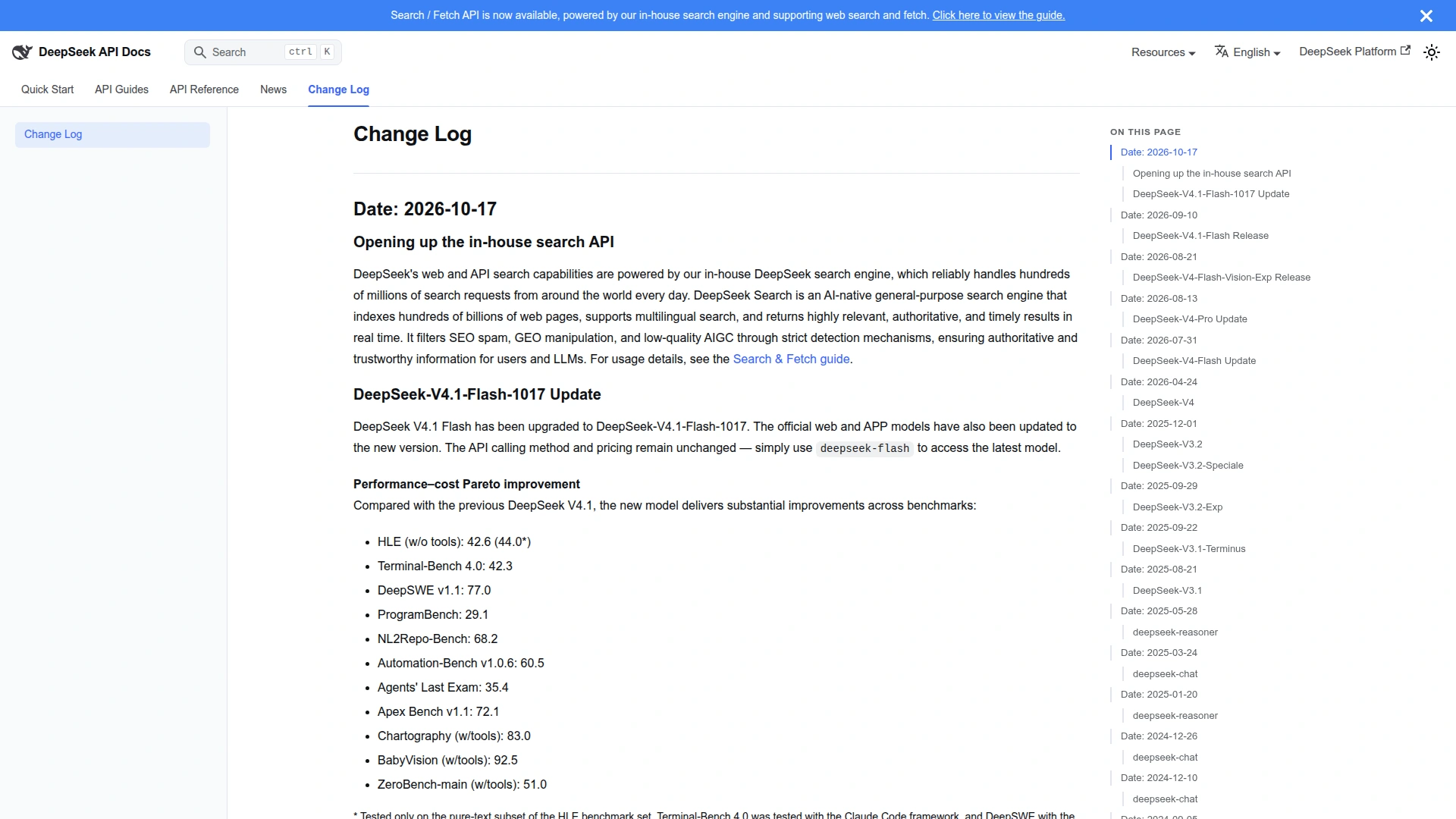 DeepSeek’s official change log pins the Oct 17 upgrade to the
 deepseek-flash name and lists the new benchmark scores (captured 2026-10-17).
This is convenient and slightly uncomfortable at the same time. Convenient because there is nothing to migrate. Uncomfortable because a model that answers your prompts changed underneath a name you treated as stable, and the September-to-October gap in behavior is large enough to matter. If you have golden outputs, regression tests, or a prompt tuned against the old Flash, the right move today is to re-run those checks against the new checkpoint rather than assume the “minor update” label means minor change. DeepSeek’s position on name stability has been consistent since the September launch; the V4.1 Flash vs V4 Pro comparison walks through why an unversioned name is not a version pin.
If you want a pinned checkpoint, the open weights are the escape hatch: DeepSeek-V4.1-Flash-1017 is published on Hugging Face and ModelScope under an MIT license, so you can host a known build and stop a future “1118” from moving under you.
What the benchmarks actually say
DeepSeek frames 1017 as a performance–cost Pareto improvement: better scores and shorter, faster answers. Here are the vendor-reported scores against the model it replaces.
| Benchmark | V4.1-Flash-1017 | V4.1-Flash (Sep) |
|---|---|---|
| HLE (without tools) | 42.6 (44.0 text-only) | 36.8 (39.1 text-only) |
| Terminal-Bench 4.0 | 42.3 | 31.2 |
| DeepSWE v1.1 | 77.0 | 74.2 |
| ProgramBench | 29.1 | 20.3 |
| NL2Repo-Bench | 68.2 | 65.4 |
| Automation-Bench v1.0.6 | 60.5 | 54.8 |
| Agents’ Last Exam | 35.4 | 31.8 |
| Apex Bench v1.1 | 72.1 | 64.6 |
| Chartography (with tools) | 83.0 | 78.9 |
| BabyVision (with tools) | 92.5 | 89.6 |
| ZeroBench-main (with tools) | 51.0 | 49.0 |
The two biggest moves are both agentic-coding scores. Terminal-Bench 4.0 jumps 11.1 points and ProgramBench jumps 8.8. DeepSeek notes the setup: Terminal-Bench 4.0 was run with the Claude Code framework and DeepSWE with the Mini-SWE-V2 harness, ZeroBench-main used Pass@5, and the HLE figure in parentheses is the pure-text subset. Those are harness-dependent results, which is a reminder that the number you get depends on the scaffold you run the model in, not only the weights.
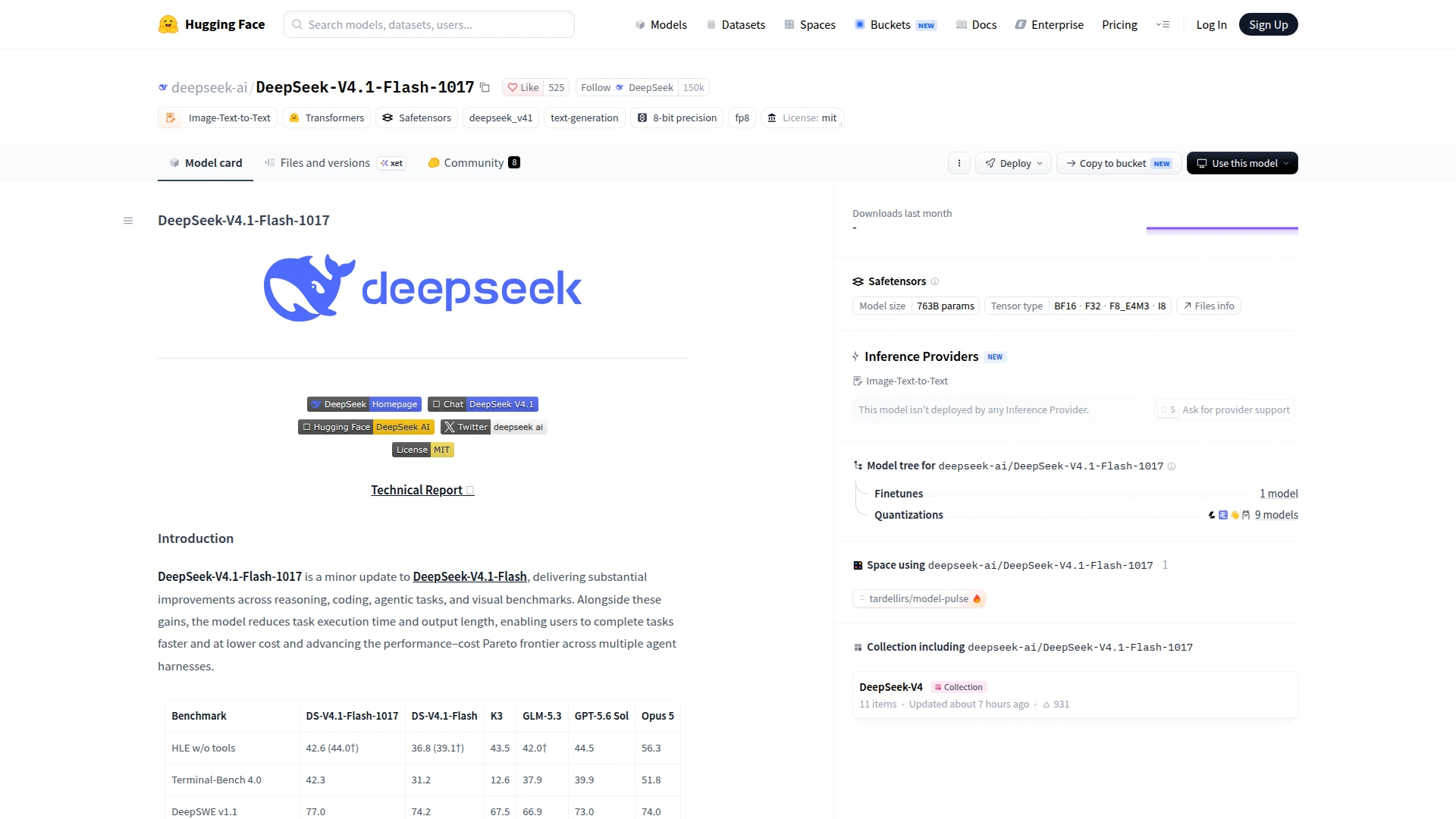 The Hugging Face card lists 763B total parameters, an MIT license, and the same comparison table DeepSeek published, including the peer columns (captured 2026-10-17).
Where it leads, and where Opus 5 still wins
DeepSeek’s launch note and model card put 1017 next to four other models: Kimi K3, GLM-5.3, GPT-5.6 Sol, and Claude Opus 5. Read across that table and the picture is specific rather than triumphant.
| Benchmark | 1017 | Kimi K3 | GLM-5.3 | GPT-5.6 Sol | Opus 5 |
|---|---|---|---|---|---|
| Terminal-Bench 4.0 | 42.3 | 12.6 | 37.9 | 39.9 | 51.8 |
| DeepSWE v1.1 | 77.0 | 67.5 | 66.9 | 73.0 | 74.0 |
| Apex Bench v1.1 | 72.1 | 47.8 | 56.6 | 54.3 | 65.8 |
| HLE (without tools) | 42.6 | 43.5 | 42.0 | 44.5 | 56.3 |
| ProgramBench | 29.1 | 17.5 | 19.0 | 23.0 | 37.0 |
| NL2Repo-Bench | 68.2 | 58.0 | 58.0 | 56.8 | 75.3 |
On DeepSWE v1.1 and Apex Bench, 1017 posts the top number in the group, ahead of Claude Opus 5 — a notable result for a model that bills at a small fraction of Opus pricing. On Terminal-Bench 4.0 it clears everything except Opus 5. But the frontier gap is real where it is real: Opus 5 leads HLE by nearly 14 points, and leads ProgramBench and NL2Repo-Bench clearly. If your workload looks like broad knowledge reasoning (HLE) or repository-scale code synthesis (NL2Repo), the bigger model is still measurably better on these tests.
The honest summary is that 1017 is a strong value pick for terminal-style and SWE-style agent loops, and a trailing option for the hardest reasoning and whole-repo tasks. That is a per-task judgment, not a leaderboard rank, and it is exactly the kind of thing worth confirming on your own prompts — the Python API tutorial sets up a reproducible way to do that.
The architecture note that explains “shorter outputs”
The 1017 technical report is titled “Pushing the Limits of KV Cache Compression,” and that theme connects to the practical claim. V4.1 Flash is a Mixture-of-Experts model built on a Causal Encoder-Decoder design: it activates roughly 8B parameters to read input and 16B to generate output, with a KV cache about a quarter the size of the previous Flash generation, per DeepSeek’s architecture description surfaced on the SandBase model page. Hugging Face lists the full model at 763B parameters. A compressed KV cache is what lets a 1M-token context stay affordable, and shorter outputs mean fewer billed output tokens per solved task.
That is the mechanism behind “lower cost and higher speed.” It is not a price cut — the per-token rate is identical to September’s. It is the model finishing tasks in fewer tokens, which only shows up as savings if your tasks were previously spending tokens on long reasoning traces. For a workload already dominated by input tokens, the output reduction will barely move the bill.
Pricing: unchanged upstream, discounted on SandBase today
DeepSeek’s official rate for deepseek-flash is unchanged by this release: at peak hours, $0.30 per million uncached input tokens and $1.20 per million output tokens, with cached input at $0.006 (and off-peak rates at half, so cached input off-peak is $0.003). Those are the figures on DeepSeek’s Models & Pricing page.
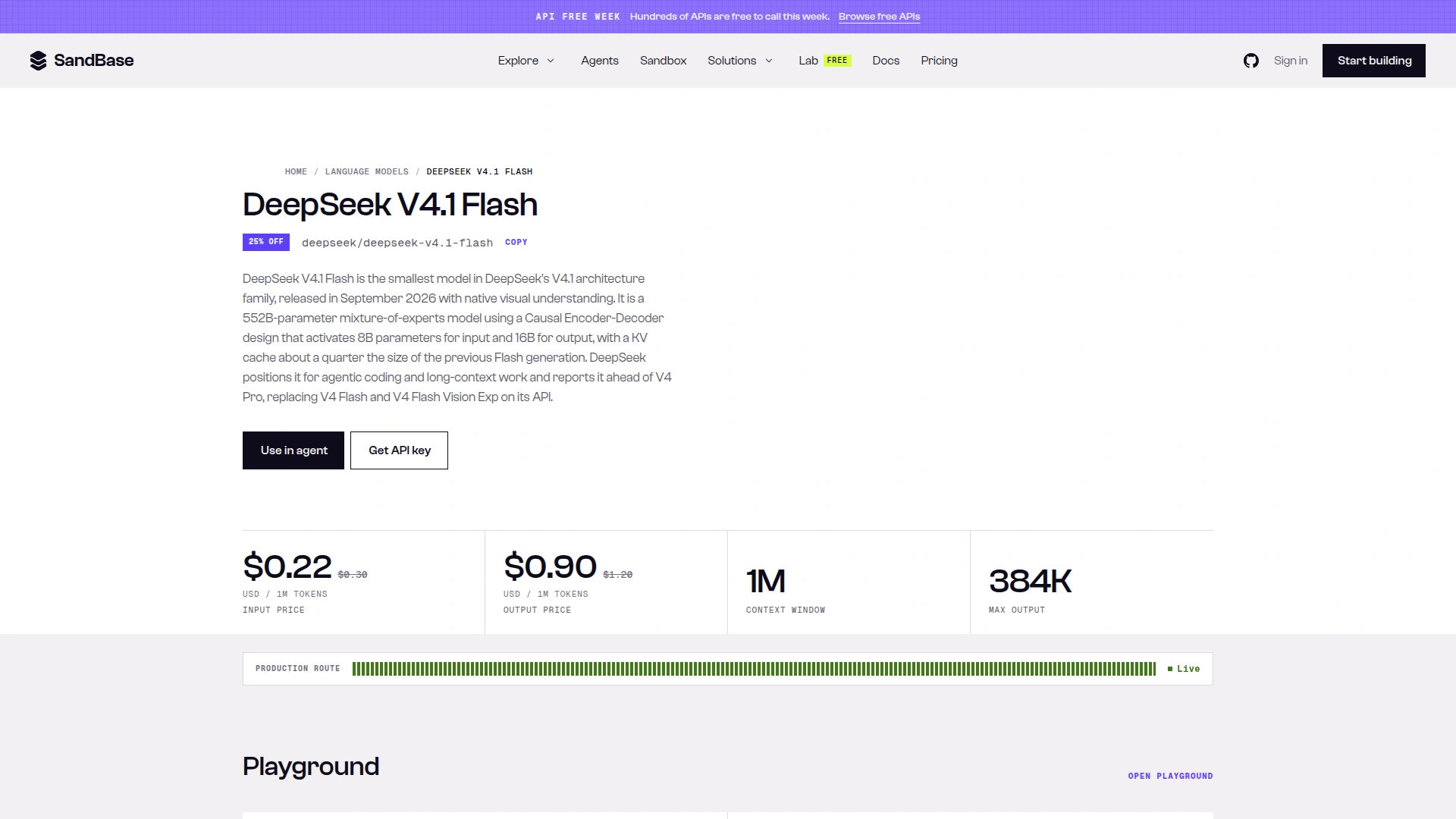 On SandBase the model id is
 deepseek/deepseek-v4.1-flash, listed at $0.30 / $1.20 with a 25% launch discount showing $0.22 / $0.90, a 1M context window, and a 384K max output (captured 2026-10-17).
Through SandBase the same model carries a 1M context window and a 384K maximum output, and at capture time a 25% model discount brought the effective rate to about $0.22 input and $0.90 output per million tokens. Discounts move, so treat that as a snapshot and check the live model page before you budget. The useful constant is that whether you call DeepSeek directly or route through SandBase, 1017 arrives under the same deepseek-flash / deepseek/deepseek-v4.1-flash identifier you were already using.
Who should pay attention
Three groups have a reason to act this week:
- Teams running a coding or terminal agent on Flash. The Terminal-Bench and DeepSWE gains target exactly your loop. Re-run your evaluation set; the upside is real but harness-dependent.
- Anyone with regression tests against the old Flash. The checkpoint changed under a stable name. Confirm your golden outputs still pass before you ship on the assumption that nothing moved.
- Teams that need a pinned version. The MIT weights let you host 1017 as a fixed build instead of tracking a moving
deepseek-flashalias.
Who can wait: input-heavy workloads where output length was never the cost driver, and reasoning-first applications where Opus-class HLE performance is the bar — 1017 narrowed that gap but did not close it.
FAQ
Do I need to change my code to use DeepSeek V4.1-Flash-1017?
No. DeepSeek upgraded the deepseek-flash model name in place on October 17, 2026, with the calling method and pricing unchanged. Direct API users and SandBase users on deepseek/deepseek-v4.1-flash get the new checkpoint automatically. The one thing to do is re-test, not re-integrate.
How much better is 1017 than the September V4.1 Flash?
On DeepSeek’s own benchmarks, every listed score improved: for example DeepSWE v1.1 rose from 74.2 to 77.0 and Terminal-Bench 4.0 from 31.2 to 42.3. These are vendor-reported and harness-dependent; they are a reason to evaluate, not a guarantee for your tasks.
Is DeepSeek V4.1-Flash-1017 better than Claude Opus 5?
It depends on the task. On DeepSeek’s comparison table 1017 leads Opus 5 on DeepSWE v1.1 and Apex Bench, while Opus 5 leads on HLE (56.3 vs 42.6), ProgramBench, and NL2Repo-Bench. For terminal and SWE agent loops 1017 is competitive at far lower cost; for the hardest reasoning it trails.
Are the model weights available?
Yes, under the MIT license on Hugging Face and ModelScope. Hosting them yourself is the way to pin a fixed checkpoint rather than track the moving deepseek-flash name.
Did anything else launch alongside the model?
Yes. DeepSeek opened its in-house Search and Fetch APIs the same day. That is a separate capability with its own pricing; the DeepSeek Search and Fetch API guide covers it.
Bottom line
V4.1-Flash-1017 is the rare update that asks nothing of you and still changes your results. The benchmark gains concentrate where agent builders feel them — terminal tasks, SWE loops, automation — and the shorter-output claim can trim the bill on reasoning-heavy work without a price change. It is not a frontier-reasoning model; Opus 5 still wins HLE and whole-repo synthesis by clear margins. Treat the “minor update” label as a prompt to re-run your evaluations under the same deepseek-flash name, and to decide whether a moving alias or a pinned MIT build is the right foundation for what you are building. To test it next to the models it competes with on one key, start from the DeepSeek V4.1 Flash model page or the Python tutorial.