H3 Image Isn’t on SandBase Yet. Turn Concept Stills into H3 Video Shots Today
H3 Image has no SandBase model string on 10 Nov 2026. Make a still on Seedream 5.0 Flash, then animate it with minimax/h3/image-to-video.
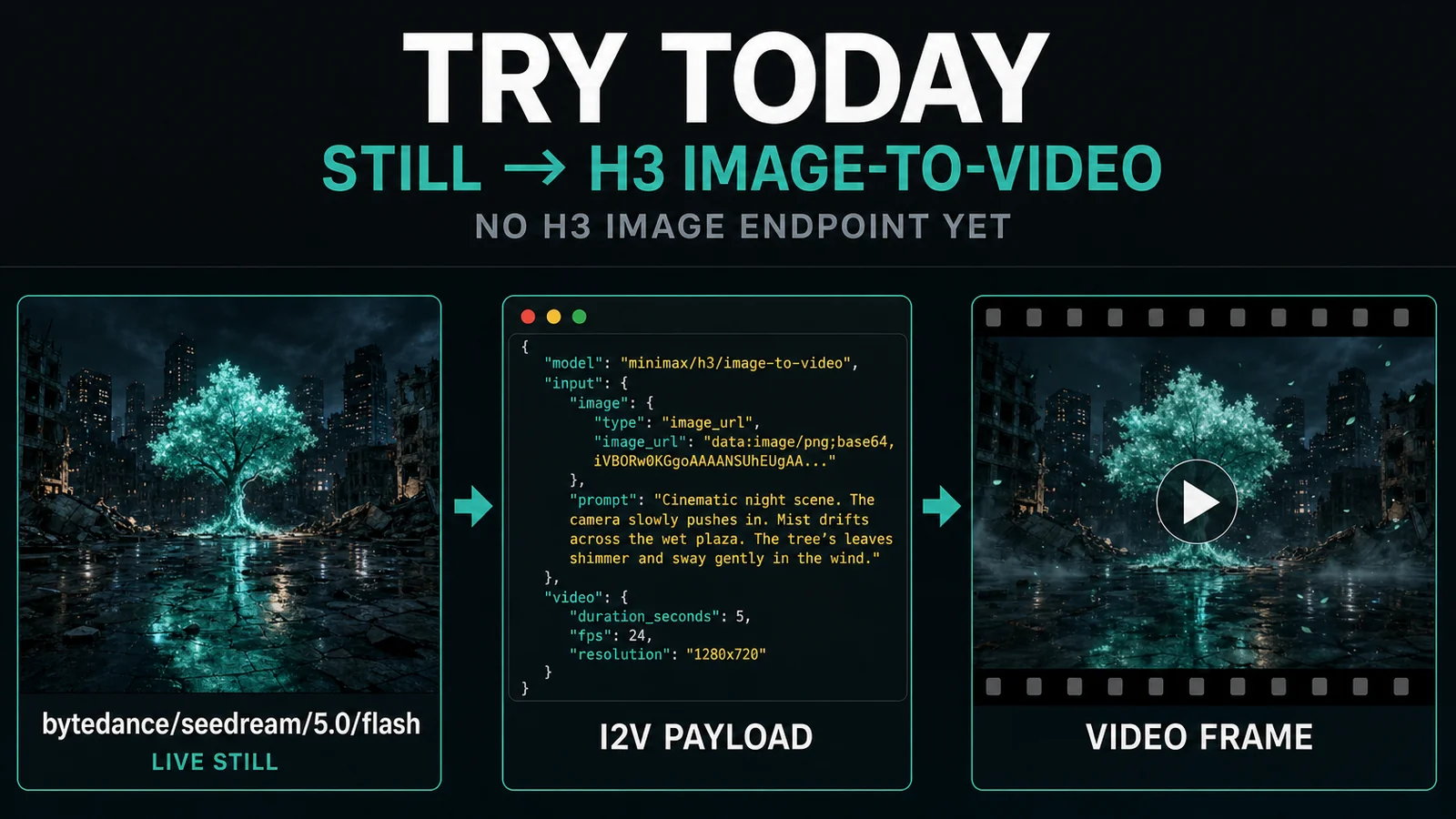
There is no H3 Image string to paste into
/v1/runtoday. You can still move a concept still into a shot.
H3 Image is the still model testers are posting from Hailuo. The workflow in this note is the thing you can ship on SandBase while that card is missing: make or bring a still with a live image model, then animate it with MiniMax H3 video. When an H3 Image card exists, swap only the still-making step. Keep the video IDs.
If you already have a licensed frame, skip ahead to MiniMax H3 Image to Video. If the idea can start as a clip, use text-to-video and skip the still. The title of this piece is the status, checked 10 November 2026: candidate still-image paths returned HTTP 404.
Key takeaway
- SandBase has no H3 Image model ID.
minimax/h3/image-to-videois video. It requires a first-frame URL and returns a clip.- A practical pair on 10 November 2026: Seedream 5.0 Flash at $0.018 per image, then 5 seconds of H3 image-to-video at 768P for $0.30. The flagship 5-second 2K clip is $0.65.
- Reference-to-video accepts up to 9 images. That is not Hailuo’s 16-reference cap on the H3 Image app config.
- The August 2026 H3 video post’s 10-second cap and $0.30–$0.80 summary are stale. Current flagship cards run 4–15 seconds.
https://example.com/concept-still.pngin the sample below is your URL, not a file this article hosts.
What you need
A SandBase key, from getting started if you do not have one. Calls are POST https://api.sandbase.ai/v1/run with the model fields at the top level of the JSON. The run reference says asynchronous work returns an id; poll GET /v1/run/{id} until the status is terminal. Do not wrap the body in an input object.
Read these before you copy a string from a screenshot of Hailuo:
- What is confirmed about H3 Image: Code still says upcoming, Hailuo’s app config names the model, Open Platform does not.
- Which still you can call: Seedream 5.0, GPT Image 2.5 Sunburst, Nano Banana 2.1. Seedream 5.5 is also 404.
- MiniMax H3 video introduction: July 2026 family history. Price the job from the live card, not from that post.
- The same “run it on the live previous card” shape, for a different model: Seedream 5.5 text and sticker workflow.
The string people will guess is minimax/h3/image-to-video. That string already works. It makes video.
Three live paths
(a) Text to video, when you do not need a locked frame. H3 text-to-video takes a prompt, a duration from 4 to 15 seconds, a resolution of 768P or 2K, and an aspect ratio. Default duration is 5. Default resolution is 2K. Default aspect is 16:9. Prompt cap is 7,000 characters. Same per-second prices as image-to-video.
(b) Still, then image-to-video. Make the still on a card that exists. This note uses Seedream 5.0 Flash because the billing table is $0.018 and the job is a concept, not a final poster. Seedream 5.0 Pro is $0.09 when the frame itself will be reviewed. Nano Banana 2.1 is the other fast still on the routing note. Then pass the image URL to image-to-video. The card requires image. end_image is optional. There is no aspect-ratio field on image-to-video; the first frame sets the frame.
(c) Several assets, reference-to-video. H3 reference-to-video takes up to 9 images, 3 videos, and 3 audio clips. Each reference image beyond the fifth adds $0.04. A 5-second 2K run with 9 images is $0.81 on the card’s table. Hailuo’s H3 Image config says 16 reference images. That cap is not this route. If you paste 16 URLs into reference-to-video, you are calling a different product with a lower image limit.
What it costs on 10 November 2026
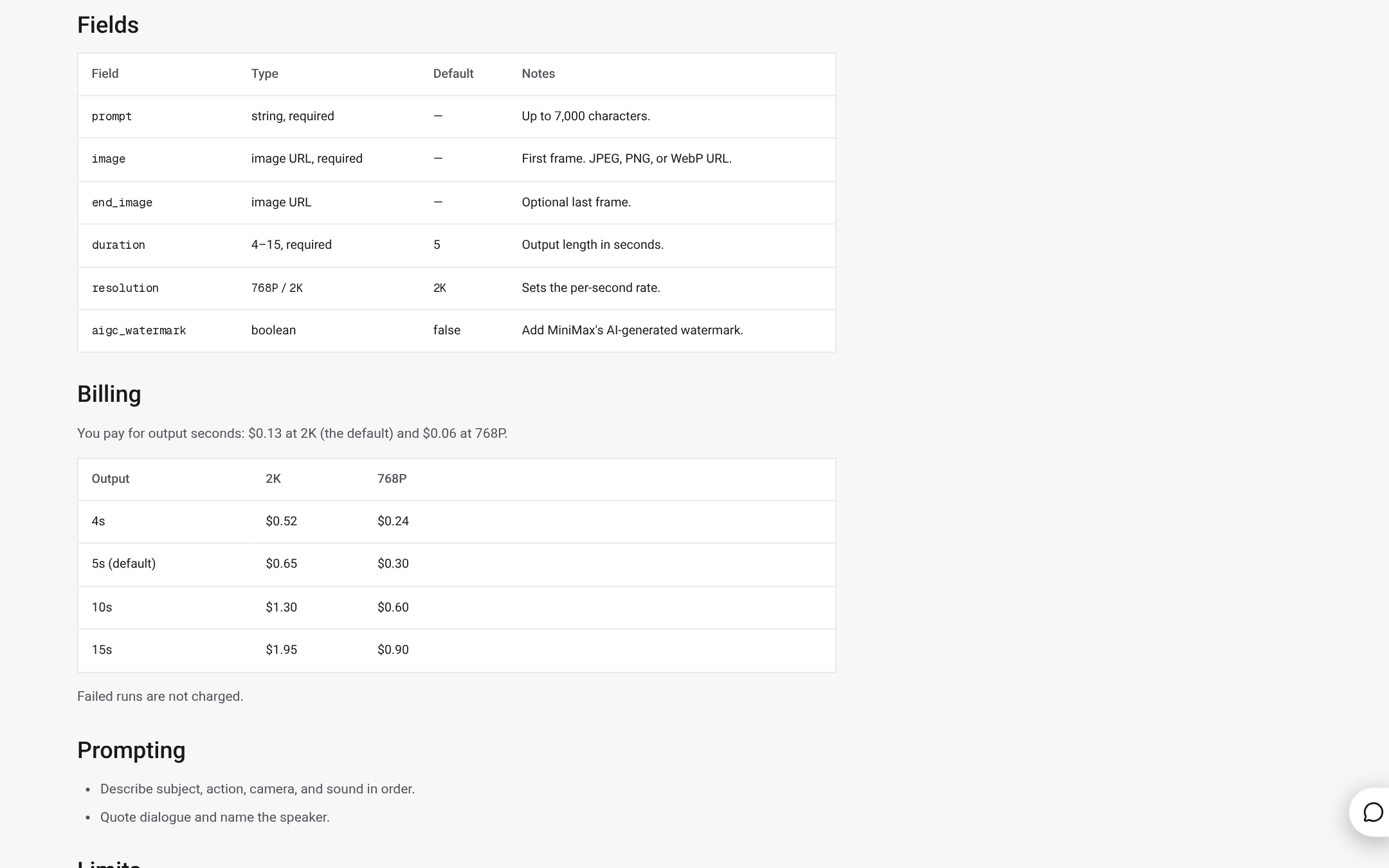
Billing table on the live MiniMax H3 Image to Video card, 10 Nov 2026, Asia/Shanghai: $0.13 per second at 2K (default) and $0.06 per second at 768P. A 5-second default costs $0.65 (2K) or $0.30 (768P). This is image-to-video pricing, not an H3 Image still-image price.
| Route | Default 5-second bill on the card | When I would pick it |
|---|---|---|
minimax/h3/image-to-video at 2K | $0.65 | The frame has to look like the flagship card |
minimax/h3/image-to-video at 768P | $0.30 | You are checking motion, camera, and sound |
minimax/h3-max/image-to-video at 768P | $0.40 | You want the Max tier and can leave 2K. 480P is $0.25 for 5 seconds |
minimax/h3-max-turbo/image-to-video at 768P | $0.20 | The brief can leave 2K. 1080P is $0.40 for 5 seconds. 480P is $0.125 |
| Seedream 5.0 Flash still, one image | $0.018 | The concept frame. Catalog header may still say $0.02. Quote this table |
| Flash still + 5s H3 at 768P | $0.318 | The pair in the curls below |
Failed runs are not charged on the H3 and Seedream cards checked that day. That sentence is on those cards. It is not a promise about a future H3 Image card.
The August blog is still worth reading for what H3 video was at launch. It is the wrong table for a purchase order. Duration on the flagship cards is 4, 5, 6, and on through 15 seconds.
Step 1: make the still on a live image model

Concept still generated on SandBase with bytedance/seedream/5.0/flash on 10 Nov 2026, Asia/Shanghai (run 360d2d64-a4ae-4b73-ba4f-7c439e27f589, about $0.018). Prompt: cinematic wide ruined city at night, single glowing tree in the plaza, wet streets, 16:9. This is a Seedream 5.0 Flash still, not an H3 Image sample.
Flash’s text-to-image card bills $0.018 per image, one image, jpeg or png. The still above is that route, from the run in the caption. The curl below is the same request shape.
curl -sS https://api.sandbase.ai/v1/run \
  -H "Authorization: Bearer $SANDBASE_API_KEY" \
  -H "Content-Type: application/json" \
  -d '{
    "model": "bytedance/seedream/5.0/flash",
    "prompt": "Concept still, cinematic wide: a ruined city at night with a single glowing tree in the plaza, wet streets, readable architecture, 16:9.",
    "aspect_ratio": "16:9",
    "output_format": "png"
  }'
Save the run id. If the status comes back failed or timeout, stop and read the JSON. Do not retry a failed prompt in a loop without looking. The card says failed runs are not charged; a timeout still costs you the afternoon if you ignore it.
If the still has to carry exact type, switch the model string to bytedance/seedream/5.0/pro and budget $0.09. The e-commerce checklist is how that desk reads letters. Flash is the wrong place to prove a logo.
Step 2: animate that still
Replace https://example.com/concept-still.png with the URL the still run returned, or with any frame you have rights to use. The host example.com is a placeholder in this article. It is not a SandBase sample, and it will not resolve to a picture.
The prompt names the camera and the sound. H3’s card describes native stereo. Ask for the move, and ask it not to invent objects. Duration 5 and resolution 768P match the $0.30 cell. Change 768P to 2K only when you want the $0.65 cell.
curl -sS https://api.sandbase.ai/v1/run \
  -H "Authorization: Bearer $SANDBASE_API_KEY" \
  -H "Content-Type: application/json" \
  -d '{
    "model": "minimax/h3/image-to-video",
    "prompt": "Hold the first frame, then a slow crane up as wind moves the tree canopy and distant signage flickers. Soft stereo wind, no new objects, no cut.",
    "image": "https://example.com/concept-still.png",
    "duration": 5,
    "resolution": "768P"
  }'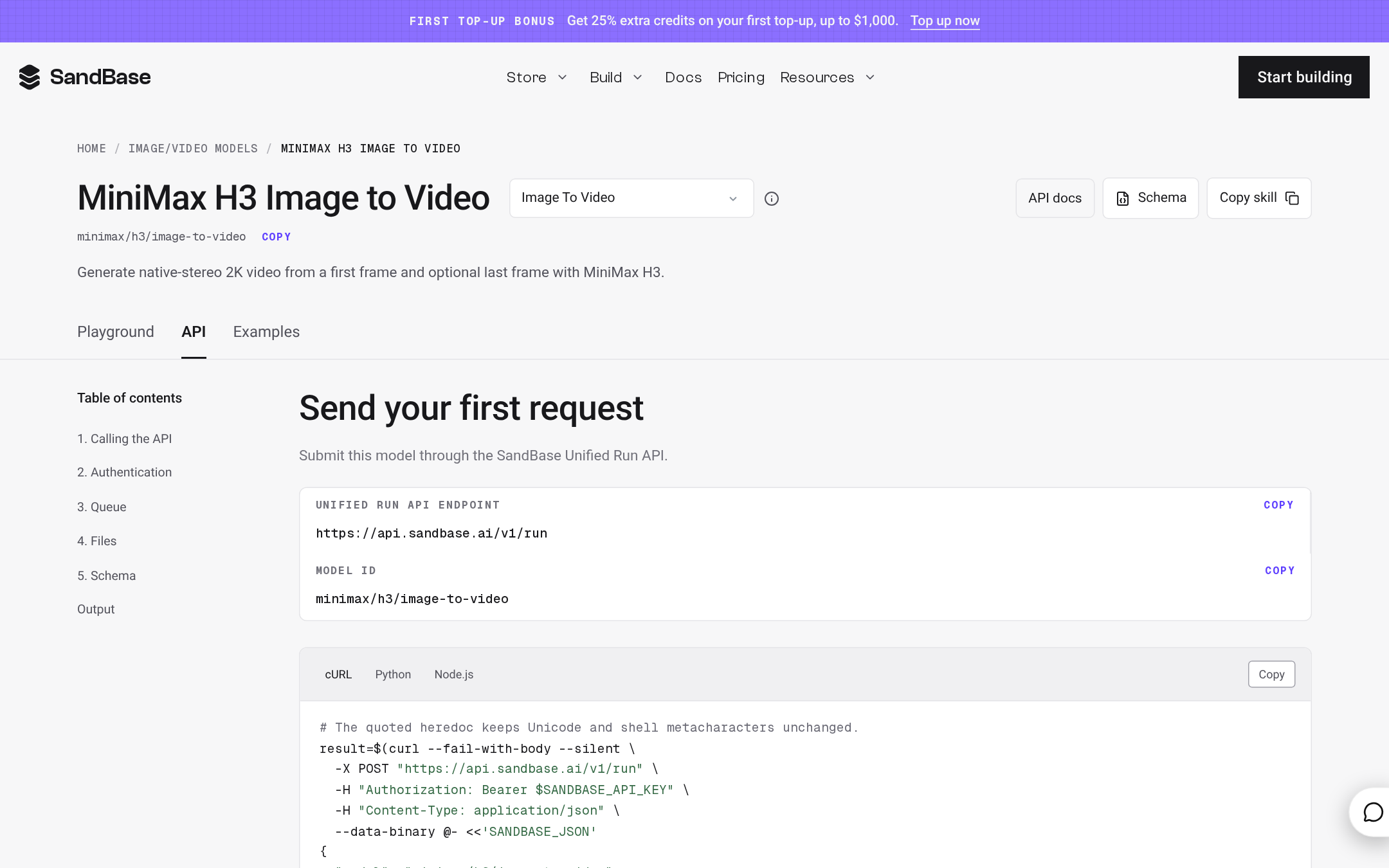
API tab on the live SandBase H3 Image to Video card, 10 Nov 2026, Asia/Shanghai. The model id minimax/h3/image-to-video is visible in the header and in the request panel. Use this string. Do not invent an H3 Image endpoint.
The image-to-video card’s own copy-skill polls until completed, failed, or timeout, then prints the JSON. This loop does the same thing for the curl above. It does not guess the output field. Read the JSON. The output shape lives on the card.
# Submit, then poll. Replace the image URL before you run this.
result=$(curl --fail-with-body --silent \
  -X POST "https://api.sandbase.ai/v1/run" \
  -H "Authorization: Bearer $SANDBASE_API_KEY" \
  -H "Content-Type: application/json" \
  --data-binary @- <<'SANDBASE_JSON'
{
  "model": "minimax/h3/image-to-video",
  "prompt": "Hold the first frame, then a slow crane up as wind moves the tree canopy and distant signage flickers. Soft stereo wind, no new objects, no cut.",
  "image": "https://example.com/concept-still.png",
  "duration": 5,
  "resolution": "768P"
}
SANDBASE_JSON
)
run_id=$(printf '%s' "$result" | jq -r .id)
if [ -z "$run_id" ] || [ "$run_id" = "null" ]; then
  echo "No run id. Body was:" >&2
  printf '%s\n' "$result" >&2
  exit 1
fi
for attempt in $(seq 1 120); do
  status=$(printf '%s' "$result" | jq -r .status)
  case "$status" in completed|failed|timeout) break ;; esac
  sleep 2
  result=$(curl --fail-with-body --silent \
    -H "Authorization: Bearer $SANDBASE_API_KEY" \
    "https://api.sandbase.ai/v1/run/$run_id")
done
status=$(printf '%s' "$result" | jq -r .status)
if [ "$status" != "completed" ]; then
  echo "Generation ended: $status" >&2
  printf '%s\n' "$result" >&2
  exit 1
fi
printf '%s\n' "$result"
Watch the first frame and a later frame side by side. You are grading whether the crane move kept the tree and the streets. You are not grading H3 Image. A good animation of a Flash still can still be a bad H3 Image substitute, because the still never went through that model.
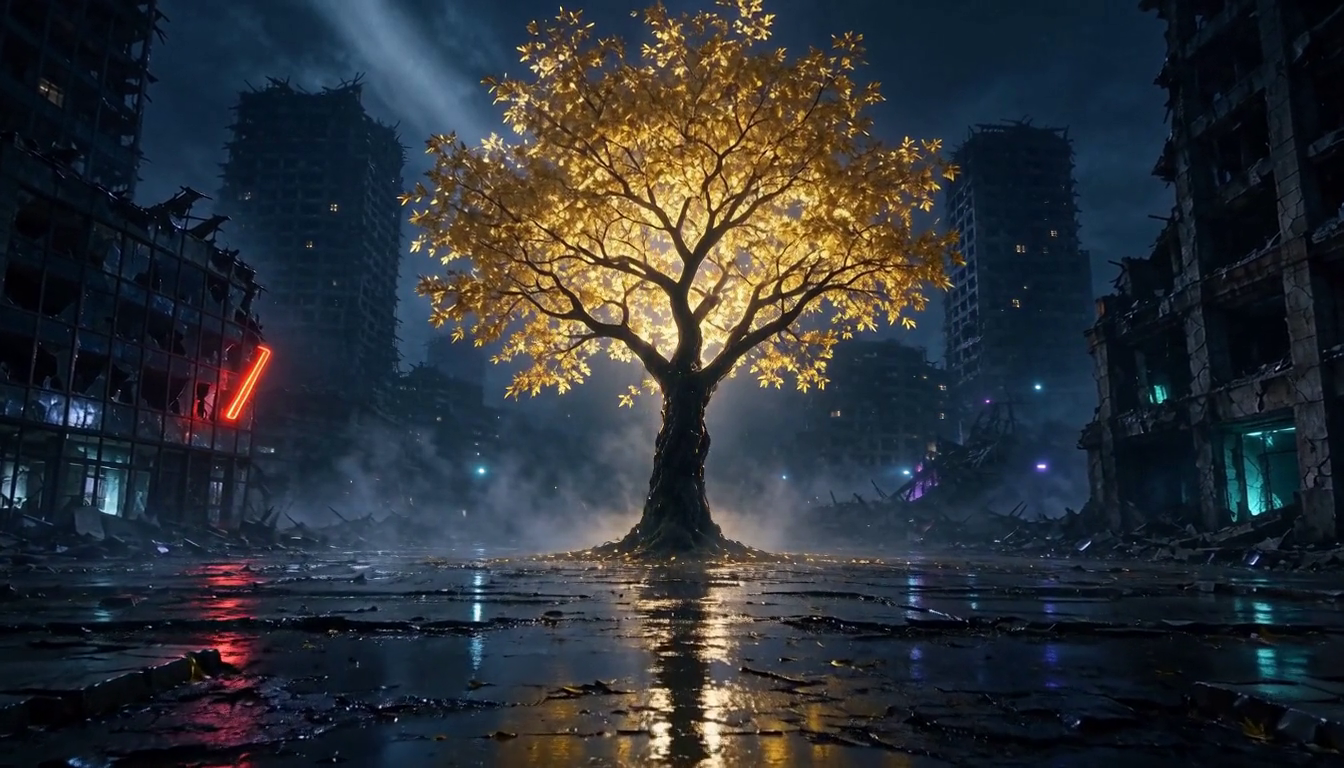
A later frame (about 3.6 seconds) from a 5-second 768P MiniMax H3 image-to-video run on 10 Nov 2026, Asia/Shanghai (model minimax/h3/image-to-video, run 9c1085bd-2d87-4a07-bf90-268e4ecf4e37, about $0.30). The first frame was the Seedream 5.0 Flash still above. This is H3 image-to-video output, not an H3 Image still.
Step 3: skip the still, or extend the clip
Text-to-video, 5 seconds, 768P, $0.30 on the same table. No image field. Aspect ratio is back, because this card has one.
curl -sS https://api.sandbase.ai/v1/run \
  -H "Authorization: Bearer $SANDBASE_API_KEY" \
  -H "Content-Type: application/json" \
  -d '{
    "model": "minimax/h3/text-to-video",
    "prompt": "A slow push-in on a cliffside observatory at dusk, layered fog, readable scale, soft practical lights in the windows, native stereo wind and distant machinery.",
    "duration": 5,
    "resolution": "768P",
    "aspect_ratio": "16:9"
  }'
If the 5-second shot is right and you need more footage, H3 Max Turbo video extend continues a clip. The card’s fields: required video URL, duration of new footage from 1 to 15 seconds (default 5), resolution 480P, 768P, 1080P, or 2K (default 768P), output of extended (source plus new footage) or continuation (new footage only). New seconds are $0.04 at 768P, so 5 new seconds at 768P are $0.20. At 2K the rate is $0.16 per second, so 5 seconds are $0.80. Prompt cap on this card is 50,000 characters, which is not the 7,000-character cap on flagship image-to-video. Describe what happens next.
curl -sS https://api.sandbase.ai/v1/run \
  -H "Authorization: Bearer $SANDBASE_API_KEY" \
  -H "Content-Type: application/json" \
  -d '{
    "model": "minimax/h3-max-turbo/video-extend",
    "prompt": "Continue the crane up. The wind keeps moving the canopy. No new buildings, no cut.",
    "video": "https://example.com/shot.mp4",
    "duration": 5,
    "resolution": "768P",
    "output": "continuation"
  }'
https://example.com/shot.mp4 is the same kind of placeholder. Use the URL from the completed image-to-video run.
When 2K is optional, H3 Max Turbo image-to-video is the lower default: $0.20 for 5 seconds at 768P. It is still video. It is still not H3 Image.
When the image card shows up
Keep the video request. Change the still. The day the MiniMax catalog lists an H3 Image card, read its ID, its price, and its reference cap from that page, rerun step 1 with that ID, and pass the new URL into the same image-to-video body. Do not guess the string in the meantime. Do not point step 1 at minimax/h3/image-to-video and call the result an H3 Image test.
Hailuo Early Access, if your account has it, is a separate place to try the still model. Sixteen reference images and an edit tag are app config, documented in the release note. They are not parameters on the curls above.
FAQ
Can I put minimax/h3-image in the model field?
Not on 10 November 2026. Those paths 404. The model field that animates a still is minimax/h3/image-to-video.
Why is my 5-second quote $0.65 when I expected $0.30?
The card defaults resolution to 2K, at $0.13 per second. Five times $0.13 is $0.65. Set "resolution": "768P" for the $0.30 cell. The August post’s range is not this table.
Can I send 16 reference images the way Hailuo’s config says?
On SandBase reference-to-video, the card says up to 9 images. The 16-image number is Hailuo’s H3 Image web-app config, a different product, and not an Open Platform spec we can call here.
Does the example.com URL work?
No. Replace it. The article uses it so nobody mistakes a made-up hosted sample for an H3 Image output.
What do I open first?
Image-to-video if you have a frame. Text-to-video if you do not. Max Turbo image-to-video if the brief can leave 2K and the $0.20 default is enough.
Related reading
- H3 Image early access, confirmed versus unknown.
- Routing stills while H3 Image and Seedream 5.5 are unlisted.
- H3 video at launch, with the price caveat above.
The handoff
Sign in, make the still, animate it, and file the clip under the video model ID. We will document the image card when it is listed. Until then, watch the MiniMax catalog, and do not poll a path you invented.