Kimi K3.1 Pro Launch: Price Cut, Nov 4 Open Weights and the Cyber Filter
Kimi K3.1 Pro launched Oct 23, 2026 at $2/$10 per MTok with open weights due by Nov 4. What Moonshot confirmed, what its cyber-data filter does, and what reasoning effort costs in a real test.
The Kimi K3.1 Pro announcement has two numbers that matter to a builder, and neither is a benchmark. The first is $2 / $10: Moonshot’s API price per million input and output tokens, one-third lower than Kimi K3 on input, cached input and output. The second is November 4, the date Moonshot gave for releasing the full weights. Everything else in the launch, including a cyber-capability filter that Reuters led its coverage with, sits between those two numbers.
This piece is for developers deciding whether to move an agent or coding workload from Kimi K3, or from a closed model, to Kimi K3.1 Pro. It separates what Moonshot published on October 23, 2026 from what third parties reported, and adds one small test of the reasoning_effort setting, because that setting can move the bill more than the price cut does.
Key takeaway
- Moonshot released Kimi K3.1 Pro and K3.1 Pro Highspeed on Oct 23, 2026 (Oct 24 in China) on Kimi.ai, Kimi Work, Kimi Code and the Kimi API. Full weights are promised “by Nov 4”; as of Oct 25 they are not downloadable.
- API list price: $2 input, $0.20 cached input, $10 output per million tokens, flat across the 1M-token window. Highspeed doubles regular input, output and cache-write rates but keeps cached input at $0.20.
- Moonshot says it removed cyber-related data from mid-training and RL for the open-weight release. Its own unpublished exploit test dropped from 90.5% to 81.0% (pass@3). Nobody outside Moonshot can rerun that test yet.
- The model always reasons and defaults to
maxeffort. In our two-prompt test through SandBase,maxused 2.9× the output tokens oflowon a log-triage task and reached the same diagnosis.- Action now: test on the API, set effort explicitly, and wait for the weights and an independent eval before planning a self-hosted deployment.
What Moonshot announced, and when
The launch post on kimi.ai calls K3.1 Pro “the first model in our new K3.1 series” and Moonshot’s most capable 3T-class open-weight model. Architecturally it is not new. Moonshot describes it as a post-trained Kimi K3 with much more post-training compute, spread across RL environments in “hundreds of downstream domains”.
| Date (2026) | Event | Source |
|---|---|---|
| Oct 23 | K3.1 Pro and K3.1 Pro Highspeed go live on Kimi.ai, apps, Kimi Work, Kimi Code and the API | Kimi blog |
| Oct 24 | Reuters reports the cyber-data removal and the Nov 4 weights date | Reuters via Yahoo |
| Oct 24 | Moonshot’s pricing page lists API and membership prices, “rates checked on October 24” | Kimi pricing |
| By Nov 4 | Full model weights promised | Kimi blog |
Two availability details are easy to miss. Kimi Enterprise admins have to switch the model on, because access is off by default. And Zero Data Retention is offered to API customers, which matters if you were holding back for data-handling reasons.
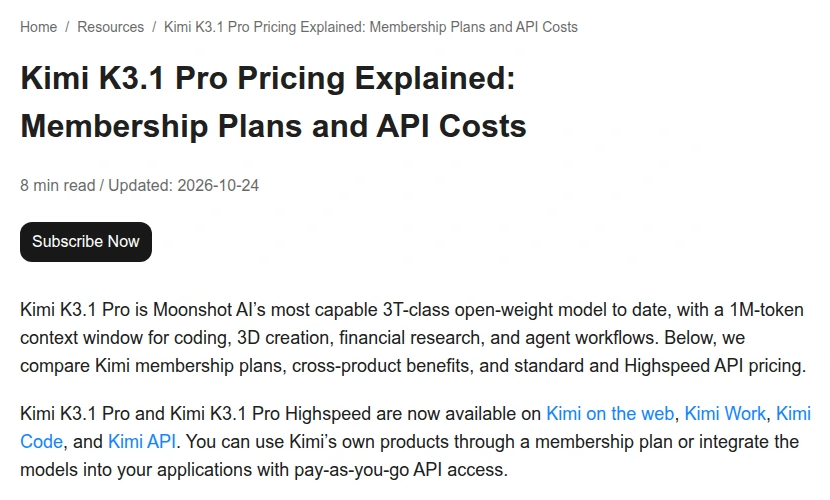 Moonshot’s pricing page, captured 2026-10-25. It is dated October 24 and names both models and all four channels. The API rate table further down the page is the source for the prices below.
Confirmed, claimed, and not yet checkable
Most launch coverage repeated Moonshot’s benchmark chart. That chart mixes Moonshot’s own runs with scores copied from other labs’ reports, and it runs K3.1 Pro inside the Claude Code harness for most coding tests. Treat it as the vendor’s case, not as a neutral leaderboard.
| Claim | Status on Oct 25 | Where it comes from |
|---|---|---|
| Released Oct 23, 1M-token context | Confirmed by Moonshot | Kimi blog |
| Highspeed runs 2–3× faster | Vendor-reported, not measured by us | Kimi blog |
| $2 / $10 API price, $0.20 cached input | Confirmed by Moonshot | Kimi pricing page |
| Terminal-Bench 4.0: 65.7% vs Opus 5.5 66.4% and GPT-6 Astra 58.2% | Vendor-reported | Kimi blog footnotes (Claude Code harness; rival scores are the higher of each lab’s own report or the official leaderboard) |
| BenchCAD 92.7% with tools vs Opus 5.5 96.2% | Vendor-reported | Kimi blog |
| Claim-level hallucination rate on Kimi Hallu Bench Hard down from 23.4% (K3) to 8.3% | Vendor-reported, internal stress test; Moonshot says it is not a daily-use error rate | Kimi blog. The API quickstart reports 6.85% on a different set, per The Implicator |
| Cyber filter cut xdev-bench-hard from 90.5% to 81.0% | Vendor-reported, benchmark not public | Kimi blog, Reuters (“not independently verified”) |
| 2.8T total / 104B active parameters (MoE) | Stated by Moonshot on X, not in the tech blog | Kimi’s launch post on X, as quoted by Gigazine |
| Open weights and license terms | Not yet available | Promised by Nov 4 |
One gap stands out. In Moonshot’s own chart, as read by The Implicator, K3.1 Pro scores 38.1 on Terminal-Bench Science against 68.1 for GPT-6 Astra and 63.3 for Opus 5.5. The model is close to the closed leaders on everyday terminal coding and well behind them on scientific terminal work. If your agent does the second kind of task, the headline coding score doesn’t describe it.
Several outlets also cite an Artificial Analysis Intelligence Index score for K3.1 Pro. The Artificial Analysis snapshot we use (v4.3, fetched 2026-10-19) predates the launch, so I’m not quoting a number here. We’ll add it once a dated snapshot includes the model.
The cyber filter is the real story
This is the part that made Kimi K3.1 Pro a hot topic beyond the model-release crowd. Moonshot says that as post-training scaled, vulnerability-research ability kept rising, and it traced that to cyber content buried in the general mid-training corpus and to cyber tasks in the RL mix. For the open-weight release it removed both and kept general coding tasks.
Then it measured the effect on xdev-bench-hard, an in-house set of exploit tasks built from real disclosed bugs in software such as the Linux kernel, Node.js and Exim. The unfiltered checkpoint solved 90.5% at pass@3. The released model solved 81.0%. Moonshot’s stated principle is that it aims “not to release open weights that would extend the absolute frontier of cyber capability”, and it says K3.1 Pro stays behind closed models that have been public for at least three months.
Three caveats before you take that at face value:
- The test isn’t public. Nobody outside Moonshot can rerun xdev-bench-hard, so 81.0% can’t be compared with anything except Moonshot’s own chart. In that chart, per The Implicator, DeepSeek V4.1 Flash scores 85.7%.
- 81% is still a lot. The Implicator notes that Kimi K3 scored 33.3% on the same test. Filtered K3.1 Pro is far more capable at exploitation than its predecessor. The filter slowed the increase but didn’t stop it.
- Weights can’t be recalled. Moonshot’s blog doesn’t address whether fine-tuning could restore the removed capability. Reuters makes the structural point: once weights spread, the developer has less ability to restrict access, monitor use or update safeguards.
The timing explains the attention. Two days before the launch, PHP shipped emergency fixes for two decade-old flaws that researchers had turned into working exploits with frontier models. We cover that in PHP2Shell: what AI-found bugs mean for builders. A lab promising to publish 3T-class weights that week had to say something about cyber capability, and Moonshot did. The useful takeaway for builders is narrower than the safety debate. If you plan to self-host after Nov 4, your security review should treat the model’s exploit ability as substantial, not removed.
Pricing: what actually changes on the bill
The pricing page lists flat per-token rates across the full 1,048,576-token window, with no long-context surcharge.
| Model | Input | Cached input | 5-min cache write | 1-h cache write | Output |
|---|---|---|---|---|---|
| kimi-k3.1-pro | $2.00 | $0.20 | $2.00 | $4.00 | $10.00 |
| kimi-k3.1-pro-highspeed | $4.00 | $0.20 | $4.00 | $8.00 | $20.00 |
| Kimi K3 (for comparison) | $3.00 | $0.30 | — | — | $15.00 |
USD per million tokens, from Moonshot’s pricing page, rates checked by Moonshot on 2026-10-24.
The cached-input rate is where agent workloads win or lose. Here’s a call shape typical of a coding agent with a large repo prefix: 180,000 input tokens, of which 150,000 hit the cache, plus 6,000 output tokens. Assume the prefix is already warm, so there are no new cache writes.
| Per 1,000 calls | Uncached input | Cached input | Output | Total |
|---|---|---|---|---|
| K3.1 Pro, cache hit | $60 | $30 | $60 | $150 |
| K3.1 Pro, no cache | $360 | — | $60 | $420 |
| K3.1 Pro Highspeed, cache hit | $120 | $30 | $120 | $270 |
| Kimi K3, cache hit | $90 | $45 | $90 | $225 |
The Highspeed row is the one to check before you upgrade by reflex. Because cached input doesn’t double, a cache-heavy agent pays 1.8× rather than 2× for Highspeed. That is still a large premium for a 2–3× speed claim we haven’t measured.
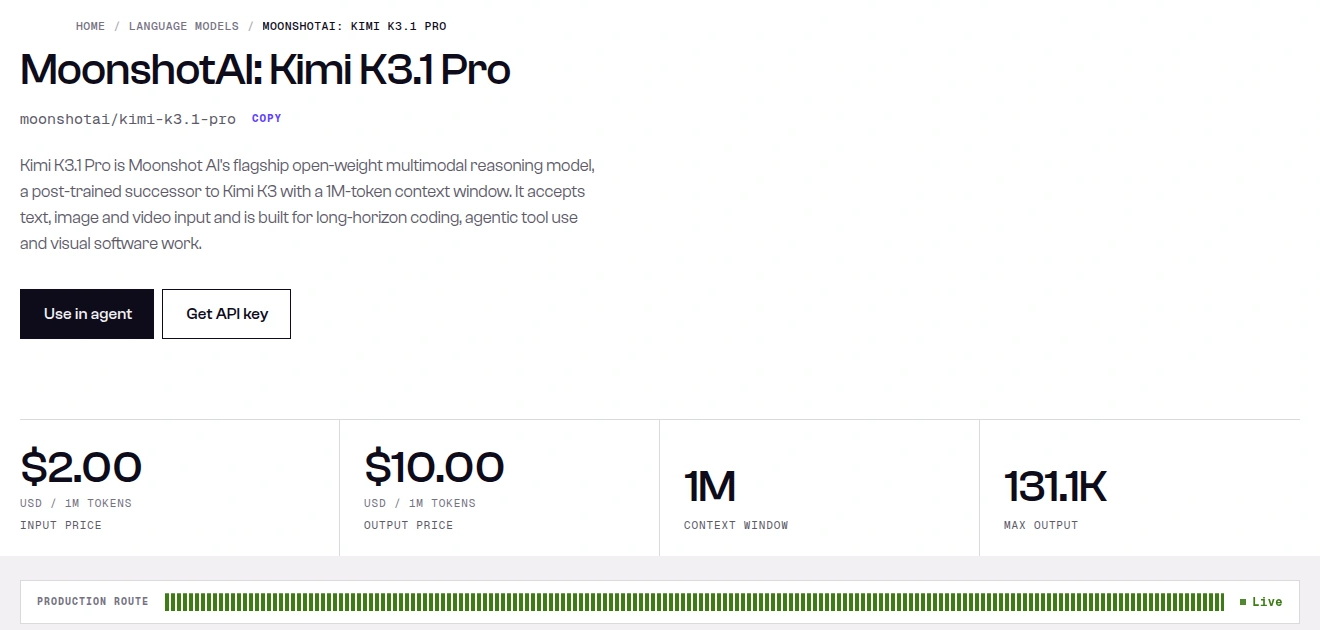 The SandBase catalog on 2026-10-25:
moonshotai/kimi-k3.1-pro is listed at Moonshot’s $2 / $10 list rates, with a 1M context and a 131.1K output cap. The Highspeed variant was not listed on SandBase that day.
Reasoning effort: the setting that moves the bill
Moonshot’s pricing page says K3.1 Pro “always reasons”, with reasoning_effort set to low, high or max, and max as the default. The Implicator, citing launch-day independent measurements, describes the model as output-heavy. That fits a max default, but those reports don’t show how much effort contributes.
So I ran a small check. I sent two prompts through the Kimi K3.1 Pro route on SandBase on 2026-10-25, once at each effort level. The first was a log-triage question: a SQLAlchemy pool-exhaustion log with a 120-word answer limit. The second was the cache-cost arithmetic from the table above.
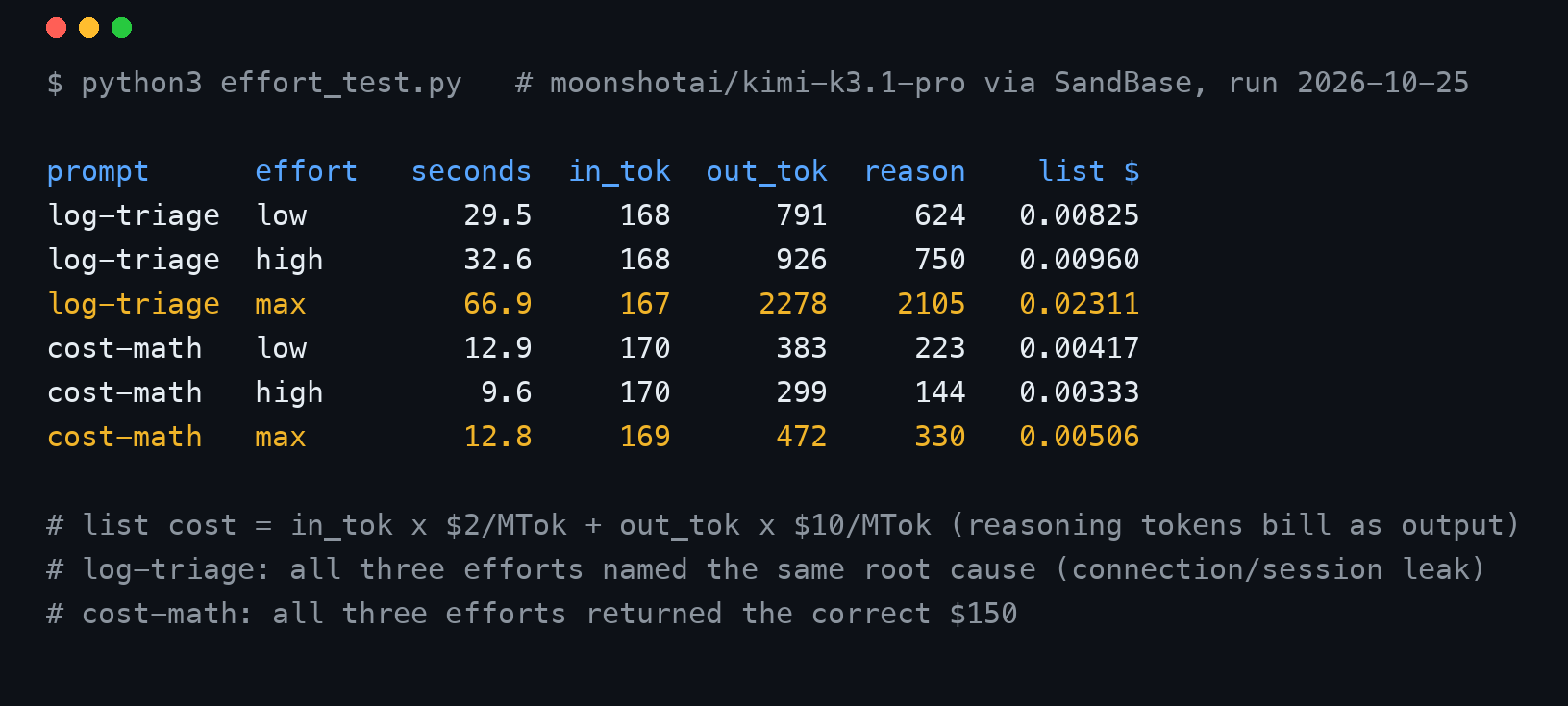 Our test through SandBase on 2026-10-25, one run per cell. Costs are list price from the API’s reported token usage. Reasoning tokens are billed as output.
What it shows, and only for these two prompts:
- On log triage,
maxtook 2.3× as long aslow(66.9 s vs 29.5 s) and produced 2.9× the output tokens (2,278 vs 791). All three settings named the same root cause, a connection or session leak. Themaxanswer was a little more careful about streaming responses and background tasks. Thelowanswer was already usable. - On the arithmetic, all three settings returned the correct $150, and the token spread was small (299–472).
That’s two prompts with one sample each, so it isn’t a benchmark. It still points to a practical rule. If you call K3.1 Pro from an agent loop and don’t set reasoning_effort, you’re paying for max on every step, including the steps that don’t need it. Set low or high for routing, extraction and simple tool calls, and reserve max for the planning or debugging step where depth matters.
What builders can do now
- Test through the API before the weights arrive. Moonshot presents the hosted model as K3.1 Pro. If it doesn’t beat your current model on your own tasks, the downloadable weights are unlikely to change that.
- Pin effort per step. Pass
reasoning_effortexplicitly and logcompletion_tokens_details.reasoning_tokens. That one field explains most surprise bills. - Keep your prefix stable. Cache hits are a tenth of the input price. Moonshot warns that changes early in a prefix break reuse after that point, so put volatile content such as timestamps and per-turn tool results at the end.
- Don’t plan a self-hosted rollout around Nov 4 yet. The license, file sizes and serving requirements aren’t published. A promised date isn’t a shipped artifact.
- If you’re on Kimi K3, the switch is a model-ID change at a lower price. Compare against our earlier Kimi K3 introduction to see what you’d be leaving behind, then run your own regression set before changing defaults.
FAQ
When was Kimi K3.1 Pro released? October 23, 2026, or October 24 in China. Moonshot launched it on Kimi.ai, the Kimi apps, Kimi Work, Kimi Code and the Kimi API on the same day.
Is Kimi K3.1 Pro open source? Moonshot calls it open-weight and promises the full weights by November 4, 2026. As of October 25 they aren’t downloadable, and the license hasn’t been published.
How much does the Kimi K3.1 Pro API cost? $2 per million input tokens, $0.20 per million cached input tokens and $10 per million output tokens. Highspeed is $4 / $0.20 / $20. There’s no long-context surcharge.
Did Moonshot really reduce Kimi K3.1 Pro’s hacking ability? Moonshot says removing cyber data cut its internal exploit-test score from 90.5% to 81.0%. The test isn’t public and the result hasn’t been independently verified. The model is still much stronger at these tasks than Kimi K3.
What is the difference between Kimi K3.1 Pro and Highspeed? Moonshot says Highspeed runs 2–3× faster. It costs twice as much for regular input, output and cache writes, and the same for cached input.
Bottom line
Kimi K3.1 Pro is a cheaper, stronger Kimi K3 with a credible coding story and a weak spot in scientific terminal work. Its cyber filter is a real experiment, but it can’t be audited yet. For now it’s a hosted model worth testing, and in a few days it may become a set of weights worth reviewing. Try it on the SandBase model page with reasoning_effort set on purpose, and revisit the self-hosting question when the Nov 4 files and license actually appear.
Sources checked 2026-10-25: Kimi K3.1 Pro tech blog, Kimi K3.1 Pro pricing, Reuters via Yahoo, The Implicator, Gigazine. The effort test is our own run through SandBase on the same date.