Tencent Hunyuan Hy4 preview: a 770B model built for real productivity work
What Tencent's Hy4 preview announcement says about long-horizon coding, office analysis, game development, science workflows, and API access.
Editorial status: Draft based on Tencent’s official Hy4 preview announcement, retrieved August 29, 2026. Vendor-reported scores and scientific results are attributed, not presented as independent benchmarks.
The interesting part is not 770B
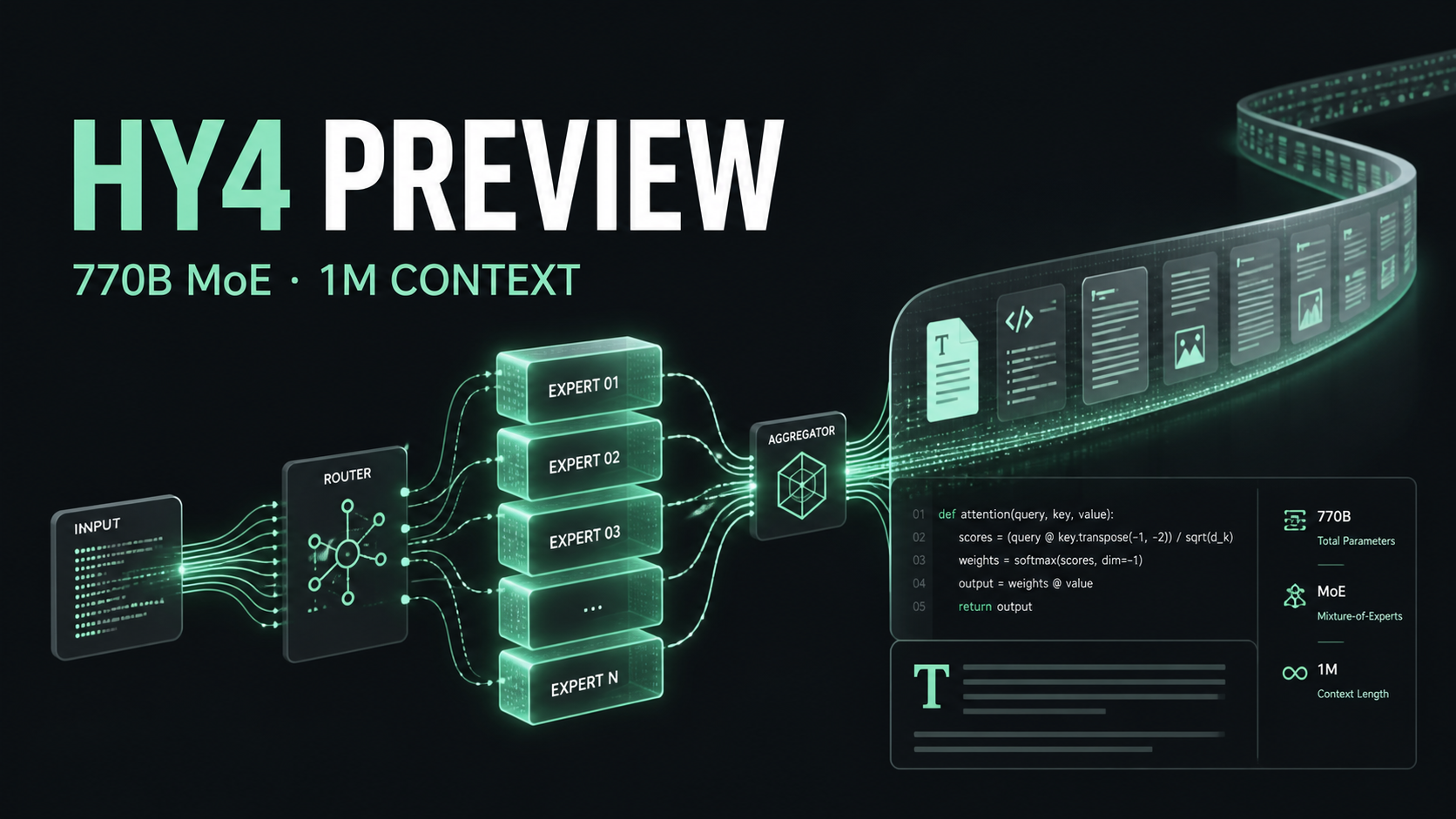
Tencent Hunyuan’s Hy4 preview arrives with the numbers that make a model launch easy to summarize: 770B total parameters, 49B active parameters, and a context window exceeding 1M tokens. The more useful question is narrower: can a model with that scale finish a real piece of work across several tools and files?
Tencent says Hy4 preview was built for productivity rather than a single benchmark. Its training data was co-developed with internal specialists in software engineering, games, finance, and security, and the model was co-designed with CodeBuddy and WorkBuddy. That positioning is a claim from Tencent; the article will test it against reproducible workflows before making a broader judgment.
Key takeaway
- Hy4 preview is an early open-weight preview, not a finished production guarantee.
- Its strongest advertised surfaces are software engineering, office analysis, games, and science.
- Tencent’s 2.99/4.00 internal blind test is directional evidence, not an independent leaderboard.
- Start with one bounded, replayable task before adding tools, long context, or self-hosted capacity.
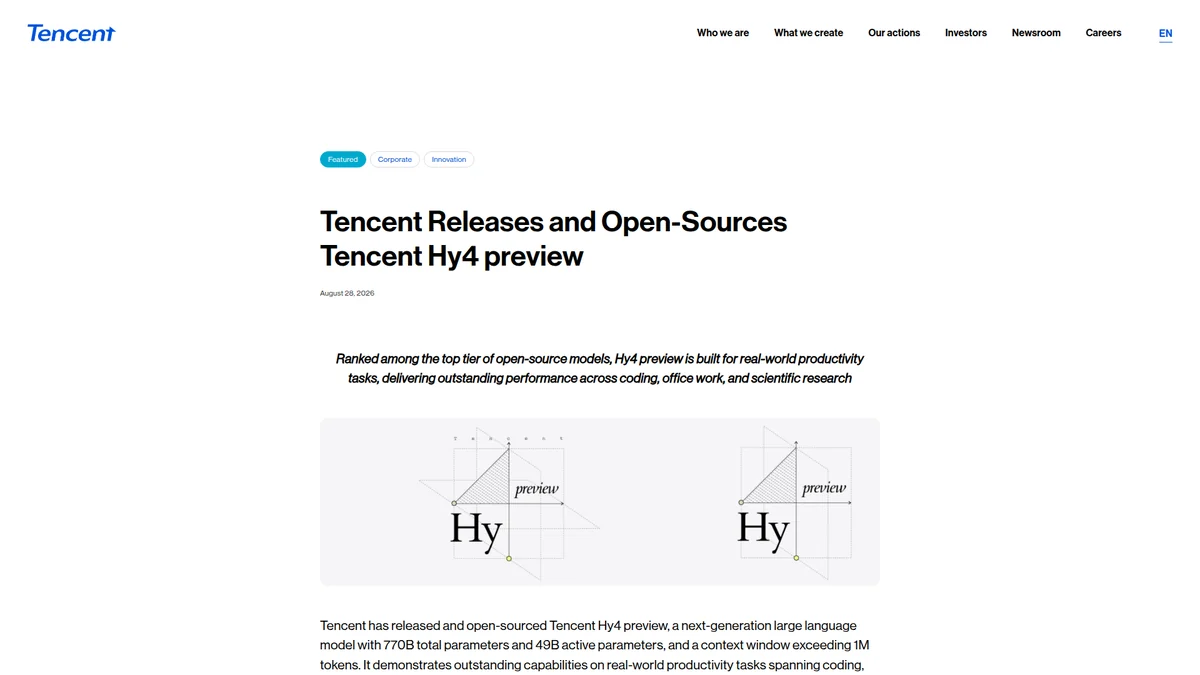
Figure 1. Tencent’s announcement is the primary source for the 770B total-parameter, 49B-active, and 1M-context claims; the image supports the release facts, not an independent performance result.
Four surfaces Tencent wants developers to try
For software engineering, Tencent describes better planning, debugging, and verification on long-running tasks, with improved visual taste and interaction quality in frontend work. The practical test is not “generate a landing page.” It is whether the model can keep a coherent plan while editing multiple files, running checks, and repairing a failed build.
For office analysis, Tencent highlights cross-file collaboration, financial analysis, and delivery of documents, spreadsheets, and presentations. One supplied example asks the model to inspect 72 files, identify the currently effective rules in three policy documents, and decide whether expense invoices comply. That is a useful evaluation because it exposes retrieval mistakes and citation gaps, not just writing quality.
For game development, the announcement shows Hy4 preview connecting to Unreal Engine 5 through MCP to build a shooter prototype, and using Unity to create a third-person penguin adventure. These demos are evidence that the model can operate a tool chain in a constrained setup. They are not proof that every generated game is production-ready.
For science, Tencent reports work spanning AI research, molecular dynamics, quantum transport, and geometry. The announcement cites a 2.0× speed-up for a 32,512-atom molecular-dynamics system, a reduction in simulated high-energy leakage from 48.2% to 4.8%, and a progress result on the 3D Blaschke–Lebesgue problem. These are important leads for independent review; they need the accompanying code, parameters, and expert validation before they become general scientific conclusions.
What the internal blind test does—and does not—tell us
Tencent says 163 internal experts evaluated 203 engineering tasks. Hy4 preview averaged 2.99/4.00, compared with 2.92 for GLM-5.3 and 2.94 for Kimi K3. This suggests a meaningful internal preference for Hy4 preview in that task set. It does not establish a universal ranking: we do not know whether the prompts, tools, sampling, or evaluation rubric match public benchmarks.
The same caution applies to Tencent’s report of a 31.8% end-to-end throughput improvement after Hy4 preview analyzed bottlenecks and iterated on operator fusion and communication optimization. It is a promising systems result, not evidence that the model can autonomously optimize any inference stack without supervision.
Access, cost, and a sensible first run
Tencent lists Hy4 preview on TokenHub and OpenRouter, and inside WorkBuddy, CodeBuddy, Yuanbao, and ima. The published prices are ¥6 per million input tokens, ¥18 per million output tokens, and ¥0.3 per million cached input tokens. WorkBuddy and CodeBuddy are offering a two-week limited free trial.
My suggested first run is deliberately small: give the model one bounded repository task, one cross-file office task, and one tool-mediated prototype. Record the prompt, model version, tool calls, wall time, token usage, failed attempts, and the final artifact. A gateway such as SandBase can keep provider keys server-side and make the same workload easier to replay across models; availability of Hy4 preview in the SandBase catalog should be verified before claiming direct integration.
Preview means preview
Tencent explicitly calls Hy4 preview an early version and lists long-task overthinking and excessive self-verification as known issues. That changes the recommendation. Teams that need a cheap, broad experiment should try it now through the published access points. Teams that need stable latency, fixed behavior, or independently audited scientific performance should treat the release as an evaluation candidate and wait for more evidence.
Bottom line: Hy4 preview is notable because Tencent is connecting a large open model to the messy interfaces of real work—codebases, office files, engines, and research environments. The launch is worth testing, but the right unit of measurement is a successful, reviewable workflow, not the parameter count alone.
A practical evaluation protocol
The cleanest way to evaluate Hy4 preview is to freeze the task before opening the model. Write down the repository commit, input files, acceptance criteria, allowed tools, time budget, and what counts as a successful result. Then run the same task with a second model. Without that control, a better-looking demo can simply reflect a more forgiving prompt.
For coding, I would use three tasks: a bug that requires tracing across files, a feature that needs a migration and tests, and a frontend change judged from a screenshot as well as a test suite. Record every tool call and every rollback. A model that writes fewer tokens but needs repeated human repair may not be cheaper in practice.
For office analysis, keep the source documents immutable and ask for a table of decisions with citations to filenames and page numbers. Measure false approvals, false rejections, missing evidence, and time to review. Hy4 preview’s 1M context may reduce manual chunking, but a larger window does not automatically make an answer faithful to the source.
For game or browser work, separate the visual result from the engineering result. Check whether the prototype launches from a clean environment, whether assets are licensed, whether interactions work on a second device, and whether the model can recover from a failed build. The impressive part of a demo is often the first pass; the expensive part is the repair loop.
API and self-hosting decisions
The published access routes make Hy4 preview easy to sample. A hosted API is the sensible first step when the goal is to learn model behavior, control spend, or compare it with another provider. Keep the provider key on the server, attach a request ID to every run, and log latency, token counts, retries, and the final status.
Self-hosting is a different decision. A 770B MoE model still has a substantial memory and networking footprint even when only 49B parameters are active per token. Teams need to estimate weight storage, quantization quality, KV-cache growth at long context, interconnect bandwidth, and the operational cost of upgrades. “Open source” changes who can run the model; it does not make inference free.
This is where a provider gateway can help. SandBase can be used as a server-side routing and observability layer when the model is present in its catalog, allowing the same evaluation harness to compare providers and retain usage records. That availability must be checked against the live catalog and API response; it should never be inferred from a blog announcement.
What I would watch in the next release
First, I would look for a public evaluation harness around the productivity claims. The internal blind test is useful directional evidence, but a reproducible task set with prompts, tools, scoring rules, and failure examples would make the result easier to interpret.
Second, I would watch long-context quality rather than window size. The important metrics are retrieval precision, citation completeness, and degradation as irrelevant material accumulates. A 1M-token window is valuable only when the model can find the right evidence without inventing connections.
Third, I would watch the trade-off between self-verification and completion time. Tencent already flags excessive self-verification as a known issue. A future release should show whether it can recognize when another check is useful and when it is merely repeating the same loop.
Frequently asked questions
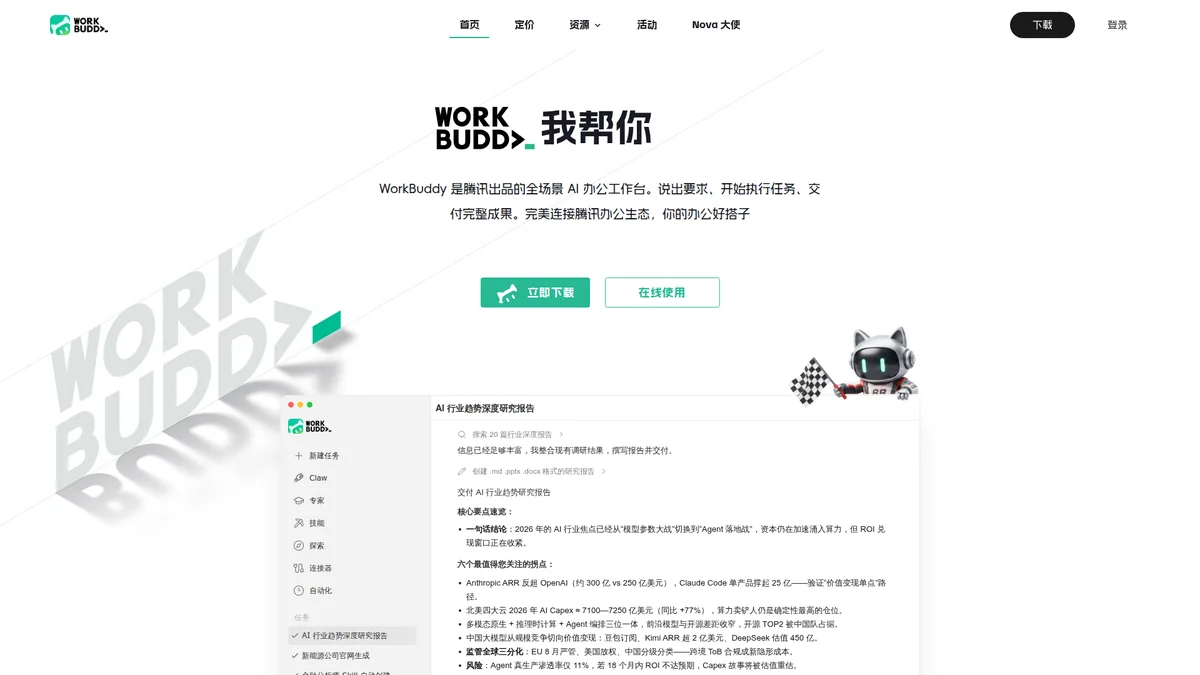
Figure 3. WorkBuddy is an official product entry point for a first bounded trial; availability and limits should still be checked in the product at the time of testing.
Is Hy4 preview open source?
Tencent says the weights are open and links to Hugging Face, GitHub, ModelScope, and GitCode. Check the repository license and hardware instructions before planning a deployment; access to weights is not the same as a turnkey production stack.
Is the 2.99/4.00 score an independent benchmark?
No. It is a Tencent-reported internal blind test involving 163 experts and 203 engineering tasks. It is useful context, but it is not a public, independently reproduced leaderboard result.
Should I use Hy4 preview for financial or scientific decisions?
Use it as an assistant with human review, citations, and a recorded audit trail. The announcement’s financial and scientific examples are promising demonstrations, not a substitute for domain expertise or independent validation.
Where should I start?
Start with one bounded task in WorkBuddy, CodeBuddy, TokenHub, or OpenRouter. Save the prompt and output, repeat it with a control model, and compare successful workflow cost. Only then decide whether a longer context window or self-hosted deployment changes the economics.
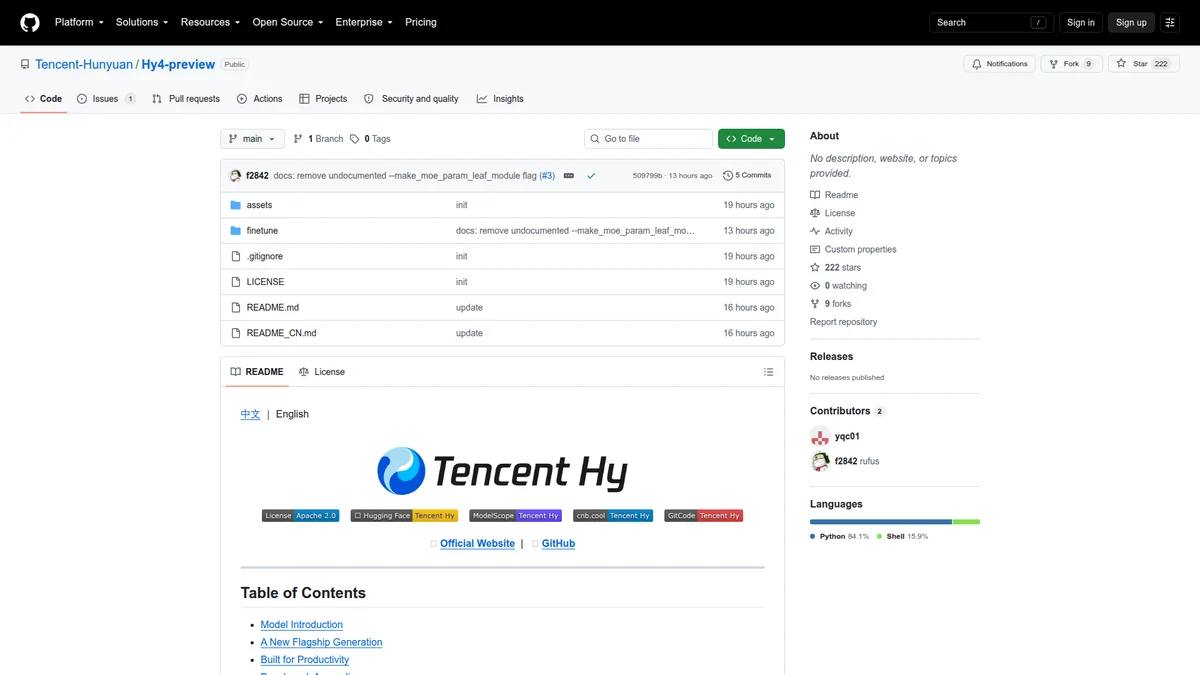
Figure 2. The repository is the right place to verify release files, runtime instructions, and license details before treating “open weights” as a deployment plan.