F5 AI Gateway: Why Agent Traffic Needs More Than Model Routing
F5 expanded AI Gateway across models, agents, and tools. The useful architecture lesson is separating routing, policy, tool authority, and evidence.
F5 AI Gateway: Why Agent Traffic Needs More Than Model Routing
A model gateway can choose a provider and count tokens. An agent gateway must also answer whether a tool call is allowed, which identity owns it, and how to stop a workflow after the model response has already triggered external work. F5’s August 18 AI Gateway update puts that distinction into the enterprise market.
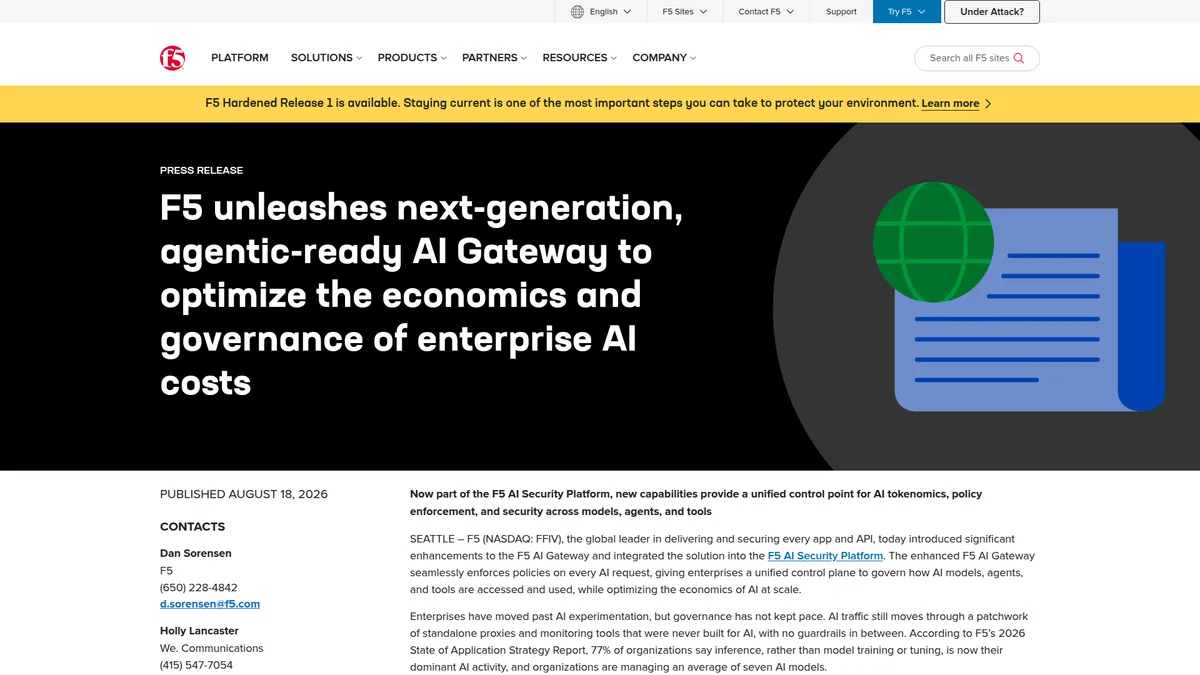
F5 emphasizes cost and governance across models, agents, and tools; buyers should verify how far enforcement reaches downstream.
TL;DR
- F5 positions its enhanced gateway as one policy point across models, agents, and tools.
- Cost routing and security policy need shared context but different enforcement.
- Prompt inspection cannot replace scoped credentials, tool authorization, and sandbox policy.
- Store decisions and downstream outcomes, not only model requests.
F5’s announcement emphasizes token economics, policy enforcement, and security. The architecture question is what a gateway can genuinely control.
| Plane | Decision | Enforcement point |
|---|---|---|
| Routing | Which model, region, and budget | API proxy |
| Content | What data may enter/leave | Request/response policy |
| Tool authority | Which action on which resource | Tool broker and scoped token |
| Execution | Filesystem, process, and network access | Sandbox/runtime |
| Evidence | What happened and who approved it | Append-only trace and audit store |
A proxy that sees prompts but not tool execution has only partial control. Likewise, a sandbox can contain a process but cannot know whether a CRM update was authorized for this user.
The practical pattern is to propagate a task identity and policy envelope from gateway to tool broker and runtime. Each event carries tenant, user, purpose, budget, allowed destinations, and approval state. Reject missing context rather than silently falling back to a broad service account.
Cost policy also needs outcome awareness. A cheap model that retries a browser task six times may cost more than an expensive model that completes once. Track cost per verified outcome, not only cost per token.
What changed when models became agents
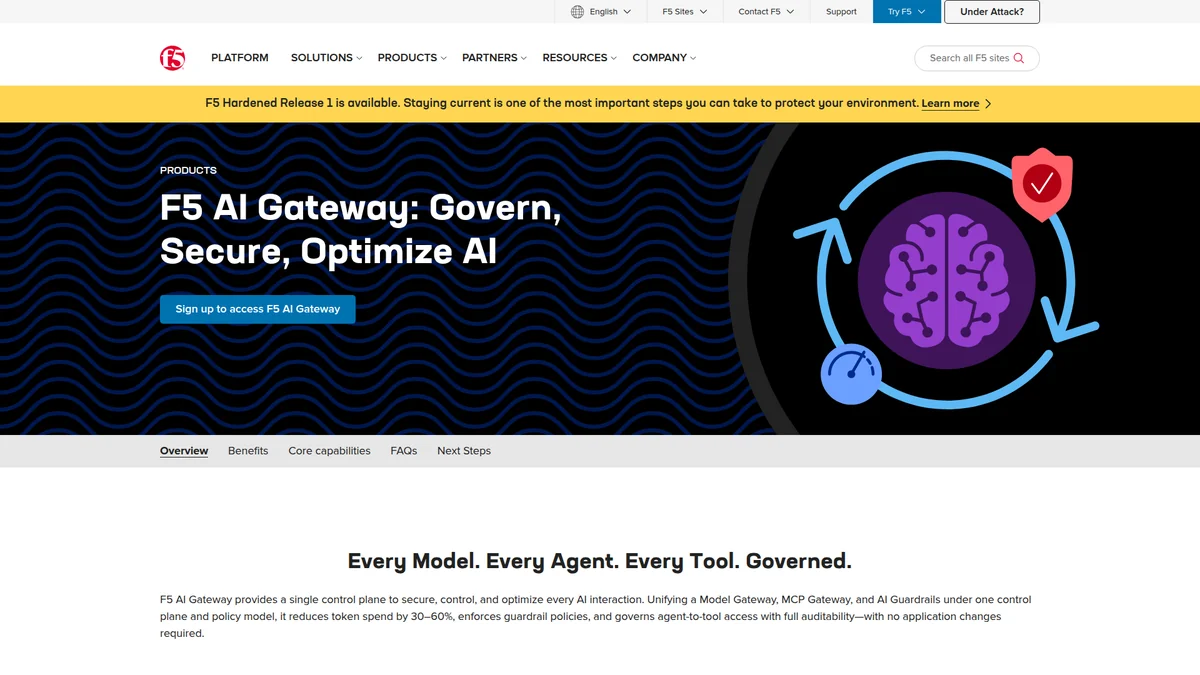
The product page makes F5’s claimed control-plane scope concrete; an evaluation must still test each enforcement boundary.
Traditional API gateways assume a relatively short transaction: authenticate a caller, apply rate limits, forward a request, and return a response. Agent work stretches that transaction across minutes or hours. One model response may initiate searches, code execution, browser sessions, file writes, and calls to systems that use different identities. The gateway sees the beginning, but the important side effects happen downstream.
That changes the unit of governance. A request ID is not enough; the platform needs a task identity that survives model changes, retries, subagents, and asynchronous tools. The policy envelope should be immutable for the task unless an authorized approval explicitly expands it. At minimum it should carry tenant, initiating user, declared purpose, data classification, allowed models, tool scopes, destination constraints, cost ceiling, expiry, and approval references.
This context must be verified at every trust boundary. Do not simply copy headers supplied by an agent process. Sign the envelope or exchange it for short-lived capability tokens at the tool broker. A database tool can then enforce “read these tables for incident 4821 until 14:30,” instead of accepting a general production credential because the upstream model gateway already authenticated someone.
The control planes should cooperate without collapsing
Routing, data protection, tool authorization, runtime containment, and audit have different failure modes. Combining their dashboards can help operations, but combining their enforcement into one giant proxy creates brittle policy and an attractive bypass target.
- The model gateway knows provider availability, model capability, token price, regional constraints, and prompt/response classification.
- The tool broker knows action schemas, resource ownership, credential scope, and idempotency.
- The runtime knows filesystem mounts, processes, network egress, CPU, memory, and execution time.
- The approval service knows who approved which concrete action and whether that approval is still valid.
- The evidence store correlates decisions and outcomes without becoming another source of ambient secrets.
The shared contract is the task identity and a consistent event format. Each service should make its own deny decision locally. If the policy service is unavailable, a sensitive tool should fail closed rather than fall back to its widest service account.
Cost routing needs quality and risk constraints
“Send easy prompts to a cheap model” sounds sensible until the router cannot recognize easy work. Agent cost includes model calls, tool compute, retries, human review, and the cost of a wrong side effect. Optimize the full transaction:
cost per verified outcome =
  model + tools + retries + review + expected failure loss
The last term is workload-specific. A failed document summary can be retried cheaply; an incorrect permission change cannot. Define routing classes before adding an adaptive optimizer. A low-risk extraction job may switch providers automatically. A production remediation task may require a validated model family, fixed region, stronger evaluation, and an explicit escalation path.
Record why the router selected a model and which fallbacks it attempted. Hidden provider failover can change data residency, tool-calling behavior, context limits, and output consistency. Fallback is a policy decision, not merely an availability feature.
Questions to ask F5—or any gateway vendor
The announcement establishes direction, not proof that every control is equally deep. A useful evaluation should follow a real agent transaction and ask:
| Question | Evidence to request |
|---|---|
| Does policy survive beyond the model call? | Trace showing the same task identity at a downstream tool |
| Can tools receive scoped credentials? | Per-action token or capability policy, not a shared secret |
| How are retries deduplicated? | Idempotency behavior and replay test |
| What happens during policy-service failure? | Documented fail-open/fail-closed behavior by action class |
| Can routing cross regions/providers? | Explicit residency and fallback controls |
| Are prompts stored in audit logs? | Redaction, retention, encryption, and access model |
| Is success measured after side effects? | Outcome events from systems of record |
Run a bypass exercise. Invoke the model directly, invoke a tool without the envelope, forge an approval reference, replay an expired task, and force a provider fallback. A polished policy screen is less informative than the resulting deny events.
A minimal rollout sequence
Start in observe-only mode. Correlate model and tool events, calculate cost per workflow, and find where identity disappears. Next, enforce model allowlists, budget ceilings, and egress destinations. Then put high-value tools behind scoped tokens and consequence-bound approvals. Only after traces are complete should you attempt dynamic cost routing or automatic remediation.
Keep raw prompts out of broad operational dashboards. Security teams need classifications and policy decisions; they rarely need every customer document. Separate evidence useful for an investigation from payloads that enlarge the breach surface.
Frequently asked questions
Can an AI gateway stop prompt injection?
It can detect some patterns and block known destinations, but it cannot reliably infer every malicious instruction. Tool scopes, runtime isolation, approvals, and postcondition checks contain the impact when detection fails.
Is a service mesh enough?
A mesh provides transport identity and network policy. It generally does not understand model budgets, tool semantics, approvals, or task-level intent. It can be an enforcement layer within the larger design.
Should every tool call pass through one gateway?
Not necessarily. Centralize policy contracts and evidence, but enforce close to the resource. A single synchronous choke point can reduce availability and still miss local authorization details.
Verdict
A gateway becomes more useful when it feeds a complete agent observability and tracing design. Its downstream enforcement should also align with production agent guardrails, rather than ending at prompt inspection.
F5’s move reflects a real shift: model access is becoming one step in a longer agent transaction. No single gateway can enforce the whole chain, but it can distribute identity and policy consistently and collect evidence from each boundary.
Buy or build based on integration depth, not a dashboard screenshot. Ask whether the gateway reaches tool credentials, sandbox network policy, approvals, and final outcomes. If it stops at the model endpoint, it is still a model gateway with an agent label.