Claude Tag for CI/CD: Designing an Agent First Responder
Anthropic uses Claude Tag as a CI/CD first responder. Here is the architecture that separates useful diagnosis from unsafe autonomous remediation.
Claude Tag for CI/CD: Designing an Agent First Responder
A CI failure already has too much data: logs, the triggering diff, test history, owner mappings, deployment state, and a flood of nearby alerts. An agent first responder is useful when it compresses that evidence into a falsifiable diagnosis—not when it posts a confident summary five seconds faster.
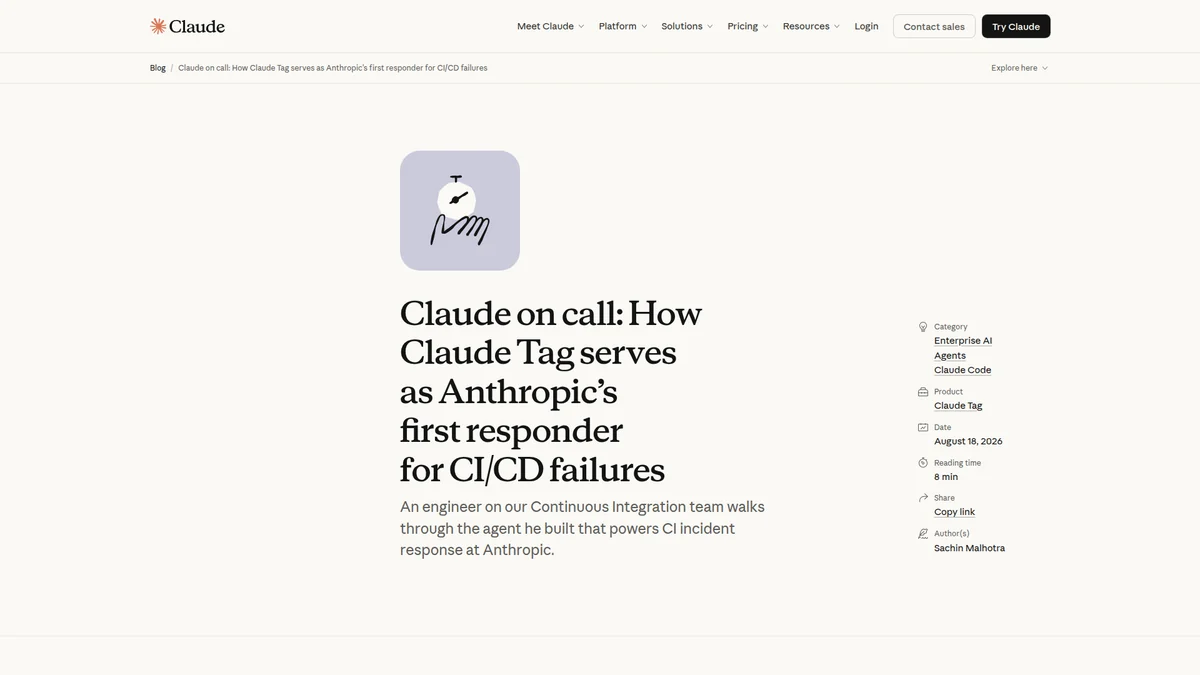
Anthropic’s case study describes Claude Tag as its CI/CD first responder; the reusable pattern is evidence-first diagnosis with bounded remediation.
TL;DR
- Anthropic published its Claude Tag CI/CD first-responder workflow on August 18.
- The safe autonomy ladder is observe, diagnose, propose, then remediate with bounded approval.
- Every conclusion should link to the exact log, diff, metric, or run that supports it.
- Measure time to correct diagnosis and avoided escalations, not message volume.
Anthropic describes Claude Tag’s on-call workflow in a dedicated case study. The reusable lesson is an evidence pipeline:
failure event -> correlate commit and owner
              -> retrieve bounded logs and recent changes
              -> form ranked hypotheses
              -> run read-only checks
              -> propose action with evidence
              -> approve bounded remediation
              -> verify and record outcome
The agent should distinguish an observation (“three integration tests timed out”) from an inference (“the database pool is exhausted”). It should also name what evidence would disprove its leading hypothesis.
Start read-only. Permit rerunning a failed test or opening an issue before allowing rollback, configuration change, or deployment. Break-glass production credentials should never be ambient in the diagnostic environment.
Avoid context dumping. Fetch the failed step and correlated service window first; expand only when the hypothesis requires it. This reduces cost and prevents an unrelated secret elsewhere in the log archive from entering model context.
Success metrics include precision of escalation routing, time to a verified hypothesis, percentage of suggestions accepted, duplicate incidents merged, and regressions caused by remediation. “Agent replied to 100% of failures” says nothing about operational value.
Define the job before granting access
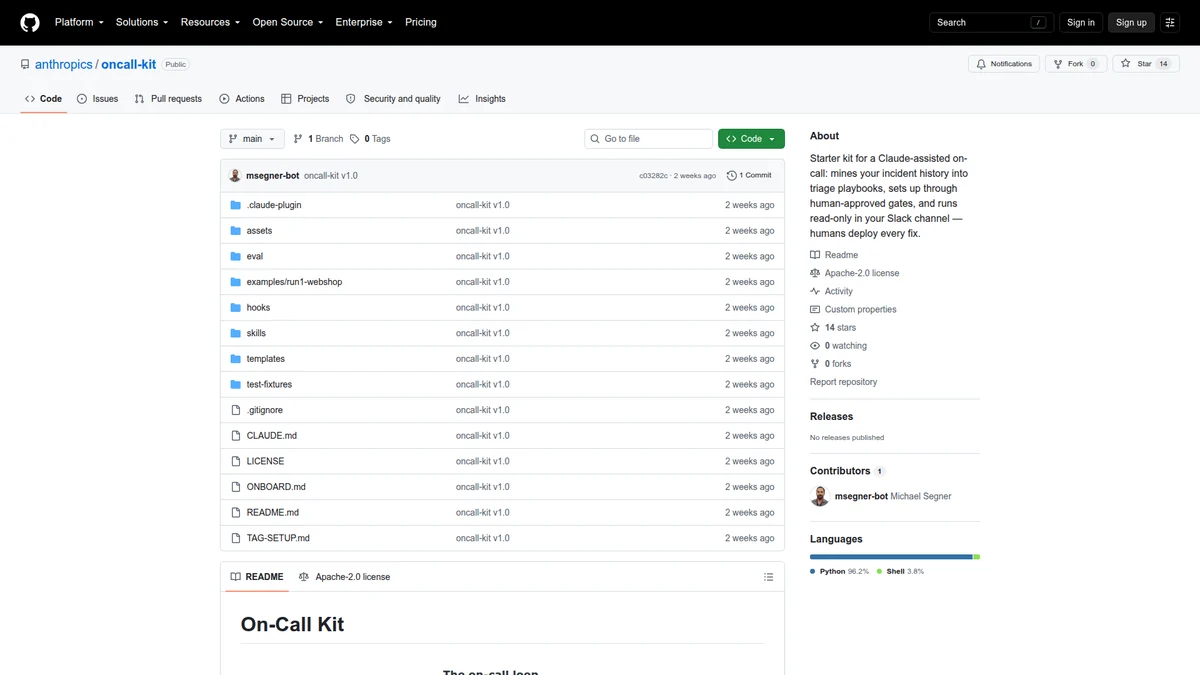
The reference kit keeps diagnosis read-only and human-gates mitigation, giving the article a concrete implementation companion.
“First responder” should be a precise operating role. The agent receives a failure event, gathers evidence within a fixed window, ranks plausible causes, performs approved read-only checks, and hands off a structured incident packet. It does not become the release manager, security responder, and production administrator merely because those systems are reachable.
Create an authority ladder and promote actions only after measuring the previous level:
| Level | Allowed work | Typical examples |
|---|---|---|
| Observe | Read bounded evidence | Failed step, triggering diff, deploy status |
| Diagnose | Run non-mutating checks | Re-run a test in isolation, query metrics |
| Coordinate | Create and route work | Open issue, identify owner, attach evidence |
| Propose | Prepare a reversible change | Draft patch, rollback plan, config diff |
| Remediate | Execute an approved action | Revert one commit, restart one canary |
Do not skip from observe to remediate because a few demo incidents were easy. Each level introduces new failure modes: excessive log access, noisy tickets, incorrect patches, and destructive production changes. Promotion should require a reviewed sample, known false-positive rate, rollback procedure, and an owner who can revoke the capability.
Build an evidence packet, not a chat reply
The output should be useful even if the next engineer never reads the agent’s prose. A good incident packet contains:
- the failing pipeline, job, step, attempt, timestamp, and commit;
- the first causal error, with routine cleanup noise separated;
- recent relevant changes and ownership paths;
- service health in the correlated time window;
- ranked hypotheses, confidence, and evidence for and against each;
- checks already performed and their raw result links;
- the smallest next action, its risk, and how to verify or reverse it.
Every link should point to an immutable or time-bounded view. “CPU was high” is not enough; identify the service, metric, interval, baseline, and whether the increase preceded the failure. “This commit caused it” is a hypothesis until the failing test passes on the parent and fails on the commit under comparable conditions.
The agent should quote sparingly. Logs often repeat the same stack trace thousands of times and may contain secrets. Extract the relevant lines, retain a link to access-controlled originals, and record the query used. This makes the diagnosis auditable without copying an entire production log archive into model context.
Correlation is the hard engineering work
CI systems know runs and steps. Source control knows commits and code owners. Observability platforms know services and deployments. Incident tools know alerts and responders. The agent needs stable identifiers connecting those domains; semantic search alone will create plausible but unrelated stories.
Maintain a service catalog that maps repositories, deployables, dashboards, runbooks, owners, and environments. Emit deployment markers with commit SHA and artifact digest. Normalize timestamps. Give the agent narrow queries such as “errors for service X from five minutes before to ten minutes after deployment Y,” rather than unrestricted access to every log.
When correlation is weak, say so. A concurrent database alert may be relevant, or it may affect a different tenant in another region. The agent should show the join keys it used and lower confidence when those keys are missing.
Remediation needs a safety case
A proposed fix should state its target, blast radius, preconditions, expected postcondition, rollback, expiry, and approval identity. Bind approval to that exact payload. If a new commit arrives or the target deployment changes, invalidate the old approval.
Prefer reversible actions. Rerunning one flaky test is safer than rerunning an entire release pipeline; disabling a canary is safer than changing the global feature flag. Use idempotency keys so a delayed response cannot trigger duplicate rollbacks or restarts. Verify in the system of record after the action, and reopen the incident automatically if the expected state does not appear.
Secrets should be exchanged just in time through a broker. The reasoning process receives a capability handle, not a cloud administrator token. Diagnostic tools and remediation tools should be separate, with different schemas and audit policies.
Evaluate with historical incidents and live shadowing
Replay a representative incident set with the evidence that was available at the time—not the clean postmortem assembled later. Include flaky tests, infrastructure outages, bad merges, dependency failures, expired credentials, quota exhaustion, and incidents whose correct conclusion is “insufficient evidence.” Prevent leakage from postmortems into the retrieval index during evaluation.
Then run in shadow mode beside the on-call team. Score top-hypothesis accuracy, evidence correctness, unsafe recommendations, missed correlations, time saved, and whether engineers accepted or corrected the routing. Weight confident wrong answers more heavily than cautious escalation.
Watch for automation bias. A well-formatted agent report may receive less scrutiny than a rough human note. Display uncertainty and counter-evidence prominently, and periodically insert controlled ambiguous cases to ensure responders still challenge the diagnosis.
Frequently asked questions
Should the agent automatically rerun failed jobs?
Only when the job is safe, bounded, and deduplicated. Automatic reruns can hide deterministic failures, consume scarce capacity, or repeat deployment side effects.
Can the agent access production logs?
It can use scoped, audited, time-bounded access where necessary. Redact secrets before model context and keep raw archives behind existing access controls.
What is the first useful production milestone?
A read-only incident packet that consistently identifies the failing component, correct owner, relevant change, and next diagnostic check. That alone can remove substantial toil without granting production write access.
Verdict
The evidence packet described here depends on reliable agent observability, logging, and tracing. Before enabling remediation, apply the concrete approval model in pre-action authorization for AI agents.
The first-responder role is a strong fit for agents because evidence gathering is repetitive while final production authority can remain human. The best system makes uncertainty visible, shows its sources, and can stop at “I do not have enough evidence.” Automating remediation before diagnosis is measurable is just accelerating the wrong feedback loop.