Best Open-Weight LLMs for AI Agents (2026): Cost & Self-Hosting
Compare the best open weights LLMs for AI agents in 2026: DeepSeek V4, openPangu-2.0-Pro, Llama 4 Maverick, cost, context, benchmarks, and self-hosting fit.
Best Open Weight LLMs for AI Agents (Aug 2026)
Last week I swapped our production coding agent from DeepSeek V3 to DeepSeek V4 Flash and watched our Terminal-Bench pass rate jump from 71 to 82.7 — without changing a single prompt. That moment crystallized something: the open-weight landscape for AI agents has shifted so dramatically in the past ninety days that our January recommendations no longer hold. This is the August 2026 refresh.
If you’re building agents — whether they’re writing code, orchestrating multi-step workflows, processing long documents, or operating autonomously — this guide tells you exactly which model to deploy and why.
The August 2026 Open-Weight Landscape
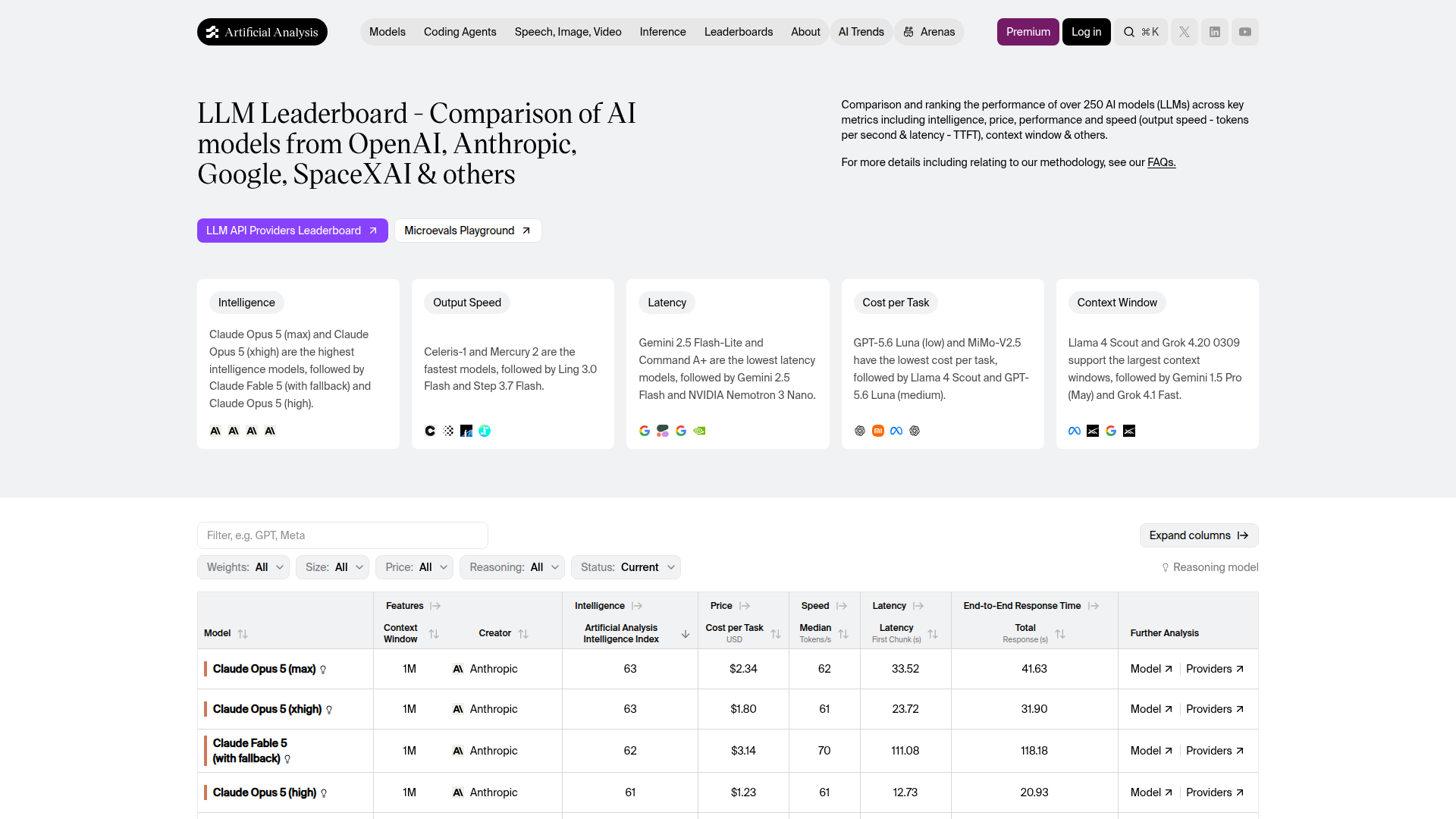 Artificial Analysis leaderboard — August 2026 rankings by Elo, speed, and pricing.
The MoE (Mixture of Experts) architecture has won. Every top-performing open-weight model released this summer uses it, keeping active parameter counts manageable while scaling total capacity. Context windows have stabilized at 512K–1M tokens, finally making single-pass repository-level reasoning practical. And licensing has never been friendlier — MIT and Apache 2.0 dominate.
Here are the eight models that matter most for agent workloads right now.
Comparison Table
| Model | Total Params | Active Params | Context | Key Benchmark | License | API Pricing (input/output per M tokens) |
|---|---|---|---|---|---|---|
| Huawei openPangu-2.0-Pro | 505B | 18B (MoE) | 512K | 34T pretrain tokens | Apache 2.0 | Self-host / Ascend Cloud |
| DeepSeek V4 | 284B | 13B (MoE) | 1M | 91.2 MMLU-Pro | MIT | $0.14 / $0.28 |
| DeepSeek V4 Flash 0731 | 284B | 13B (MoE) | 1M | 82.7 Terminal-Bench, 54.4 DeepSWE | MIT | $0.14 / $0.28 |
| Meta Muse Spark 1.2 | — | — | — | Long-horizon agent tasks | Llama License | Meta API |
| Llama 4 Maverick | 400B | 17B (MoE) | 1M | Strong general | Llama License | Multi-provider |
| Qwen 3.8 Max | — | — | — | Top multimodal agent | Apache 2.0 | Alibaba Cloud |
| Kimi K3 (Moonshot) | — | — | 1M | Long-document leader | Moonshot License | Moonshot API |
| GLM-5.1 (Zhipu) | — | — | — | #1 SWE-bench Pro (open) | GLM License | Zhipu API |
Model Deep Dives
 DeepSeek’s homepage — the V4 family offers the best cost-performance ratio among open-weight models in August 2026.
DeepSeek V4 & V4 Flash — The Default Choice
DeepSeek V4 is the model I’d recommend if you could only pick one. At 284B total / 13B active parameters, it’s remarkably efficient to serve. The 1M context window handles entire codebases in a single pass. MIT licensing means no restrictions on commercial deployment or fine-tuning. And the API pricing — $0.14 input / $0.28 output per million tokens — is roughly 10× cheaper than comparable proprietary alternatives.
The V4 Flash 0731 update is an alignment-only refresh: same weights architecture, better instruction following for agent loops. It scores 82.7 on Terminal-Bench (autonomous terminal tasks) and 54.4 on DeepSWE (end-to-end software engineering), both state-of-the-art among open-weight models as of this writing.
Best for: General-purpose agents, coding agents, cost-sensitive production deployments.
Huawei openPangu-2.0-Pro — The Capacity King
At 505B total parameters with 18B active, openPangu-2.0-Pro is the largest open-weight MoE released this year. Pre-trained on 34 trillion tokens — the most of any open model — it has exceptionally broad world knowledge. The 512K context window is slightly shorter than DeepSeek’s 1M but sufficient for most agent tasks.
The catch: it’s Ascend-native. You’ll need Huawei Ascend 910B hardware or Huawei Cloud for optimal inference. NVIDIA GPU support exists via community conversions but with performance penalties. If your infrastructure is Ascend-based (common in Chinese enterprise environments), this is arguably the strongest model available.
Best for: Enterprise deployments on Ascend infrastructure, knowledge-intensive agent tasks requiring broad world knowledge.
Meta Muse Spark 1.2 — Built for Agent Loops
Meta’s Muse Spark 1.2 is purpose-built for coding agents. Co-trained with the Muse Code harness, it natively understands long-horizon development tasks: planning across files, executing multi-step refactors, and managing async subagents. Where other models need elaborate scaffolding to handle tool-use loops, Muse Spark treats them as first-class.
Its standout feature is async subagent coordination — the model can spawn and manage parallel work streams, then synthesize results. This is a game-changer for complex engineering tasks that benefit from divide-and-conquer execution.
Best for: Complex coding agents, multi-step development workflows, systems requiring subagent orchestration.
Llama 4 Maverick — The Generalist Workhorse
Llama 4 Maverick (400B/17B active MoE, 1M context) is Meta’s general-purpose flagship. It doesn’t specialize in any single agent task but performs well across all of them. The broad ecosystem support — available on every major inference provider from day one — makes it the safe choice when you need wide compatibility.
Best for: Multi-purpose agent systems, teams already invested in the Llama ecosystem, workloads requiring broad provider availability.
Qwen 3.8 Max — The Multimodal Agent
Alibaba’s Qwen 3.8 Max is the strongest multimodal open-weight model for agent tasks. If your agents need to process images, screenshots, diagrams, or video frames alongside text, Qwen 3.8 Max is the clear leader. Its vision-language capabilities are tightly integrated rather than bolted on, resulting in more reliable multimodal tool use.
Best for: Multimodal agents, UI automation, visual QA pipelines, agents that process screenshots or diagrams.
Kimi K3 (Moonshot) — The Long-Context Specialist
Kimi K3 from Moonshot AI delivers the most reliable long-context performance in our testing. While several models claim 1M token contexts, K3 actually maintains coherent reasoning across the full window. For document-heavy agent workflows — legal analysis, research synthesis, codebase understanding — this matters enormously.
Best for: Long-document agents, research assistants, RAG systems requiring full-context retrieval.
GLM-5.1 (Zhipu) — The SWE Champion
GLM-5.1 holds the #1 spot on SWE-bench Pro among all open-weight models. If your primary use case is autonomous software engineering — resolving GitHub issues, implementing features from specs, fixing bugs — GLM-5.1 is the empirically best choice right now.
Best for: Autonomous software engineering agents, issue resolution bots, CI/CD-integrated coding agents.
Recommendations by Use Case
Coding Agents (General)
Pick: DeepSeek V4 Flash 0731. Best balance of cost, performance, and license freedom. MIT license means you can fine-tune for your codebase without restrictions.
Autonomous Software Engineering
Pick: GLM-5.1. Highest SWE-bench Pro score among open weights. If you’re building a Devin-style agent, start here.
Long-Horizon Development Tasks
Pick: Meta Muse Spark 1.2. Purpose-built for multi-step, multi-file engineering tasks with native subagent support.
Budget-Constrained Production
Pick: DeepSeek V4. At $0.14/$0.28 per million tokens via their API, nothing else comes close on cost-per-quality. Self-hosting the 13B active parameter model is also feasible on modest hardware.
Multimodal Agent Workflows
Pick: Qwen 3.8 Max. Only serious choice if your agent needs vision capabilities alongside tool use.
Long-Document Processing
Pick: Kimi K3. Most reliable across the full 1M context window for document-heavy tasks.
Enterprise (Ascend Infrastructure)
Pick: Huawei openPangu-2.0-Pro. Unmatched performance on Ascend hardware with the broadest pretraining data of any open model.
General-Purpose / Unsure
Pick: Llama 4 Maverick. Widest ecosystem support, strong across all benchmarks, low integration risk.
Deployment Considerations
 HuggingFace Open LLM Leaderboard — community-driven evaluation of open-weight models.
Self-hosting MoE models: The active parameter count is what determines your GPU memory requirements. DeepSeek V4’s 13B active footprint means you can serve it on a single A100/H100 for inference (with quantization). The full 284B weights load across multiple GPUs but only route through 13B per token.
Context window costs: A 1M context window is expensive to fill. At DeepSeek’s pricing, filling the full 1M context costs $0.14 per request on input alone. Design your agents to use context efficiently — sliding windows, hierarchical summarization, and selective retrieval still matter.
License nuances: MIT (DeepSeek) and Apache 2.0 (openPangu, Qwen) are fully permissive. Llama License and Moonshot License have usage restrictions above certain user thresholds. Check the fine print if you’re building a product with >700M monthly active users.
FAQ
Q: Which model is cheapest to self-host for agent workloads? A: DeepSeek V4, due to its 13B active parameter count and MIT license allowing unrestricted deployment. The small active footprint means lower GPU requirements per request.
Q: Can I fine-tune these models for my specific agent tasks? A: Models under MIT (DeepSeek V4) and Apache 2.0 (openPangu, Qwen) allow unrestricted fine-tuning. Llama License permits fine-tuning but with distribution conditions. Always check the specific license terms.
Q: Has the gap between open-weight and proprietary models closed? A: For agent tasks specifically, yes — significantly. DeepSeek V4 Flash’s Terminal-Bench score (82.7) is within 3 points of the best proprietary models. GLM-5.1’s SWE-bench Pro score exceeds several proprietary alternatives. The remaining gap is primarily in multi-turn reliability over very long sessions.
Q: Should I use the API or self-host? A: For prototyping and moderate traffic, use the API — DeepSeek’s pricing is extraordinarily competitive. Self-host when you need data privacy, custom fine-tuning, or predictable latency at high volume.
Q: What about Llama 4 Scout vs. Maverick for agents? A: Scout is the smaller, faster variant. For agent tasks specifically, Maverick’s larger expert count provides meaningfully better tool-use accuracy. Use Scout for latency-critical lightweight agents; Maverick for everything else.
Conclusion
August 2026 is the best time in history to build AI agents on open-weight models. DeepSeek V4 Flash is our top overall recommendation — but the right choice depends on your specific workload. Use the decision matrix above, pick the model that matches your use case, and start building. The performance gap to proprietary models has never been smaller, and the cost advantage has never been larger.
Last updated: August 10, 2026. We re-evaluate these recommendations monthly as new models and benchmark results emerge.