Best Bilibili API in 2026: Pricing Compared
Best Bilibili API in 2026 by listed price: 46 SandBase endpoints, 38 at $0.001, one at $0.002, and seven at $0.014286. Official open-platform prices stay Unknown.
Video metadata and app search are both listed at $0.001, and they are different requests. On the 21 Nov 2026 check (Asia/Shanghai), Bilibili on SandBase listed 46 endpoints. Video Metadata is the path bilibili/web/one-video. App Search is bilibili/app/search-all. The pricing-page sample names two other paths, bilibili/app/one-video and bilibili/app/cinema-tab, also at $0.001. Those sample paths are not Video Metadata. Thirty-eight cards listed $0.001, one card listed $0.002 (bilibili/web/one-video-v2), and seven cards listed $0.014286. Official open-platform pages returned HTTP 200 as JavaScript shells with no readable price list, so official dollar prices stay Unknown. Accuracy and latency stay Unknown. This is not a third-party bake-off.
Key takeaway
- On 21 Nov 2026 the SandBase Bilibili hub listed 46 endpoints. The span was $0.001 on 38 cards, $0.002 on
bilibili/web/one-video-v2, and $0.014286 on seven cards described as user profile, user published videos, video captions, comments, danmaku, video details, and video search.- Video Metadata (
web/one-video) and App Search (app/search-all) both showed “100 free calls / day — First 100 calls per day free (shared per organization) · Resets at 00:00 UTC. Pay per call after that.” That pool is shared per organization, not 100 calls per card. The hub page has no free-allowance row. Do not treat all 46 cards as eligible.bilibili/web/one-videois not the sample-list pathbilibili/app/one-video. The sample also namesbilibili/app/cinema-tab. This article does not treat those sample paths as confirmed free-quota cards.- One thousand calls at the $0.001 floor are $1.00 as list-price floor math, not a bill. Official dollar prices stay Unknown.
- Call
POST https://api.sandbase.ai/v1/api/bilibili/{endpoint}with a Bearer key and a JSON body. Video Metadata and App Search were not flagged asynchronous. Do not POST /v1/run to start.
What a Bilibili API means in 2026
The live hub title was “Bilibili APIs: Research Videos, Creators and Community Response | SandBase.” The catalog covers public video and community surfaces: search and feeds on app and web paths, video details, comments, cinema and bangumi tabs, and user surfaces. This article does not list all 46 names. SandBase is not Bilibili. A listed card is a research read of public information. It is not an official partner seat, and it is not permission to publish on an account.
The official open platform is a separate product. On 21 Nov 2026 these pages returned HTTP 200: open.bilibili.com/doc, the developer-service agreement, and openhome.bilibili.com. Each fetched page was a JavaScript shell. The visible title identified the open platform. No price table was readable. This article does not quote a third-party blog as an official rate.
A separate unofficial vendor account is the third option. It is not measured here. This article does not borrow anyone else’s accuracy scores. Official Bilibili terms still apply to how those records are used.
Budget the card you open. Video Metadata at $0.001 is one of the 38 cards. The seven cards at $0.014286 are a separate bucket on the same key.
Bilibili API endpoints you can call on SandBase today
The data API index listed 2,247 endpoints from 182 providers on the same check. The Chinese Social Media category counted 627 APIs. Those censuses can change. Do not flatten this hub to $0.001.
| Listed price, 21 Nov 2026 | Cards | What this article can say |
|---|---|---|
| $0.001 per call | 38 | Includes Video Metadata and App Search. Floor of the hub. |
| $0.002 per call | 1 | Path bilibili/web/one-video-v2 only. |
| $0.014286 per call | 7 | Described as user profile, user published videos, video captions, comments, danmaku, video details, and video search. Paths are not listed here. |
| Card | List price, 21 Nov 2026 | Call | What the card describes | Async | Free allowance |
|---|---|---|---|---|---|
| Video Metadata | $0.001 per call | POST /v1/api/bilibili/web/one-video | Honor and recommendation tags | Not flagged | Visible 100/day row |
| App Search | $0.001 per call | POST /v1/api/bilibili/app/search-all | Query content with sorting controls | Not flagged | Visible 100/day row |
web/one-video-v2 | $0.002 per call | POST /v1/api/bilibili/web/one-video-v2 | The single $0.002 card on the hub | Not opened here | Not confirmed on a captured card |
| Seven higher cards | $0.014286 per call | Paths not listed in this article | User profile, published videos, captions, comments, danmaku, video details, video search | Not opened here | Not confirmed on a captured card |
The two screenshot prices come from card Markdown, and the free row was visible on those two live cards. The pricing-page sample names bilibili/app/one-video and bilibili/app/cinema-tab at $0.001. That sample is not a complete roster, and neither path is bilibili/web/one-video. Copying the sample path calls a different card from the Video Metadata screenshot. This article does not mark the sample paths, the v2 card, the seven $0.014286 cards, or the other $0.001 cards as free-quota eligible.
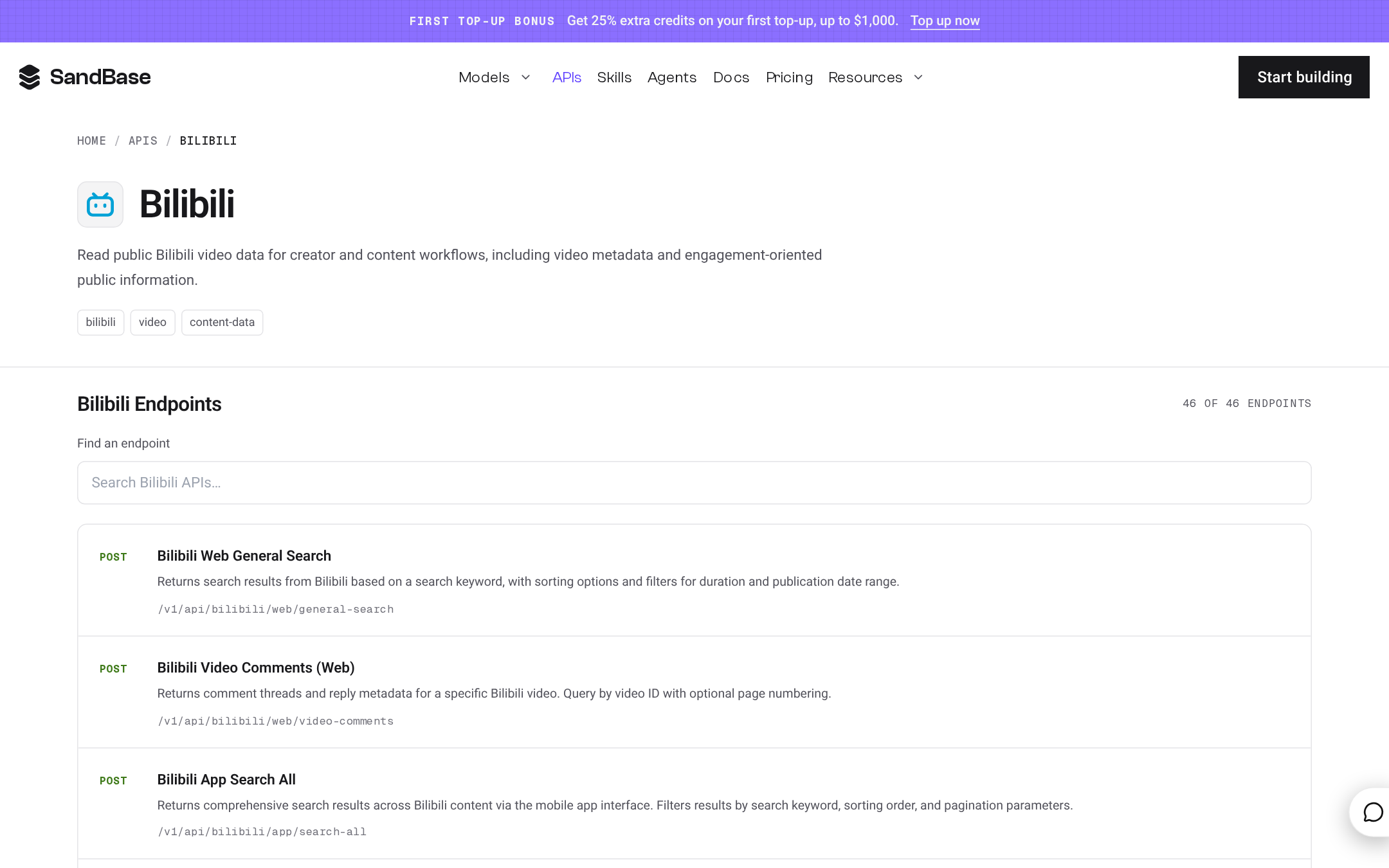
SandBase Bilibili hub, captured logged out in a light theme on 21 Nov 2026 (Asia/Shanghai). The HTML title is “Bilibili APIs: Research Videos, Creators and Community Response | SandBase.” The page is the 46-endpoint catalog. It has no free-allowance row.
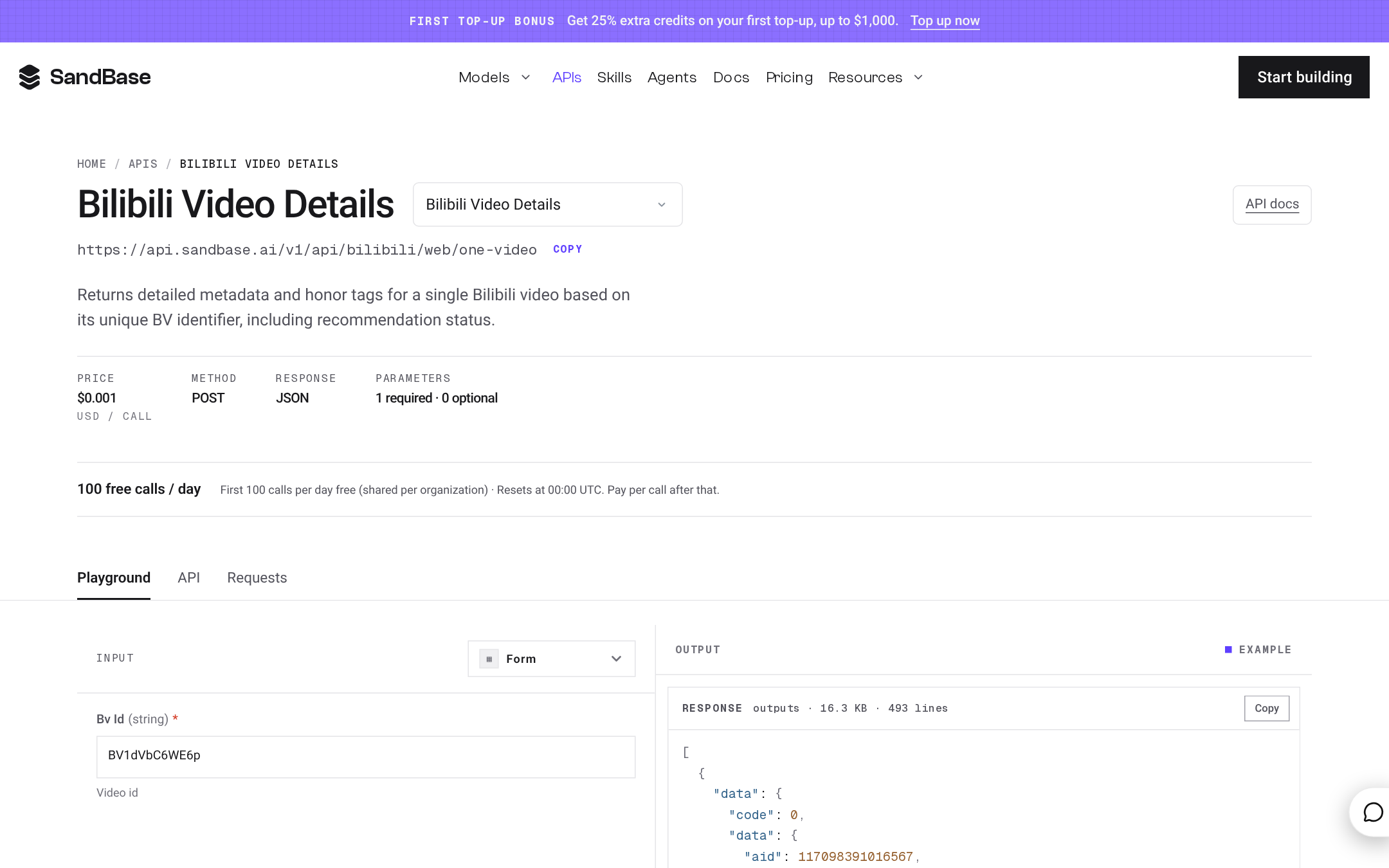
SandBase Bilibili Video Metadata card, captured logged out in a light theme on 21 Nov 2026 (Asia/Shanghai). The HTML title is “Bilibili Video Metadata API: Honor and Recommendation Tags | SandBase.” The path is web/one-video at $0.001 per call. The card showed the shared 100-free-calls row. This path is not app/one-video.
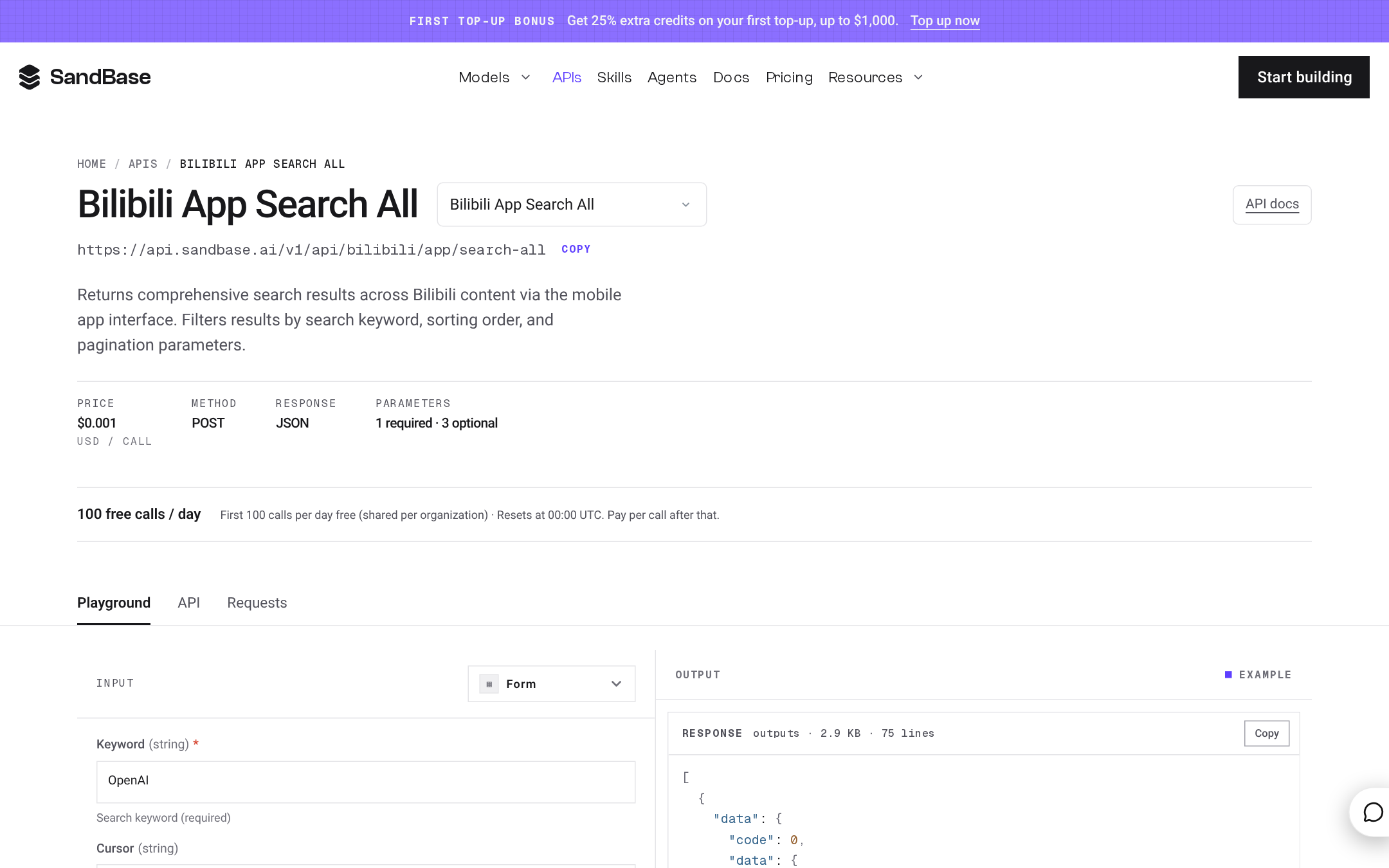
SandBase Bilibili App Search card, captured logged out in a light theme on 21 Nov 2026 (Asia/Shanghai). The HTML title is “Bilibili App Search API: Query Content with Sorting Controls | SandBase.” The path is app/search-all at $0.001 per call. The card showed the same shared 100-free-calls row.
Official Bilibili API pricing versus the SandBase catalog
The rows are different products. Latency and accuracy are Unknown in every row.
| Path | What you can call, as checked 21 Nov 2026 | Billing | Free trial or allowance | Docs |
|---|---|---|---|---|
| Official Bilibili open platform | The fetched pages were JavaScript shells. No readable endpoint or price list. | Official dollar prices Unknown. | Unknown from the pages fetched. | open.bilibili.com/doc |
| SandBase Bilibili hub | 46 research endpoints. Floor $0.001 on 38 cards. One card at $0.002. Seven cards at $0.014286. | Pay per call, no subscription. Start ($0), Build (Metered), Scale (Custom). | Video Metadata and App Search showed the shared 100-calls row. The hub did not. The other cards were not confirmed here. | Live cards plus API passthrough |
| A separate unofficial vendor account | Whatever that vendor lists. Not measured here. | That vendor’s contract. Unknown here. | Unknown here. | That vendor’s own docs |
Same catalog, separate hubs, not a bake-off: Zhihu listed 51 endpoints with a $0.001 floor, and Douyin listed 319 endpoints with a $0.001 floor. YouTube is the already-published video pillar in the same catalog. Pricing posts: Best YouTube API in 2026, Best Zhihu API in 2026, and Best Douyin API in 2026.
Best Bilibili API for each need
- Lowest listed price: the 38 cards at $0.001, including Video Metadata and App Search. One thousand calls at $0.001 are $1.00 as list-price floor math, not a bill.
bilibili/web/one-video-v2lists at $0.002. The seven cards at $0.014286 are described as user profile, user published videos, video captions, comments, danmaku, video details, and video search. Paths for those seven are not stated here. This article did not capture a free row on the v2 card or on those seven.- Confirmed free-quota cards in this check: Video Metadata and App Search only. They share one organization pool. They do not each grant 100 calls.
- Official partner access, official support, or authorized publishing: the official open platform. This check could not read a price there.
How to call the Bilibili API on SandBase
Data APIs use POST https://api.sandbase.ai/v1/api/{vendor}/{endpoint} with Authorization: Bearer $SANDBASE_API_KEY and a JSON body. Language models use POST /v1/chat/completions. Media models use POST /v1/run. Do not POST /v1/run to start. The passthrough reference is the data-API page. The first API call walkthrough is chat completions only.
Video Metadata and App Search were not flagged asynchronous on 21 Nov 2026. If a live card later says the endpoint runs asynchronously, poll GET https://api.sandbase.ai/v1/run/{id} until status is completed. That GET is the poll. Do not POST /v1/run to start. This comparison did not run a paid call. Replace the empty object with the fields on the live card. Read outputs[0].data. If that object is missing, fail loudly.
import os
import requests

payload = {}  # replace with the fields on the live Video Metadata card before sending

headers = {
    "Authorization": f"Bearer {os.environ['SANDBASE_API_KEY']}",
    "Content-Type": "application/json",
}
response = requests.post(
    "https://api.sandbase.ai/v1/api/bilibili/web/one-video",
    headers=headers,
    json=payload,
    timeout=90,
)
response.raise_for_status()
body = response.json()
# Video Metadata (web/one-video) was not flagged asynchronous on 21 Nov 2026.
# Do not POST /v1/run to start.
outputs = body.get("outputs") or []
if body.get("status") not in (None, "completed") or not outputs or not isinstance(outputs[0], dict):
    raise RuntimeError(f"SandBase call did not complete: {body.get('status')} {body.get('error')}")
data = outputs[0].get("data")
App Search is /v1/api/bilibili/app/search-all. The v2 card is /v1/api/bilibili/web/one-video-v2. The sample-list path app/one-video is a different URL from the sketch above. The snippet is a client sketch, not a measured latency.
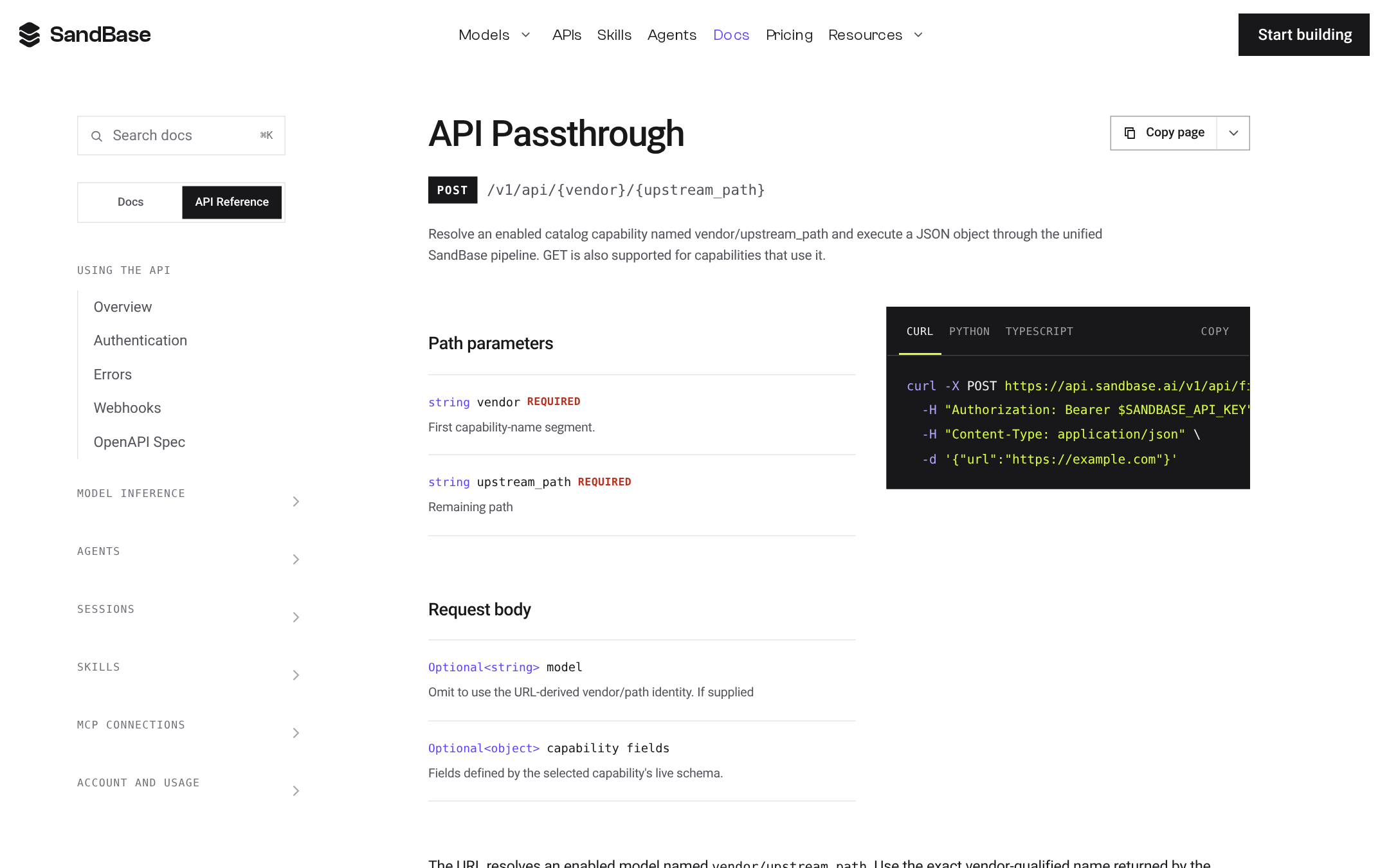
SandBase API passthrough page, captured logged out in a light theme on 21 Nov 2026 (Asia/Shanghai). The HTML title is “API Passthrough.” It documents POST /v1/api/{vendor}/{endpoint} for data APIs. It is not a Bilibili price.
What the Bilibili API daily allowance does and does not cover
Pricing and Pricing and Usage, checked 21 Nov 2026, give every organization 100 free data API calls per UTC day for eligible tools. The pool is shared across eligible data APIs and all keys, resets at 00:00 UTC, and does not carry over. Video Metadata and App Search showed that row. The hub screenshot did not. A call on either card draws the same pool. It does not open a second allowance of 100.
The pricing sample’s bilibili/app/cinema-tab and bilibili/app/one-video entries are not proof for web/one-video. This article confirms the visible row only on the two captured cards. After the 100th eligible call, requests still complete and are billed at the listed price. A zero balance can still spend remaining allowance. Failed calls are not charged. Catalog browsing is $0. Plans are Start ($0), Build (Metered), and Scale (Custom). Language models and media models are outside the pool. The billing page says some pricier or formula-priced data APIs are billed from the first call. Its examples include some batch endpoints, crawl endpoints, Xiaohongshu PGY, and Douyin Xingtu kol-* routes. Those examples are not a verdict on the Bilibili cards left unopened.
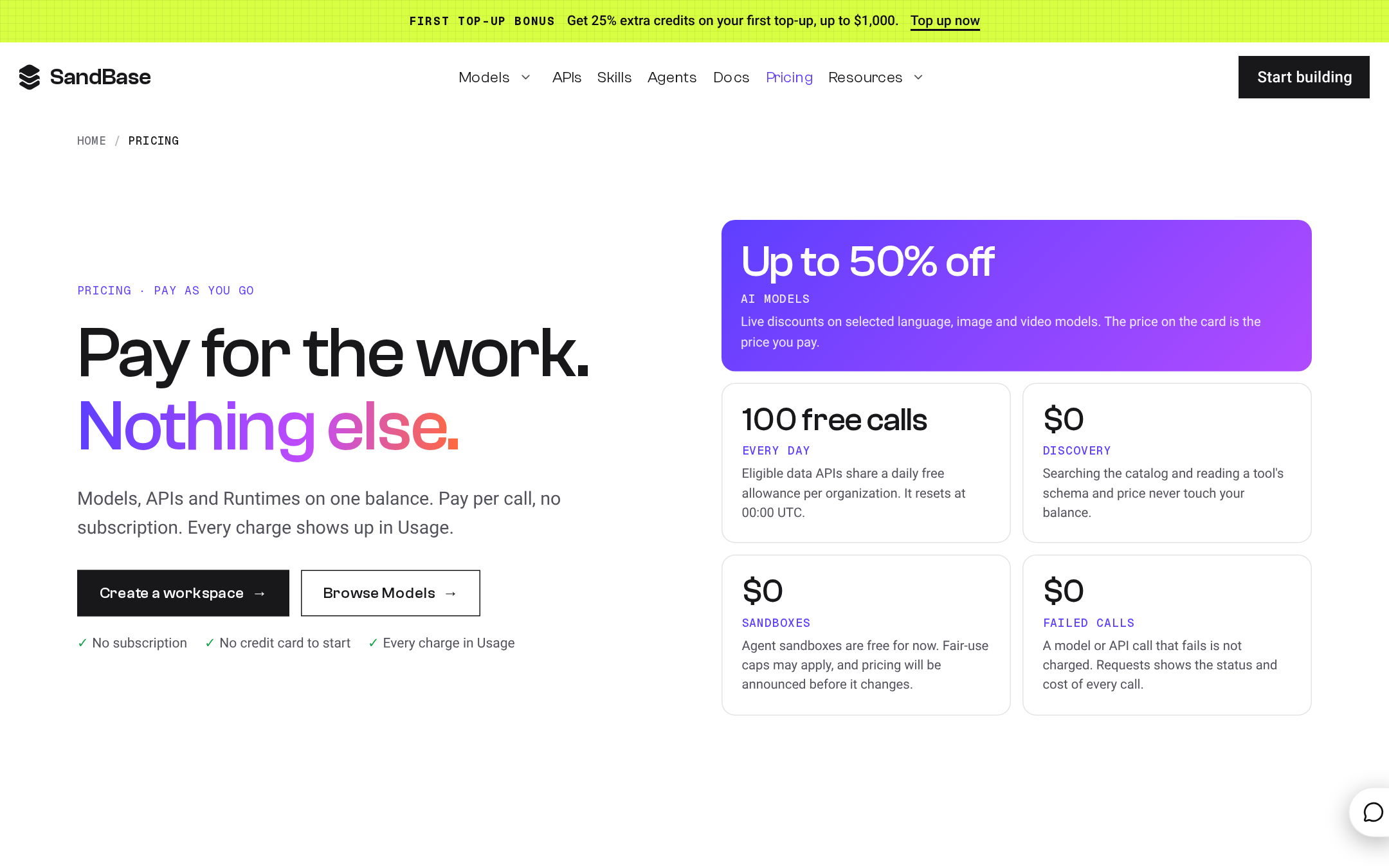
SandBase pricing page, captured logged out in a light theme on 21 Nov 2026 (Asia/Shanghai). The HTML title is “SandBase Pricing: Models, APIs and Usage-Based Billing.” Plans are pay per call. The page is not a Bilibili rate card.
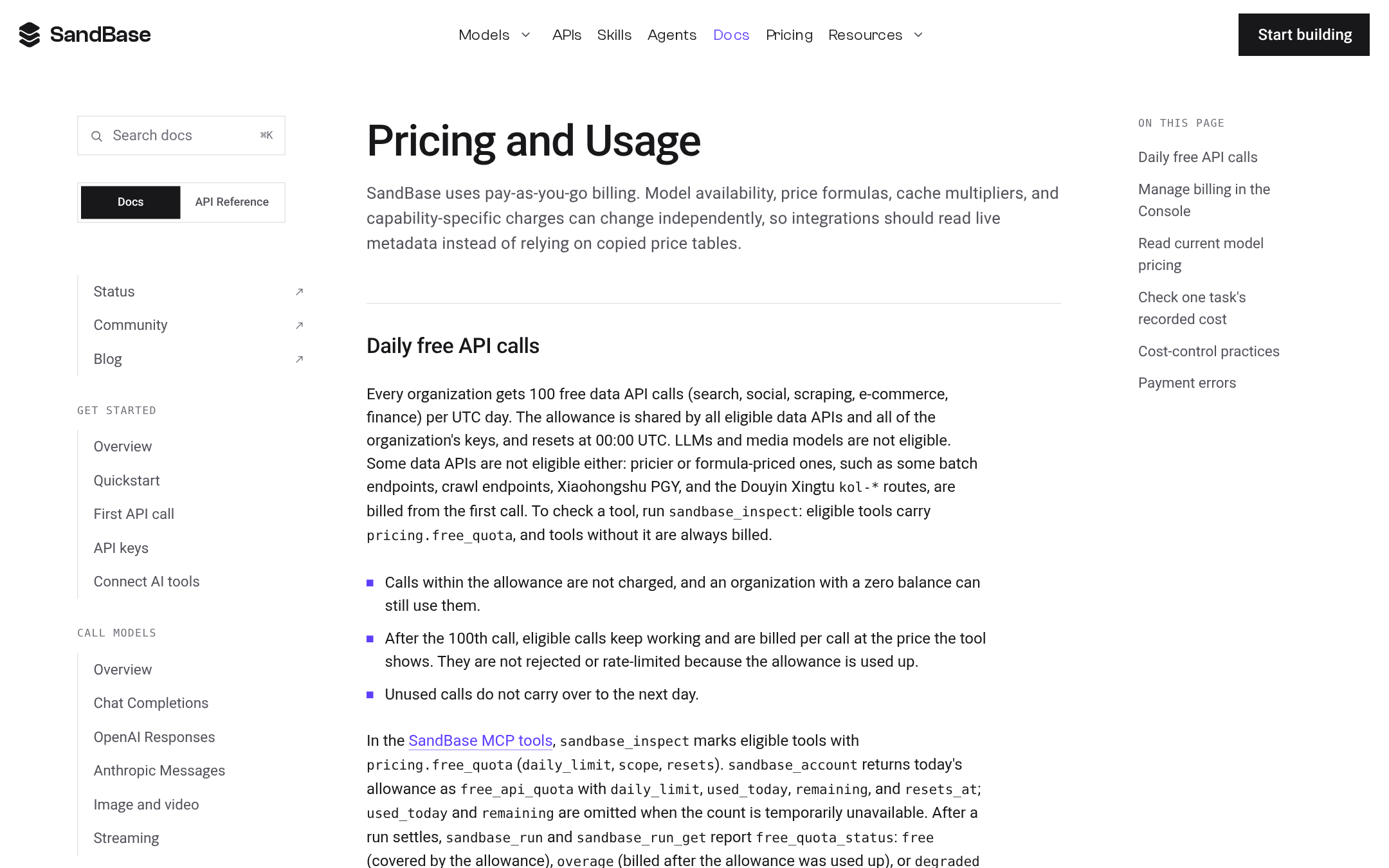
SandBase Pricing and Usage guide, captured logged out in a light theme on 21 Nov 2026 (Asia/Shanghai). The HTML title is “Pricing and Usage.” Eligible data APIs share 100 free calls per organization per UTC day. Only the Bilibili cards that showed the row are described as eligible here.
One thousand calls at $0.001 are $1.00 if every call bills at that list price. One thousand web/one-video-v2 calls at $0.002 are $2.00. One thousand calls at $0.014286 are $14.286. That is list-price math, not an invoice. Subtract the shared 100 only for calls on a card that showed the row, and only until the organization pool is gone.
Open Console API keys, read pricing, and use signup, which redirects to sign-in. Agents can start from the SandBase skill file.
When not to use the SandBase Bilibili API hub
Stay on the official open platform for partner access, official support, or authorized account publishing. Official Bilibili terms still apply. Stay put when the buying criterion is a measured accuracy or latency rank among unofficial providers. This check did not produce that rank.
Bilibili API FAQ
What does “Bilibili API” mean in this article?
The 46 SandBase cards on /apis/bilibili, checked 21 Nov 2026. The official open platform stays on Bilibili’s own site and did not show a public dollar rate card in this check.
When is the SandBase hub a better fit than the official open platform?
For a public video-metadata read or an app search, billed per call on one key, at the card you opened. For official partner publishing, start with Bilibili. Official dollar prices stay Unknown.
How much do the SandBase Bilibili endpoints cost?
$0.001 per call on 38 cards, $0.002 on bilibili/web/one-video-v2, and $0.014286 on seven cards. One thousand calls at $0.001 are $1.00 as list-price floor math.
Are the first 100 Bilibili calls free?
On Video Metadata (web/one-video) and App Search (app/search-all), the card showed a shared row: 100 free calls per organization per UTC day, resetting at 00:00 UTC, then the listed price. The allowance is one organization pool, not 100 per card, and not 100 on every one of the 46 cards. web/one-video is not the sample-list path app/one-video.
How do official Bilibili APIs compare with SandBase?
The official pages fetched were JavaScript shells with no price list. SandBase lists 46 research endpoints with public per-call prices. Latency and accuracy were not measured.
Do official Bilibili terms still apply?
Yes. A catalog price is not a license to ignore them, and it is not an official publishing grant.
How do I start a call?
POST https://api.sandbase.ai/v1/api/bilibili/web/one-video or POST https://api.sandbase.ai/v1/api/bilibili/app/search-all with a Bearer key and JSON. Do not POST /v1/run to start. Read outputs[0].data. Poll GET https://api.sandbase.ai/v1/run/{id} only if that live card says the endpoint is asynchronous. These two cards were not flagged asynchronous.
Does this article list all 46 Bilibili endpoints?
No. It gives the three price buckets and the two cards that were captured. The live hub is the full list.
Related Bilibili API reading
Field notes, not rewritten here: Bilibili Public Data API, Bilibili creator research, and Bilibili video comment analysis. Neighboring 2026 pricing posts: Best YouTube API in 2026, Best Zhihu API in 2026, and Best Douyin API in 2026.
Open the Bilibili hub, then Video Metadata or App Search beside the passthrough reference. Create a key in the Console, read pricing, or start from the skill file.
Found this useful? Share it