OpenAI Opens the Codex Harness: Agents Move Beyond the Chat Box
OpenAI has opened the Codex harness, CLI, SDKs, and App Server. Here is why the architecture, ARC-AGI-3 result, and product boundaries matter beyond coding chat.
OpenAI Opens the Codex Harness: Agents Move Beyond the Chat Box
This is not a new model release, yet it may matter more to product builders than another benchmark bump. By opening the Codex harness, OpenAI is turning Codex from a finished assistant in a terminal, IDE, or desktop app into an execution layer that other software can embed.
For two years, the default AI product pattern has been a chat box bolted onto an existing application. It makes users translate business state into prompts even when the dashboard, selected record, permissions, and available actions already contain that context. The open Codex harness points toward a different product architecture: keep the domain interface, data model, and approval rules, and place the agent loop underneath them.
Key takeaway
- The Apache-2.0
openai/codexrepository includes the CLI, SDKs, App Server, and harness components. It does not open the desktop UI or model weights.codex execfits bounded automation, the TypeScript and Python SDKs fit programmatic integration, and App Server fits full interactive products.- Harness design is a performance variable: OpenAI moved GPT-5.6 Sol from 13.3% to 38.3% on the ARC-AGI-3 public task set by retaining reasoning and compacting context, while using six times fewer output tokens.
stdiois the stable default. WebSocket support is explicitly experimental and unsupported.- Open source reduces integration work; identity, isolation, least privilege, audit, idempotency, and outcome verification still belong to the host product.
What OpenAI actually opened
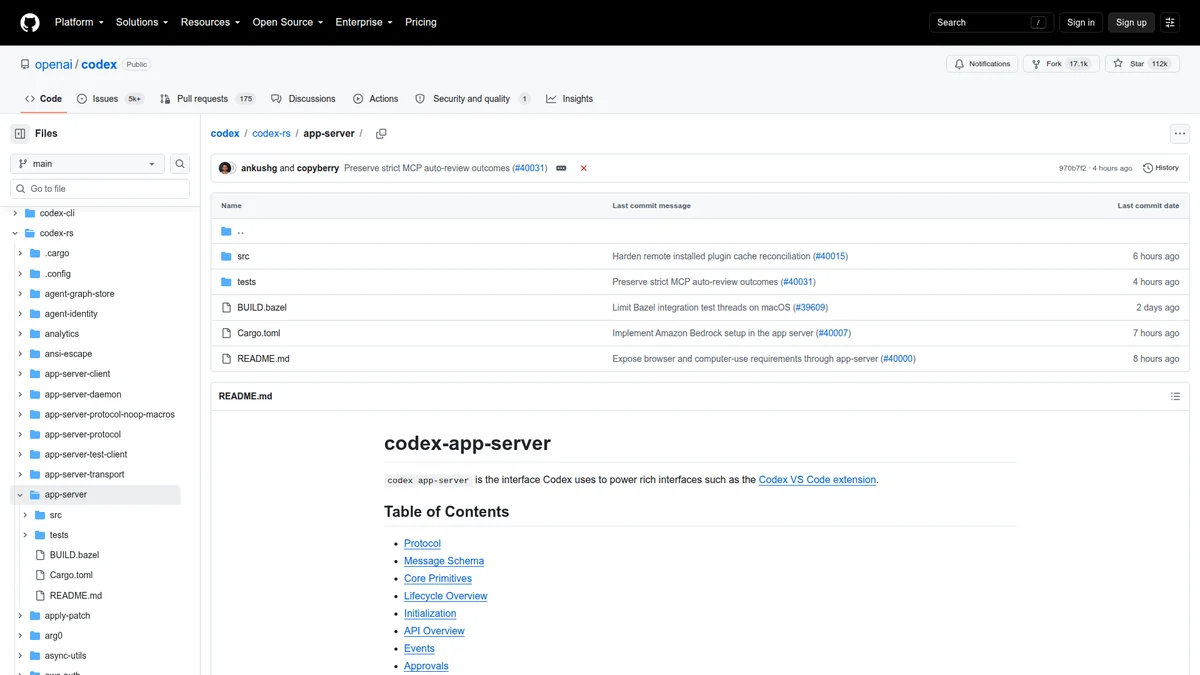
The App Server implementation lives in the open Codex repository; this is separate from the desktop application’s closed UI.
OpenAI’s App Server engineering note describes it as the link between Codex surfaces and the shared harness underneath them. The implementation and protocol live in the public openai/codex repository.
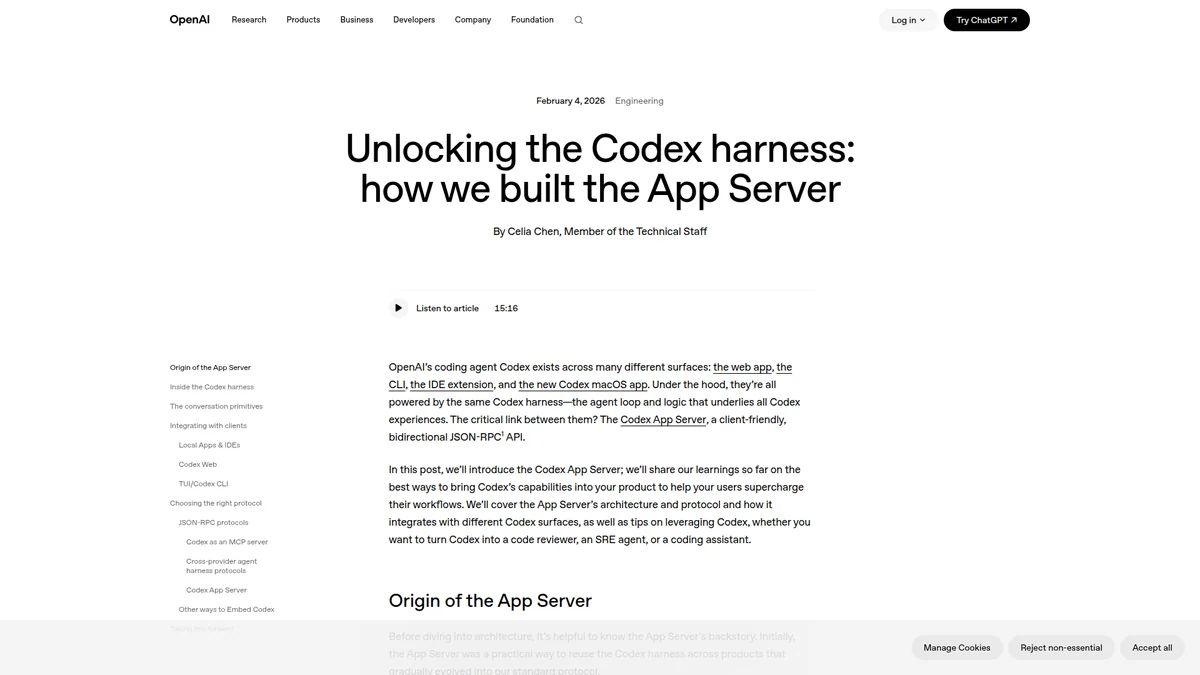 OpenAI documents App Server as the client-facing bridge to the shared Codex harness. Source: OpenAI, captured August 22, 2026.
That is different from open-sourcing the desktop application or the model weights. The distinction matters because “build your own Codex client” is accurate, while “fork the entire Codex product” is not. Apache-licensed source also does not make hosted inference, compute, or enterprise support free.
The server hosts Codex core threads and translates their lower-level events into a smaller client-facing stream. Communication is bidirectional: the client starts work, the server emits progress, and the server can pause to ask the client for an approval or user response.
A harness is the machine around the model
Calling an agent “a model plus a prompt” is like calling a database “a disk plus SQL.” A demo may work, but a production system quickly exposes everything the definition omitted.
A useful harness has to preserve and resume long-running work, decide what context to retain or compact, discover and validate tools, execute inside a sandbox, stream observable events, pause for approval, recover after interruption, and verify outcomes outside the model. The model proposes the next action. The harness determines what the model can see, what it may do, and what happens afterward.
That makes the harness more than integration glue. It is simultaneously an execution loop, context manager, security boundary, and observability surface.
Two settings nearly tripled an ARC-AGI-3 score
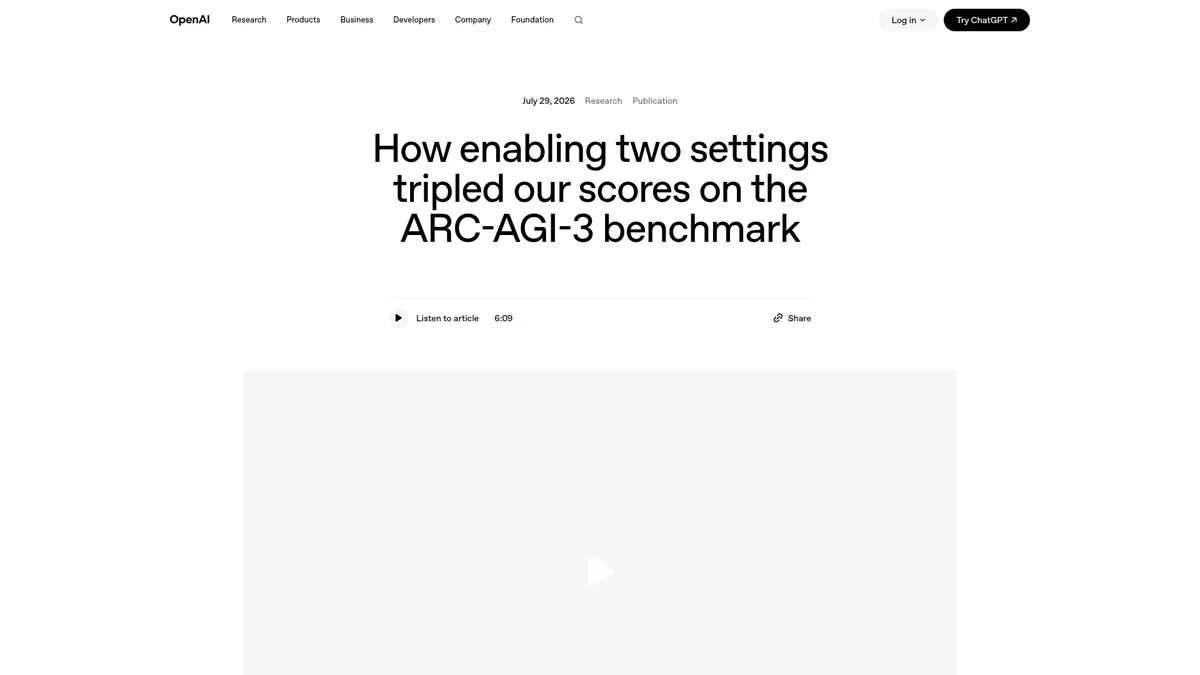
OpenAI isolated the effect of retained reasoning and context compaction on ARC-AGI-3. Source: OpenAI, captured August 22, 2026.
OpenAI’s July 2026 experiment provides an unusually clear demonstration. GPT-5.6 Sol scored 13.3% RHAE on the ARC-AGI-3 public task set with a generic harness. Retaining private reasoning state and compacting context raised the score to 38.3%, compared with an estimated 48% human tester baseline. Output-token use fell by roughly six times.
| System configuration | ARC-AGI-3 RHAE | Effect |
|---|---|---|
| Generic harness | 13.3% | Baseline |
| Retained reasoning + compaction | 38.3% | About 2.9× the score |
| Output tokens | About one-sixth | Less cost and repetition |
The model weights and task set did not change. One setting stopped the system from discarding reasoning state between steps; the other summarized important context instead of relying on rolling truncation near the context limit.
This does not mean the model became three times smarter. It means an agent benchmark measures a combined system—model, harness, and configuration. Context continuity, tool feedback, and compaction policy can determine both capability and cost.
Three entry points for three integration depths
OpenAI does not require every integration to start with App Server.
| Entry point | Best fit | What you own |
|---|---|---|
codex exec | CI, scripts, bounded background jobs | Inputs, execution boundary, structured result |
| Codex SDK | Starting, resuming, and streaming work from TypeScript or Python | Thread lifecycle, application state, error handling |
| Codex App Server | IDEs, desktop tools, and operational consoles | Process, protocol version, event UX, approval, and permissions |
The current repository includes official TypeScript and Python SDKs. A production system may use all three surfaces: exec for a PR gate, an SDK for a job service, and App Server for an interactive engineering client.
Three protocol primitives—and one critical control point
| Primitive | What it represents | What a client does with it |
|---|---|---|
| Item | A message, command, diff, tool call, or other renderable unit | Display progress and results |
| Thread | Persistent agent conversation | Start, resume, fork, list, and inspect history |
| Turn | One unit of requested work | Start, steer, or interrupt active execution |
| Approval | A critical server-initiated request, not a fourth top-level primitive | Allow, deny, or route a risky action to policy |
OpenAI’s official primitives are Item, Turn, and Thread. Approval is a server-initiated request layered into that lifecycle. This shape is more useful than a single prompt -> response endpoint: a UI can distinguish a proposed command from its output and preserve the decision that allowed an external mutation.
The current v2 surface also includes model discovery, account and rate-limit state, configuration, skills, apps, and collaboration modes. The authoritative shapes are the Rust protocol definitions and the version-matched schemas generated by codex app-server generate-ts or generate-json-schema.
A minimal client lifecycle
A real integration begins by spawning a compatible Codex binary, then opening the default JSONL-over-stdio channel.
client                         codex app-server
  |--- initialize -------------------->|
  |<-- initialize result --------------|
  |--- initialized ------------------->|
  |--- thread/start ------------------>|
  |<-- thread/started -----------------|
  |--- turn/start -------------------->|
  |<-- item and progress events -------|
  |<-- exec approval request ----------|
  |--- allow / deny ------------------>|
  |<-- turn/completed -----------------|
The client must send initialize once per connection before other methods. That is not ceremony: capability negotiation tells the server which extensions and notifications the client understands.
Pinning the Codex binary is equally important. OpenAI’s own clients ship a tested platform-specific binary so UI and protocol behavior move together. Generated TypeScript or JSON schemas are tied to the binary version that produced them.
App Server is not an HTTP API
The stable transport is local stdio. The server documentation also describes WebSocket and Unix-socket modes, but labels WebSocket experimental and unsupported. It rejects browser-originated WebSocket requests, which is a useful warning: do not expose an unauthenticated local agent port to a web page.
For a hosted product, the common design is to run App Server beside the checked-out workspace inside an isolated worker. A backend owns the process and transports sanitized events to the browser. The browser should not receive ambient developer credentials or direct shell authority.
The newer App Server daemon supports lifecycle operations for SSH-connected and remote clients, but its contract is also experimental. Treat it as an integration surface under active development, not a production SLA.
App Server vs MCP vs Agents SDK
| Interface | Best when | Main trade-off |
|---|---|---|
| Codex App Server | You want the full Codex thread, tool, approval, skill, and event model | Codex-specific binding and lifecycle work |
| Codex MCP server | An MCP host needs to invoke Codex as a tool | Rich Codex events collapse into MCP semantics |
| OpenAI Agents SDK | You are defining your own agent orchestration in application code | You build the coding-agent UX and repository loop |
| Cross-provider protocol | One client must target multiple harnesses | Usually exposes the common subset, not every native feature |
There is no universal winner. A JetBrains-style integration benefits from native Codex events. A control plane coordinating several providers may prefer a portable abstraction. The mistake is claiming portability while quietly depending on provider-specific approvals and session behavior.
Beyond the chat box does not mean removing the interface
The problem with generic chat is not conversation itself. It is making users manually transport context that the product already knows.
A security analyst works from an alert queue, affected services, and incident history. A tax professional works from forms, evidence, and anomalous fields. A logistics operator works from delayed shipments, routes, carrier quotes, and delivery commitments. Those interfaces encode objects, current selection, permissions, and valid next actions. They are part of the agent context, not decoration around it.
A more native product starts from a meaningful domain action. The host assembles authorized context, the harness plans and invokes tools, policy or a human approves mutations, and the original business state updates when the work completes. Free-form chat can remain available without becoming the entire application.
Consider a delayed-shipment dashboard. “Compare recovery options” is a better starting point than an empty prompt because the application already knows the shipment and constraints. The agent’s job is to retrieve current data, evaluate trade-offs, and propose an auditable action—not ask the operator to narrate the screen.
What 7,000 tax returns reveal about vertical agents
An official Tax AI case study from OpenAI, Thrive Holdings, and Crete shows what a vertical workflow can become. Over six months, the teams worked with more than 30 accounting firms. The pilot season processed 7,000 tax returns, saved roughly one-third of preparation time, increased throughput by about 50%, and reached up to 97% drafted-return accuracy.
The learning loop is more important than the headline numbers. Practitioner corrections became failure patterns, production traces became evaluations, and Codex helped improve the workflow. In six weeks, the share of returns reaching a 75% correct field-completion threshold rose from 25% to 86%.
This is not evidence that App Server autonomously files taxes. The official case describes a broader Codex-powered production system, and qualified practitioners remain in the review loop. Its lesson is that the moat in a vertical agent comes from domain data, feedback, evaluation, and approval—not from a more talkative chat surface.
The security boundary belongs outside the model
App Server can request approval, but a client still decides what approval means. A trustworthy integration should:
- run Codex in a disposable workspace or sandbox;
- start with no ambient production credentials;
- show the exact command, working directory, and affected files;
- separate “allow once” from reusable policy;
- log the request, decision, execution result, and exported diff;
- mediate network access independently of model instructions.
- make retries idempotent for messages, payments, and database writes;
- verify tests and business invariants outside the model;
- map every thread to an end-user, tenant, and service identity;
- pin the Codex binary and use schemas generated by the same version.
The UI is part of the security system. Hiding a command behind “Codex needs permission” removes the information a reviewer needs.
A pragmatic first 30 days
Start with a narrow code-review client rather than a complete IDE or a universal “digital employee.” Give it one repository, read-only network policy, diff rendering, command approval, and a hard stop before push.
- Week 1: validate one bounded task with
codex exec, including objective acceptance criteria. - Week 2: connect App Server and render items, turn state, commands, and diffs.
- Week 3: add disposable workspaces, network policy, readable approvals, and audit logs.
- Week 4: build evaluations from real failures and test interrupt, resume, timeout, and duplicate execution.
Measure task completion, human correction, first-pass success, recovery time, and cost per accepted result—not conversation length or generated tokens.
Once the event model is reliable, add resumable remote sessions or parallel tasks. The open harness makes those products possible. It does not remove the engineering required to isolate workspaces, handle backpressure, migrate schemas, and make approvals understandable.
Verdict
If you are deciding where App Server belongs in a larger system, start with the distinction between a coding client and a production agent runtime, then apply pre-action authorization to the approvals exposed by the protocol.
Codex App Server is important because it turns Codex from a finished interface into an embeddable agent runtime. The open-source artifact is the harness and its client protocol, not the desktop UI or model weights. The shift makes domain interfaces more important, not less: the host retains identity, business state, data, and approval while Codex handles reasoning, tools, and long-running execution.
The honest starting point is stdio, a pinned binary, generated schemas, and a small approval-aware client. Build the polished remote control plane only after those fundamentals survive real repositories.
FAQ
Is the Codex desktop app open source?
No. The public code covers Codex CLI, core harness components, and App Server. The desktop application itself is not open source.
Is App Server compatible with JSON-RPC 2.0 libraries?
It uses the request, response, and notification shape but omits the jsonrpc header on the wire. Check library assumptions before adopting one unchanged.
Can I expose App Server directly to a browser?
That is not the supported architecture. Keep it beside the workspace, mediate access through a trusted backend, and treat WebSocket mode as experimental.
Does App Server replace MCP?
No. App Server is a richer Codex-native client protocol; MCP is useful when Codex participates as a tool in a broader MCP host.