GitHub Copilot SDK Meets Agent Framework
A practical look at combining GitHub Copilot SDK with Microsoft Agent Framework: what the harness adds, where trust boundaries sit, and when to use it.
GitHub Copilot SDK Meets Agent Framework
Most “build an agent” demos quietly stop before the hard part. The model can call a function, but it cannot maintain a plan, survive a long task, ask for approval, preserve useful memory, or hand work to another agent. Those omissions are exactly where an agent becomes either a dependable system or an expensive autocomplete loop.
Microsoft Agent Framework now supplies that missing harness around GitHub Copilot SDK. The pairing is interesting because each side has a distinct job: Copilot provides a coding-capable execution backend; Agent Framework provides a common agent interface, orchestration, state, middleware, and production controls.
TL;DR
- Use the Copilot SDK integration when you want Copilot’s file, shell, URL-fetching, and MCP capabilities inside a larger application.
- Use a harness agent when the task needs plans, todos, modes, memory, approvals, file access, or background subagents—not merely a single tool-calling conversation.
- The framework unifies the interface, not the behavior. Copilot, Claude, and model-backed agents still differ in tools, sessions, and failure modes.
- Treat built-in file and shell capabilities as privileged operations. Approval and middleware coverage must be tested, not assumed.
- Start with one agent and explicit tools. Add multi-agent workflows only when task boundaries are measurable.
What was actually integrated
Microsoft announced the GitHub Copilot SDK integration in January 2026. It wraps Copilot as an Agent Framework agent in both Python and .NET. That gives applications the same high-level agent abstraction used for OpenAI, Anthropic, Microsoft Foundry, and other providers.
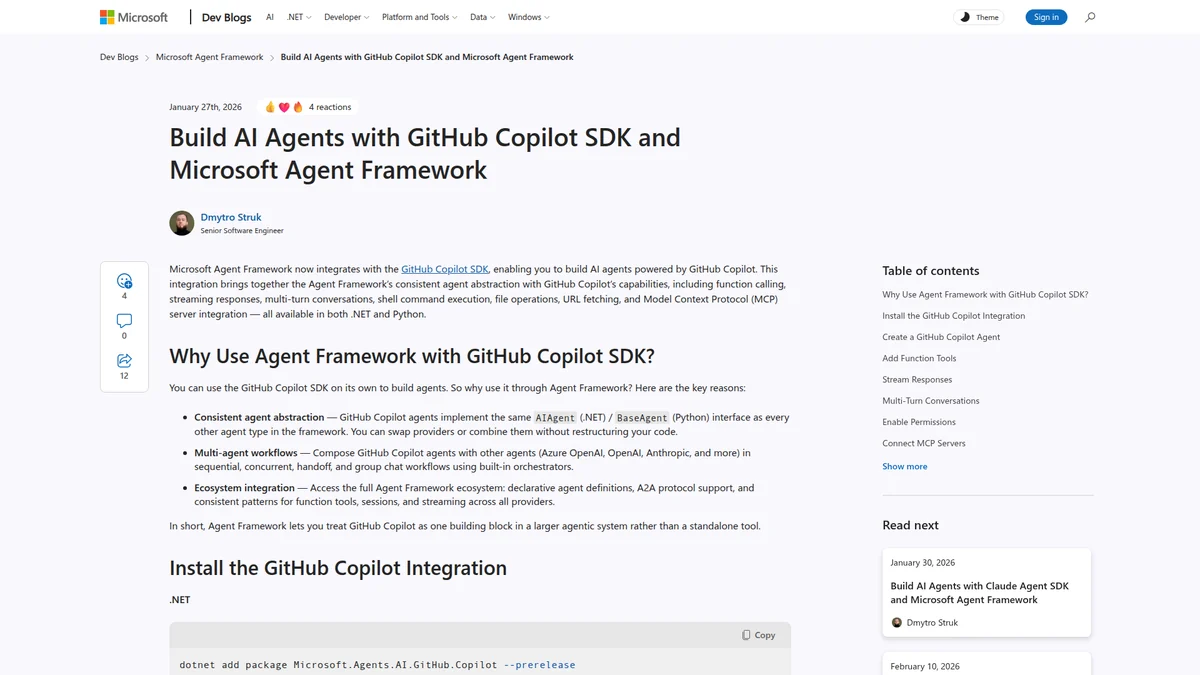 The integration exposes Copilot capabilities through Agent Framework rather than replacing the Copilot runtime. Source: Microsoft Agent Framework Blog.
That distinction matters. Agent Framework is not a new coding model, and Copilot SDK is not a workflow engine. The integration is an adapter between a capable coding-agent backend and a broader application framework.
The practical result is that a Copilot-powered agent can participate in sequential, concurrent, handoff, or group workflows. It can also use framework-level middleware and OpenTelemetry while retaining Copilot features such as streaming, multi-turn sessions, function calls, file operations, shell execution, URL fetching, and MCP.
SDK, agent, and harness are different layers
The terminology is easy to blur, so I use three layers when reviewing an architecture:
| Layer | Primary responsibility | Typical failure |
|---|---|---|
| GitHub Copilot SDK | Coding session and native execution capabilities | Tool or session behaves differently than another provider |
| Agent Framework agent | Common messages, runs, sessions, tools, middleware | Adapter hides a provider-specific event or option |
| Agent harness | Long-running work loop, plan, mode, memory, files, approvals, subagents | Excess autonomy or state that cannot be audited |
A plain agent answers or invokes tools for a turn. A harness adds the operating machinery needed to continue working. In the Python framework, create_harness_agent and its providers have matured rapidly through the 1.7–1.12 releases: file access, file memory, shell execution, todo tracking, modes, tool approvals, looping, background agents, progressive MCP disclosure, and mid-run message injection.
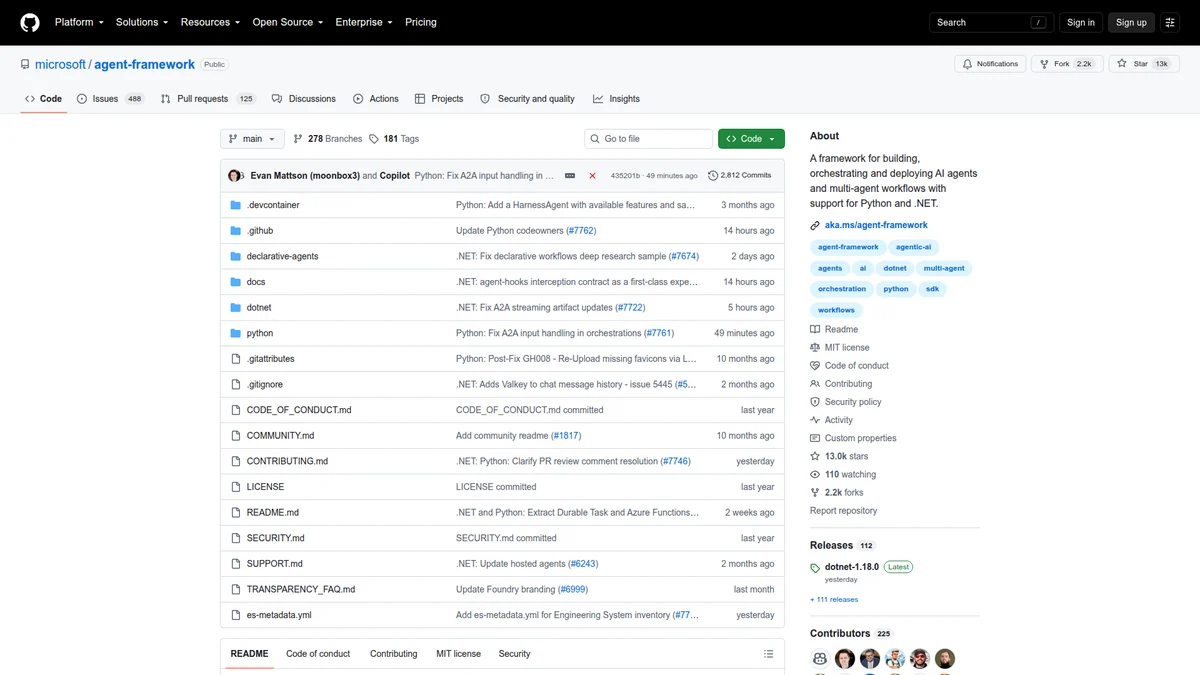 The repository documents Python and .NET support, middleware, workflows, sessions, checkpointing, and provider integrations. Source: microsoft/agent-framework.
This is more than convenience. A todo provider makes remaining work visible. A mode provider distinguishes planning from execution. File memory gives useful state a lifecycle outside the model context. Approval middleware creates a human decision point before a sensitive tool call. None of those features makes the model smarter; they make its work governable.
A realistic architecture
For a repository-maintenance service, I would separate the components this way:
issue or user request
  -> application policy and identity
  -> Agent Framework HarnessAgent
       - mode + todo providers
       - tool approval middleware
       - scoped file access and memory
       - OpenTelemetry
  -> GitHubCopilotAgent / Copilot SDK session
  -> repository sandbox + allowed MCP servers
  -> patch, test evidence, and review request
The application—not the prompt—should decide the writable repository root, allowed commands, credential scope, maximum runtime, and approval rules. The prompt can explain policy, but enforcement belongs below the model.
There should also be a durable record connecting the original request to tool calls, file changes, test output, approvals, and the final response. Without that chain, an agent can produce a convincing summary that is difficult to reconcile with what actually happened.
Why the common interface is useful
The strongest reason to adopt Agent Framework is not provider swapping. It is composition.
Imagine a release workflow with three roles:
- A Copilot-backed coding agent diagnoses and patches the repository.
- A policy agent checks the diff against organization rules.
- A deterministic function runs tests and packages evidence.
Agent Framework can express that flow without pretending every step is an LLM. Deterministic nodes are often the correct choice for builds, schema validation, permission checks, and deployment gates. Agents are useful where interpretation and adaptation are required.
Sessions and checkpointing also matter for work that outlives an HTTP request. If a human approval arrives 20 minutes later, the workflow should resume from recorded state rather than ask the model to reconstruct history from a transcript.
The sharp edges
A common abstraction is not common semantics
One provider may expose shell execution natively while another receives a shell function defined by your app. Streaming tool events, cancellation, attachments, reasoning content, and session continuation can vary. The Agent Framework changelog is full of adapter-specific fixes because those differences are real.
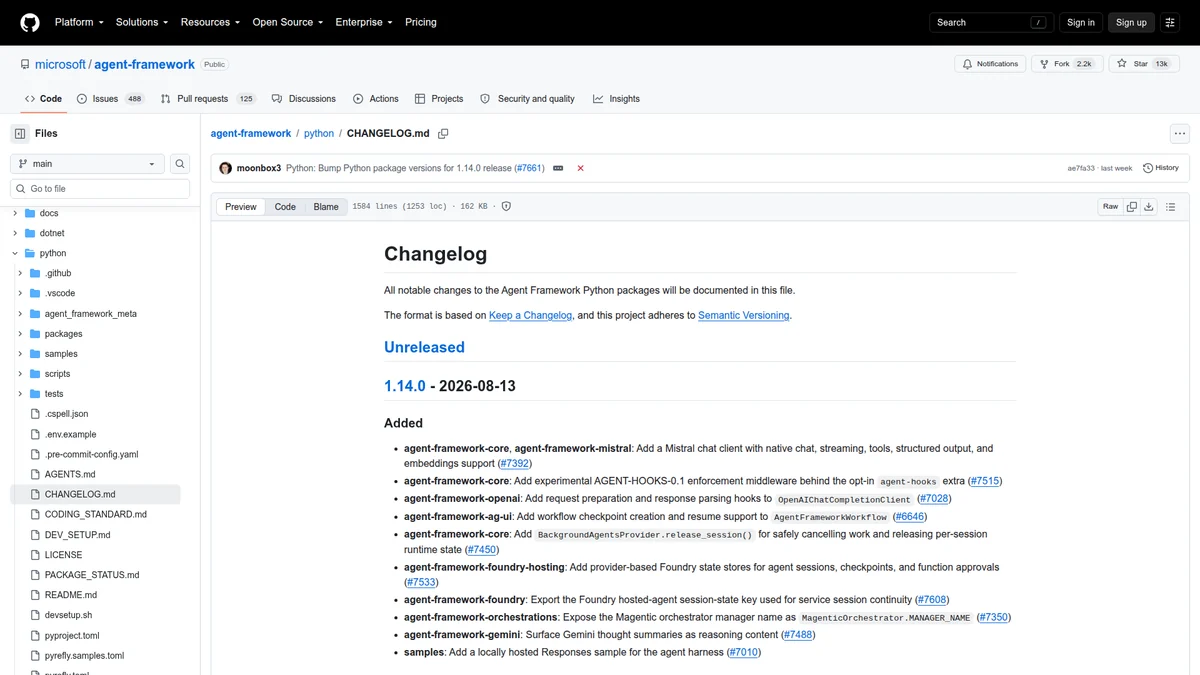 Recent releases stabilized
 create_harness_agent, approval middleware, file memory, and the Copilot package while continuing provider-specific fixes. Source: Python changelog.
Write contract tests around the behavior you need. Do not stop at “both implement the same interface.” Test cancellation after a partial stream, denied tool calls, attachment forwarding, session resume, and error propagation.
Built-in tools can bypass the seam you monitor
A July 2026 framework issue about harness interception captured a subtle risk: native file access, web search, or memory capabilities may not travel through the same observable tool-call seam as application-registered tools. The issue was addressed, but the lesson is broader. A security control is only useful if every privileged path passes through it.
For each built-in capability, verify:
- whether middleware sees the call and arguments;
- whether an approval can deny it before side effects;
- which files, hosts, and commands it can reach;
- what appears in traces and audit logs;
- how cancellation and timeouts behave.
If the answer is unclear, disable the native capability and expose a narrower application-owned tool.
More agents create more ambiguity
Multi-agent diagrams look clean because arrows hide ownership. In production, define who may modify files, who may only review, who resolves disagreement, and what ends the workflow. Two coding agents editing the same working tree concurrently are usually a coordination bug, not a productivity feature.
A useful boundary is artifact ownership: one agent creates a patch; another reads the immutable diff and returns findings; a deterministic gate decides whether the patch advances.
A rollout plan that catches real failures
Start with a single repository and one narrow task class, such as dependency bumps or test-failure diagnosis.
Stage 1: read-only diagnosis. Give the Copilot-backed agent repository read access and test-log access. Measure whether diagnoses cite concrete files and reproduce failures.
Stage 2: sandboxed patches. Allow writes only inside an ephemeral worktree. Require tests and collect the exact diff. Reject changes outside the task scope.
Stage 3: approval gates. Add explicit approval for network access, package installation, secret use, and any command outside a small allowlist.
Stage 4: durable workflow. Add checkpoints, resumable human review, and trace correlation. Kill the worker mid-run and confirm that resumption does not repeat side effects.
Stage 5: selective composition. Introduce a reviewer or specialist agent only after a benchmark shows the single-agent design has a repeatable gap.
The evaluation set should include messy cases: a flaky test, an instruction hidden in repository content, a symlink escaping the workspace, a partial shell failure, and an approval that arrives after timeout. Happy-path coding tasks reveal very little about a harness.
When I would choose this stack
The combination is compelling for a .NET or Python team already invested in GitHub Copilot that needs to embed coding capability in a larger product or internal workflow. It is especially useful when non-Copilot agents, deterministic workflow nodes, durable state, and enterprise telemetry must share one orchestration layer.
I would not add Agent Framework to a developer’s one-off local coding session merely for architectural neatness. Copilot CLI or the native host is simpler there. I would also avoid a multi-agent design when one scoped agent plus reliable tools can complete the task.
The decision resembles the routing trade-off in our Google vs LiteLLM vs OpenRouter comparison: the interface is visible, but the real choice is which operational boundary your team wants to own.
FAQ
Does Agent Framework replace GitHub Copilot SDK?
No. It adapts Copilot into Agent Framework’s agent and workflow abstractions. Copilot still supplies the underlying coding session and native capabilities.
Is HarnessAgent the same as GitHubCopilotAgent?
No. A provider agent connects to a backend. A harness composes operational capabilities such as modes, todos, memory, files, looping, approvals, and background agents around an agent loop.
Can I mix Copilot and other model providers?
Yes. That is a core benefit of the framework. They can participate in the same workflow, but provider-specific behavior still needs contract tests.
Is shell execution safe if approval middleware is enabled?
Not automatically. Confirm that the exact execution path is intercepted, constrain the sandbox and credentials, and test denied, timed-out, and malformed calls.
Should every coding workflow become multi-agent?
No. Add another agent only when it owns a distinct artifact or decision and improves a measured outcome. Otherwise it adds cost, latency, and failure states.
Bottom line
GitHub Copilot SDK plus Microsoft Agent Framework is best understood as a separation of capabilities from operations. Copilot can do the coding work; the framework can make that work composable, resumable, observable, and reviewable.
The stack becomes valuable when you use those controls deliberately. A harness with broad file and shell access but untested approval coverage is not production infrastructure. It is a longer-running agent with a larger blast radius.