Best Google Play API in 2026
Best Google Play API in 2026 by listed price: 6 SandBase endpoints at $0.00015. All six show the shared 100-call row. The $5,000 Play Catalog Access fee is a different product.
Six catalog cards share one listed price, and a $5,000 official fee belongs to a different Google product. On the 21 Nov 2026 catalog check (Asia/Shanghai), Google Play on SandBase listed 6 endpoints, each $0.00015 per call. The HTML title was “Google Play APIs: App Reviews and Movie Catalog Data | SandBase.” /apis/google-play-store, /apis/googleplay, and /apis/play-store returned HTTP 404. This is not Best Google API in 2026, Best Google Maps API in 2026, or Best Google Shopping API in 2026. App Store on SandBase is a sister hub with 3 endpoints, all $0.00015, title “App Store APIs: App Details, Reviews and Search Results | SandBase.” It is not folded into this count. Official Play Catalog Access, from 22 July 2026, is a US third-party app-store program with a $5,000 upfront fee, then annually. That fee is not a per-call search or review price. Official per-call prices for general Play search, product, or review research stay Unknown. Accuracy and latency against other vendors stay Unknown, because this article did not run that comparison.
Key takeaway
- On 21 Nov 2026 the SandBase Google Play hub listed 6 endpoints: apps, games, books, movies, product, and reviews. Each was $0.00015 per call.
- All six cards showed “100 free calls / day.” The 100 calls are one shared organization pool, not 100 per card, and not a caption for every Google hub.
- Reviews and Movies show Async JSON. The other four were not flagged asynchronous. Do not start any of them with
POST /v1/run.- Play Catalog Access is $5,000 upfront, then annually, for US third-party Android app stores from 22 July 2026. It is not this catalog’s per-call price.
- One thousand calls at $0.00015 are $0.15 only as list-price math. Call
POST https://api.sandbase.ai/v1/api/google-play/{endpoint}.
This is not the Google, Maps, or Shopping post
Web search, trends, and scholar sit on the Google post. Places and directions sit on the Maps post. Product price comparison sits on the Shopping post. Film and title metadata on IMDb is Best IMDb API in 2026. iOS listings stay on the App Store hub named above. None of those paths is /apis/google-play.
What a Google Play API means in 2026
The name covers three purchases. Only one of them is the 6-card hub.
The first is Google’s own Play developer surface. On 21 Nov 2026 the Google Play Developer API title was “Google Play Developer API | Google for Developers.” It covers publishing and in-app purchases for a developer’s own apps. It is not a public catalog search or reviews API, and the opened page had no per-call consumer rate card. The Play Catalog API guide is for third-party app stores to poll recent catalog changes. It cannot retrieve a full catalog. Events are limited to the last 36 hours. The QPS limit is 2, shared across methods. Enrollment in Play Catalog Access says that starting 22 July 2026, third-party US Android app stores can access the Play catalog, and that they pay Google an upfront service fee of $5,000 for security and policy review during onboarding, then the same fee annually. That $5,000 is not a per-call price for search, product, or reviews.
The second purchase is a separate unofficial vendor account. This article does not name those vendors or borrow anyone else’s accuracy scores.
The third is the SandBase hub. SandBase is not Google Play. A catalog row does not enroll a third-party app store in Play Catalog Access. Official Google Play terms still apply.
Google Play endpoints you can call on SandBase today
The wider data API index listed 2,247 endpoints from 182 providers on the same check. On this hub the listed price does not vary. Async and the call path still do.
| Card | List price, 21 Nov 2026 | Call | What the card describes | Async | Free allowance |
|---|---|---|---|---|---|
| App Search | $0.00015 per call | POST /v1/api/google-play/apps | Apps by keyword | Not flagged | Visible row |
| Games Search | $0.00015 per call | POST /v1/api/google-play/games | Games by keyword | Not flagged | Visible row |
| Books Search | $0.00015 per call | POST /v1/api/google-play/books | Ebooks by keyword | Not flagged | Visible row |
| Movies | $0.00015 per call | POST /v1/api/google-play/movies | Films, shows, charts | Async JSON | Visible row |
| Product Details | $0.00015 per call | POST /v1/api/google-play/product | Ratings, installs, reviews | Not flagged | Visible row |
| Reviews | $0.00015 per call | POST /v1/api/google-play/reviews | Reviews by rating and sort | Async JSON | Visible row |
The visible row on each of these six cards reads: “100 free calls / day — First 100 calls per day free (shared per organization) · Resets at 00:00 UTC. Pay per call after that.” The pool is shared across eligible data APIs and all org keys. Six cards do not mean 600 free calls. The pricing-page sample lists google-play/apps and google-play/books at $0.00015 after the allowance. That sample is not the roster. The visible row is. It was confirmed on all six cards above, and only those six are described as eligible here.
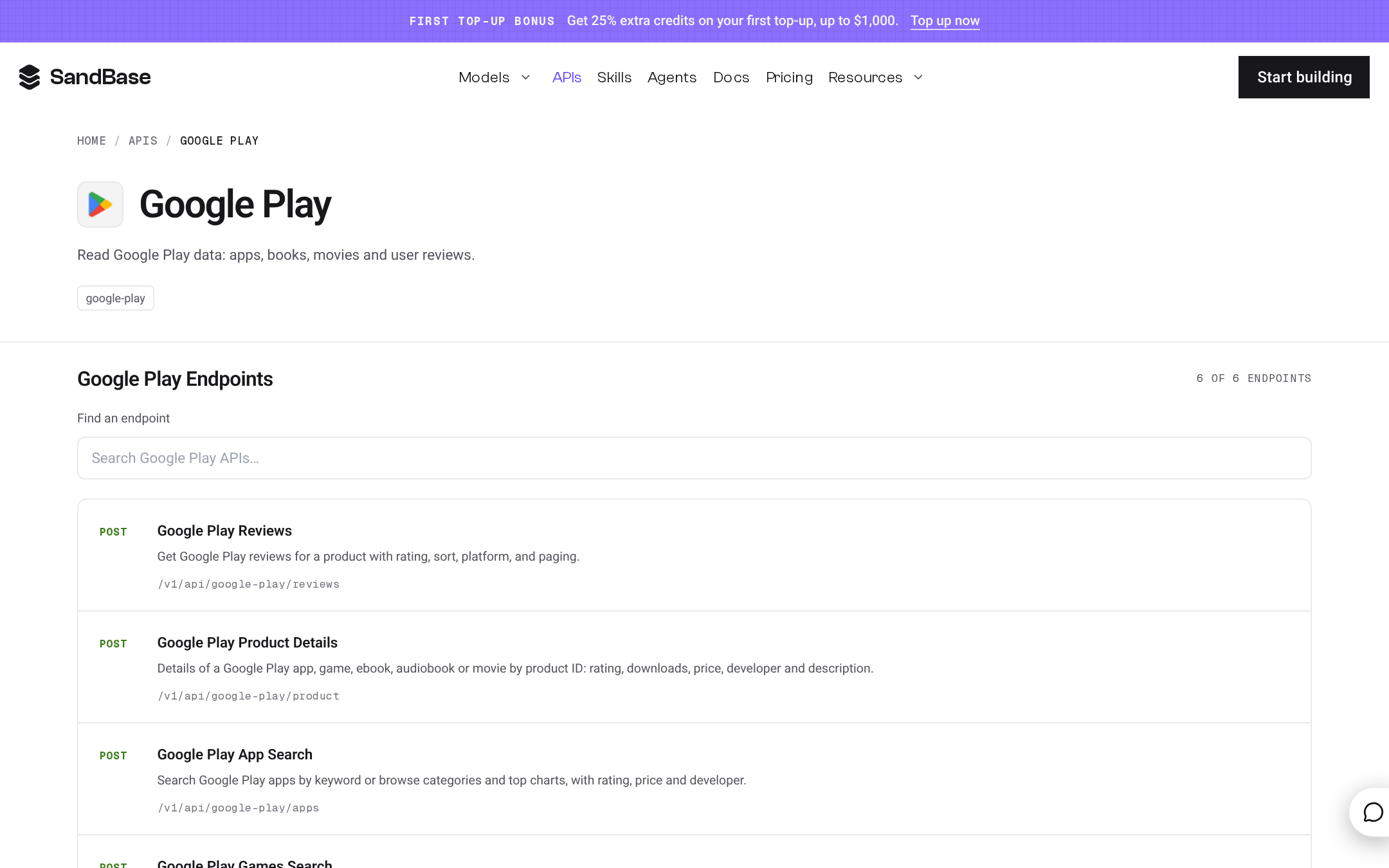
SandBase Google Play hub, logged out, 21 Nov 2026 (Asia/Shanghai). HTML title: “Google Play APIs: App Reviews and Movie Catalog Data | SandBase.” Six endpoints at $0.00015.
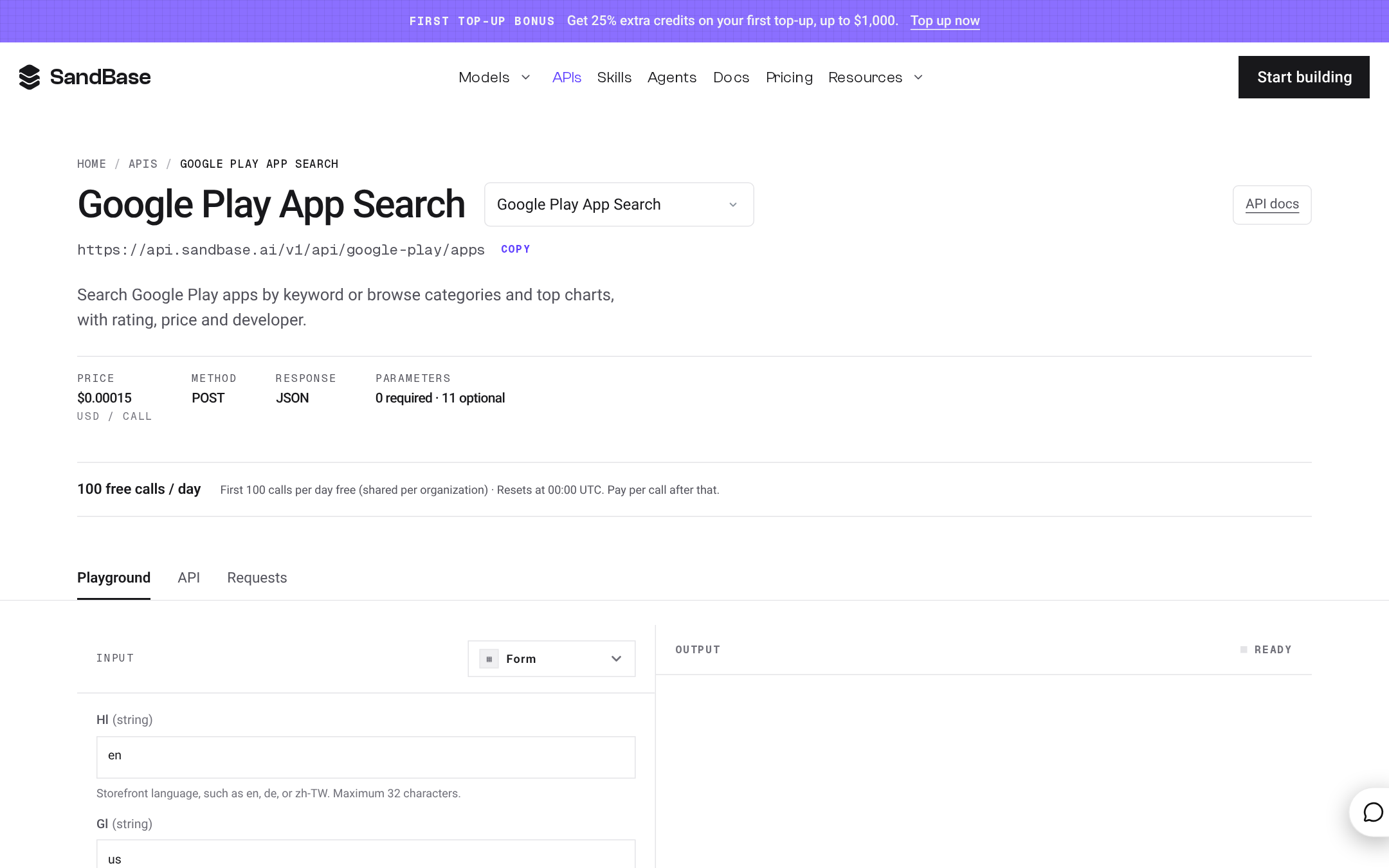
Google Play App Search card, logged out, 21 Nov 2026 (Asia/Shanghai). Title: “Google Play App Search API: Find Apps by Keyword | SandBase.” $0.00015. The shared 100-free-calls row is visible.
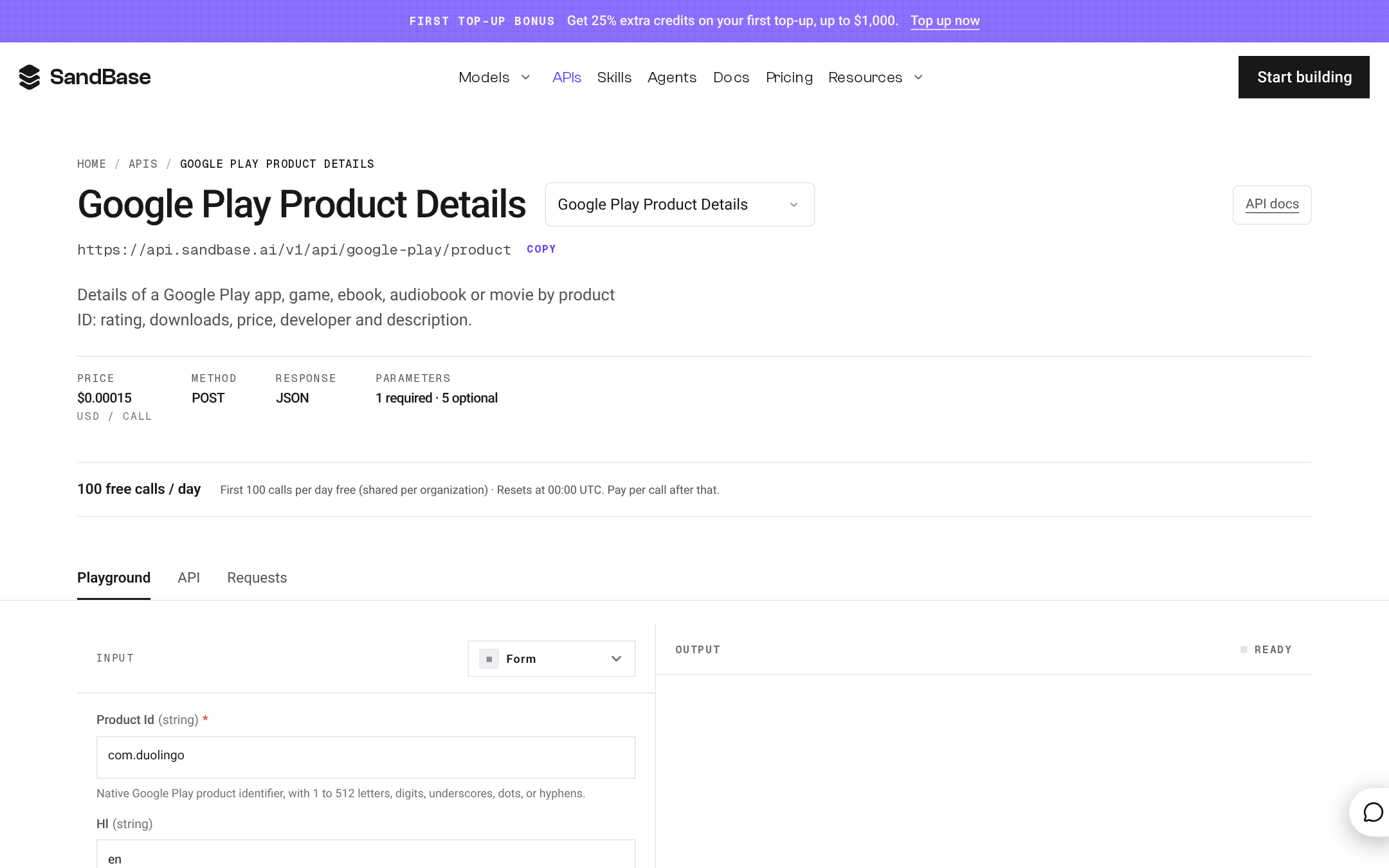
Google Play Product Details card, logged out, 21 Nov 2026 (Asia/Shanghai). Title: “Google Play App Details API: Ratings, Installs and Reviews | SandBase.” $0.00015. The shared 100-free-calls row is visible.
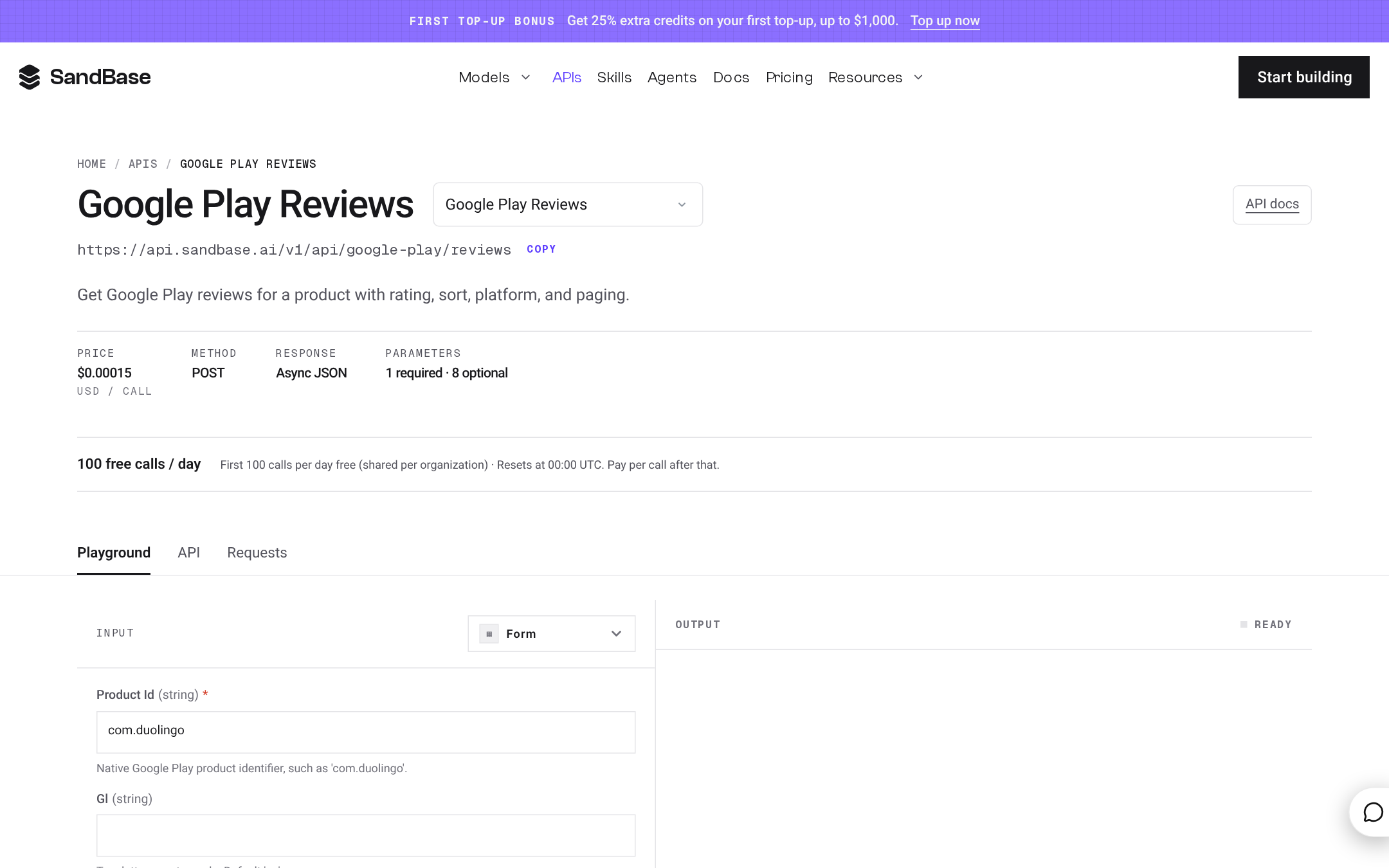
Google Play Reviews card, logged out, 21 Nov 2026 (Asia/Shanghai). Title: “Google Play Reviews API: App Reviews by Rating and Sort | SandBase.” $0.00015. Async JSON. The shared 100-free-calls row is visible.
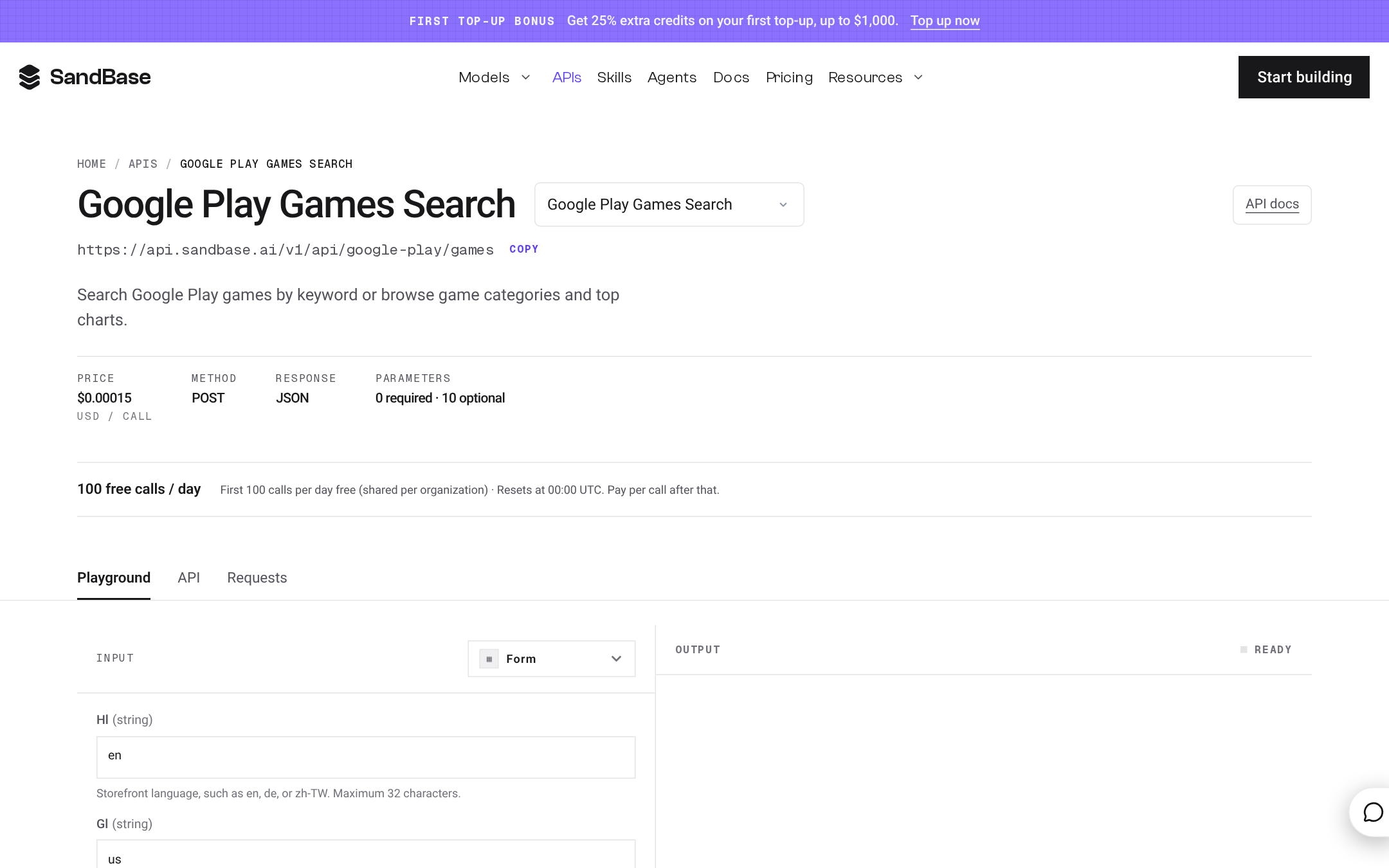
Google Play Games Search card, logged out, 21 Nov 2026 (Asia/Shanghai). Title: “Google Play Games Search API: Find Games by Keyword | SandBase.” $0.00015. The shared 100-free-calls row is visible.
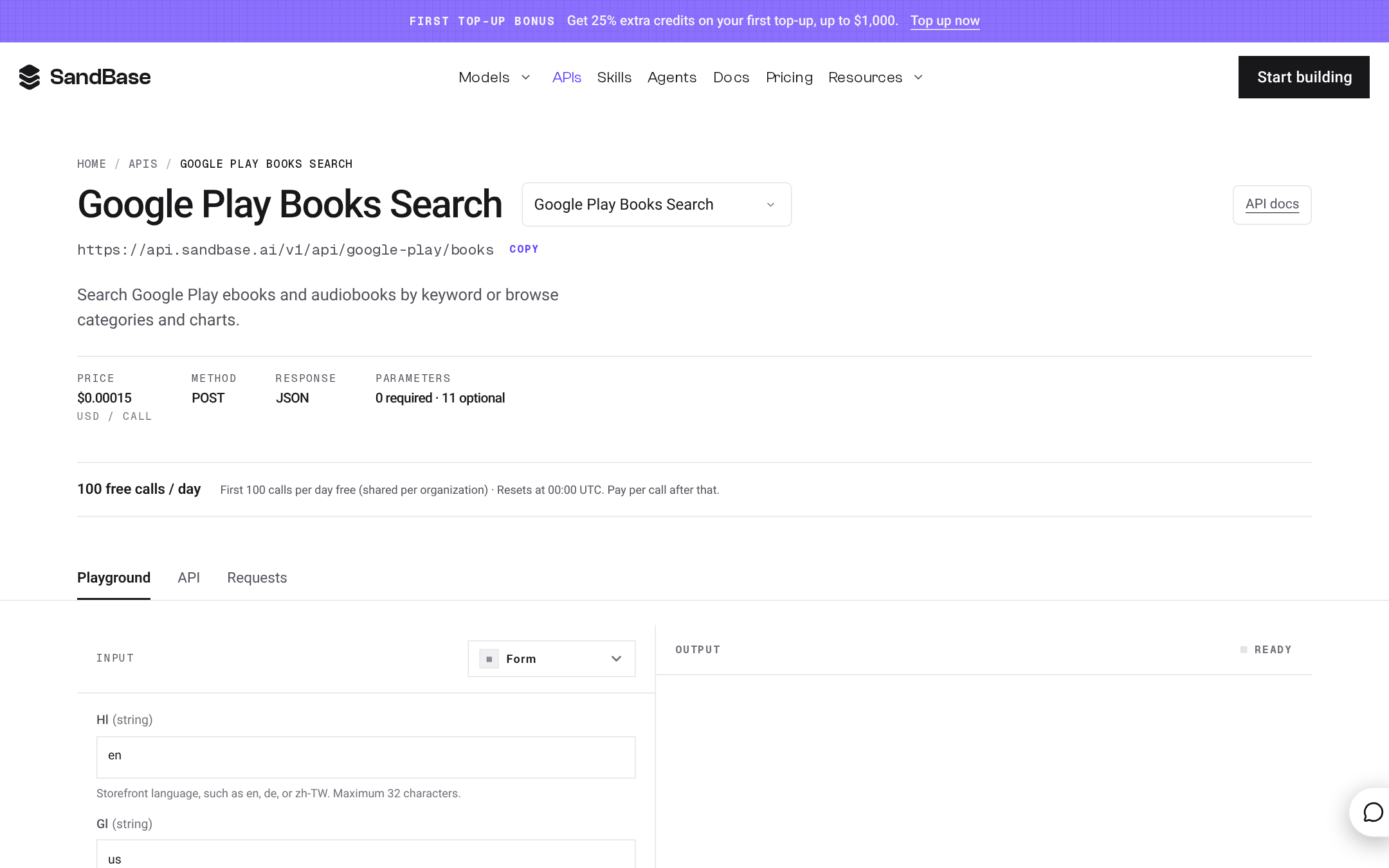
Google Play Books Search card, logged out, 21 Nov 2026 (Asia/Shanghai). Title: “Google Play Books Search API: Find Ebooks by Keyword | SandBase.” $0.00015. The shared 100-free-calls row is visible.
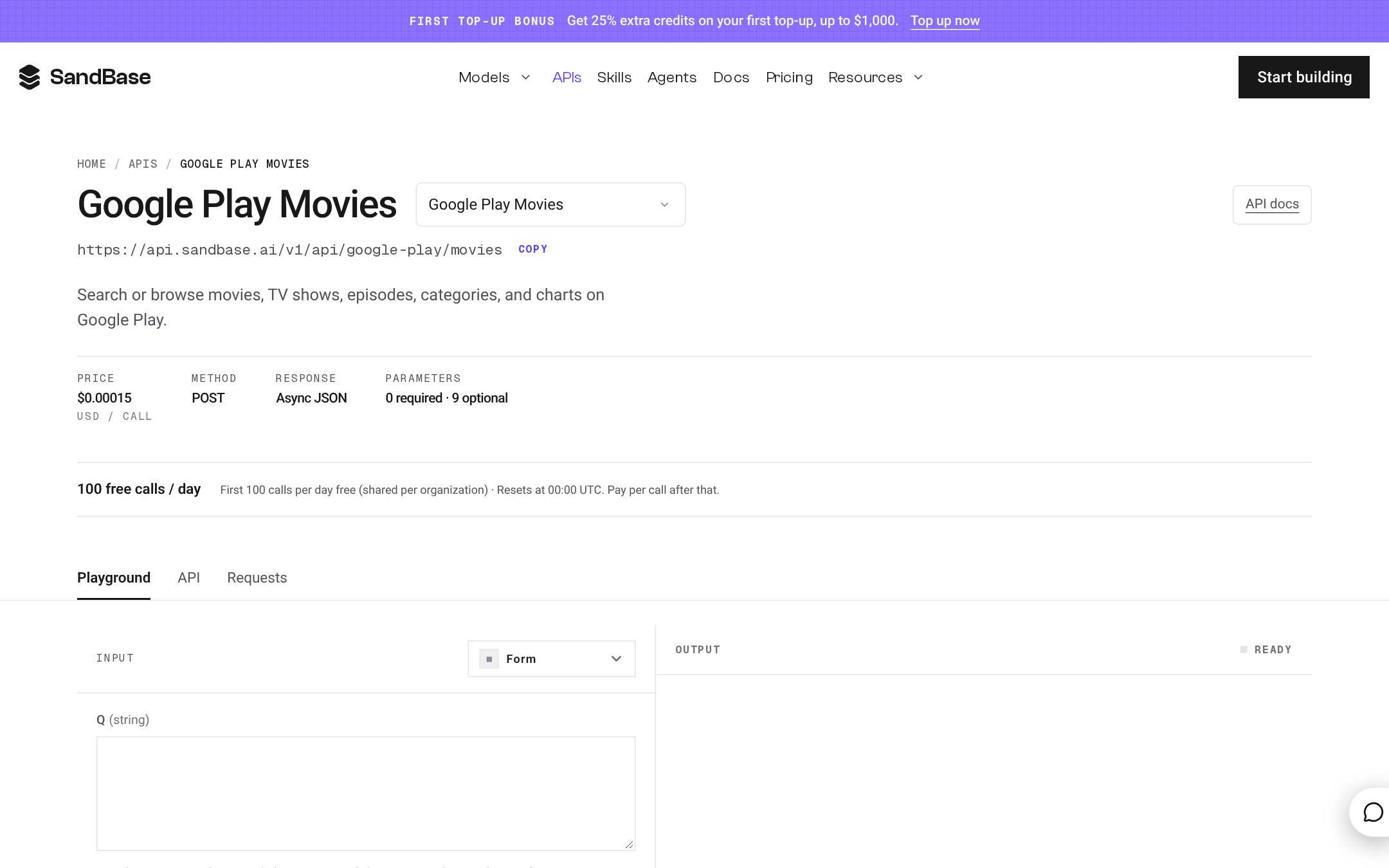
Google Play Movies card, logged out, 21 Nov 2026 (Asia/Shanghai). Title: “Google Play Movies API: Browse Films, Shows and Charts | SandBase.” $0.00015. Async JSON. The shared 100-free-calls row is visible.
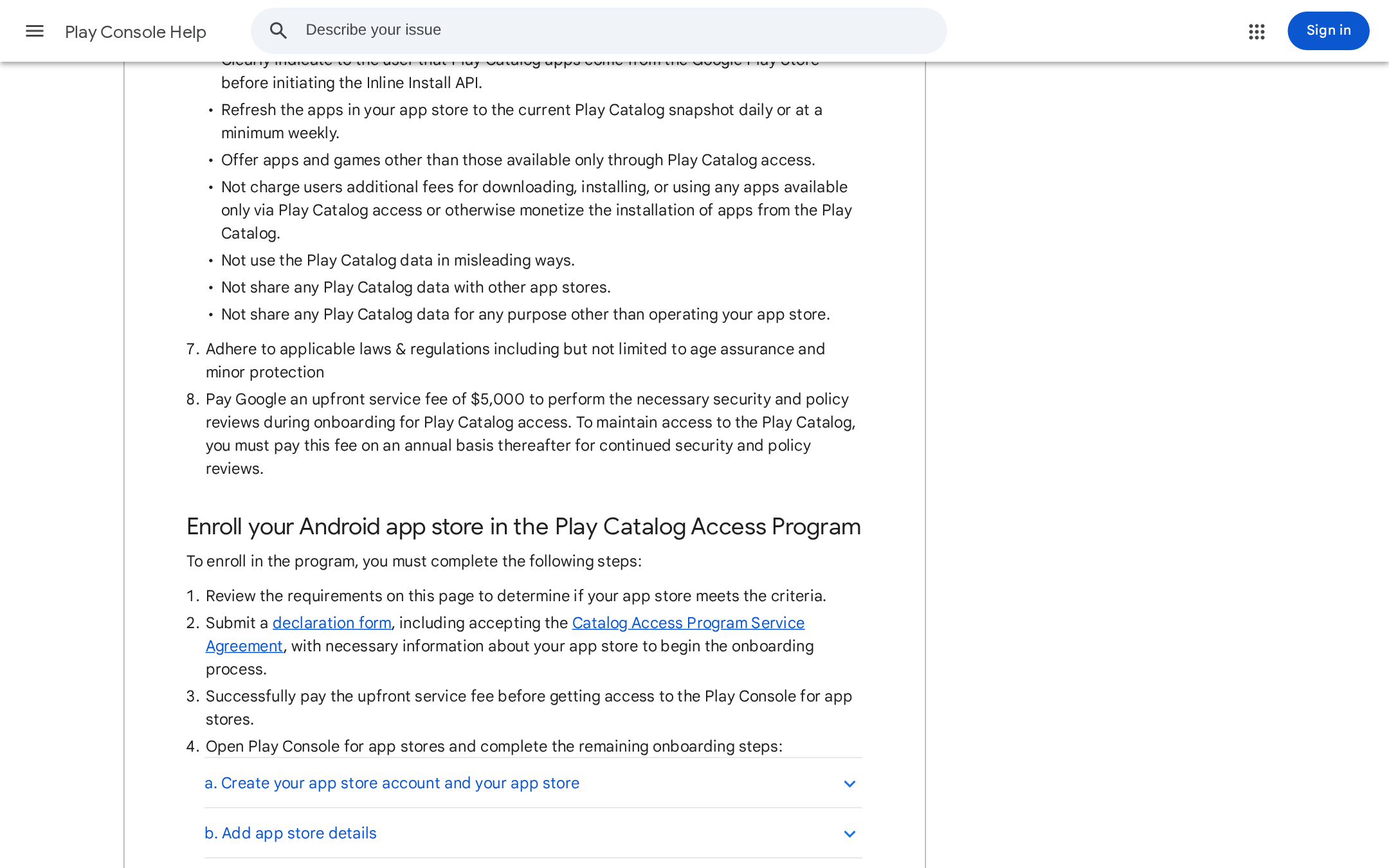
Official Play Catalog Access page, 21 Nov 2026 (Asia/Shanghai). Title: “Enrolling in the Play Catalog Access Program - Play Console Help.” A $5,000 upfront then annual fee for US third-party app stores. Not a per-call search or review price.
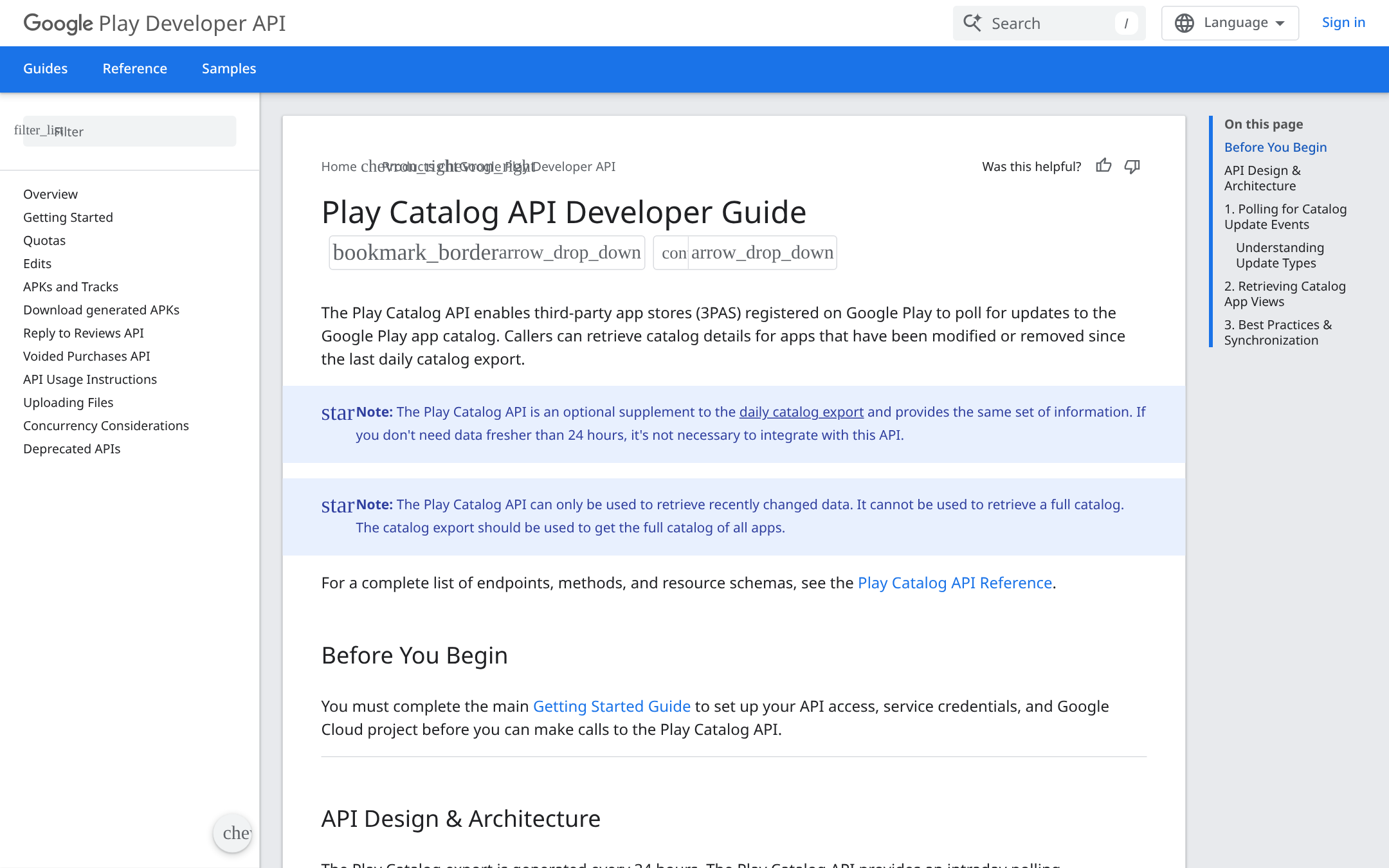
Official Play Catalog API guide, 21 Nov 2026 (Asia/Shanghai). A polling API for third-party app stores. Not a full-catalog search or reviews rate card.
Official Play products versus the SandBase catalog
The rows are different products. The table is not a rank. Latency and accuracy are Unknown in every row.
| Path | What you can call, as checked 21 Nov 2026 | Billing | Free trial or allowance | Docs |
|---|---|---|---|---|
| Official Play developer and Catalog Access | Publishing and in-app purchases for your own apps. Catalog API polls recent changes for third-party US app stores. Not a public search or review catalog. | Play Catalog Access: $5,000 upfront, then annually, from 22 July 2026. Catalog API QPS limit of 2. Official per-call search/review $ is Unknown. | The $5,000 fee is onboarding, not 100 research calls. | Developer API, Catalog API, enrollment |
| SandBase Google Play hub | 6 research endpoints, each $0.00015. Reviews and Movies are asynchronous. | Pay per call, no subscription. Start ($0), Build (Metered), Scale (Custom). | Visible row on all six cards. Shared 100 calls per organization per UTC day. | Live cards plus API passthrough |
| SandBase App Store hub (sister only) | 3 endpoints, all $0.00015: product, reviews, search. Not part of this count. | Pay per call. | Not assessed as a free-quota claim on this page. | App Store hub |
| A separate unofficial vendor account | Whatever that vendor lists. Not measured here. | That vendor’s contract. Unknown here. | Unknown here. | That vendor’s own docs |
Best Google Play API for each need
- Every listed Google Play card is $0.00015. Apps, games, books, movies, product details, and reviews do not have a cheaper sibling on this hub.
- Confirmed free-quota cards: all six. They draw one shared pool. Do not budget 100 free calls per card.
- Async cards: Reviews and Movies. Start with POST, then poll. App Search, Games, Books, and Product Details were not flagged asynchronous.
- A US third-party app store that needs the official catalog feed pays the $5,000 program, not $0.00015.
- App Store listings stay on
/apis/app-store. Google web, Maps, and Shopping stay on their posts.
How to call the Google Play API on SandBase
Data APIs use POST https://api.sandbase.ai/v1/api/{vendor}/{endpoint} with Authorization: Bearer $SANDBASE_API_KEY and a JSON body. Language models use POST /v1/chat/completions. Media models use POST /v1/run. Do not start a data API with POST /v1/run. The passthrough reference is the data-API page. The first API call walkthrough is chat completions only.
Reviews and Movies show Async JSON. App Search, Games Search, Books Search, and Product Details were not flagged asynchronous on 21 Nov 2026. For Reviews and Movies, POST first. When status is not completed, poll GET https://api.sandbase.ai/v1/run/{id} until it is. That GET is the poll. Do not POST /v1/run to start. This comparison did not run a paid call. Replace the empty object with the fields on the live card. Read outputs[0].data. If that object is missing, fail loudly.
import os
import time
import requests

payload = {}  # replace with the fields on the live Google Play Reviews card before sending

headers = {
    "Authorization": f"Bearer {os.environ['SANDBASE_API_KEY']}",
    "Content-Type": "application/json",
}
response = requests.post(
    "https://api.sandbase.ai/v1/api/google-play/reviews",
    headers=headers,
    json=payload,
    timeout=90,
)
response.raise_for_status()
body = response.json()
# Reviews shows Async JSON. Poll GET /v1/run/{id}. Do not POST /v1/run to start.
run_id = body.get("id")
if body.get("status") != "completed":
    if not run_id:
        raise RuntimeError(f"SandBase call returned no id: {body.get('status')} {body.get('error')}")
    for _ in range(30):
        time.sleep(2)
        poll = requests.get(
            f"https://api.sandbase.ai/v1/run/{run_id}",
            headers=headers,
            timeout=90,
        )
        poll.raise_for_status()
        body = poll.json()
        if body.get("status") == "completed":
            break
outputs = body.get("outputs") or []
if body.get("status") != "completed" or not outputs or not isinstance(outputs[0], dict):
    raise RuntimeError(f"SandBase call did not complete: {body.get('status')} {body.get('error')}")
data = outputs[0].get("data")
Movies uses the same poll at /v1/api/google-play/movies. App Search is /v1/api/google-play/apps and was not flagged asynchronous. The snippet is a client sketch, not a measured latency.
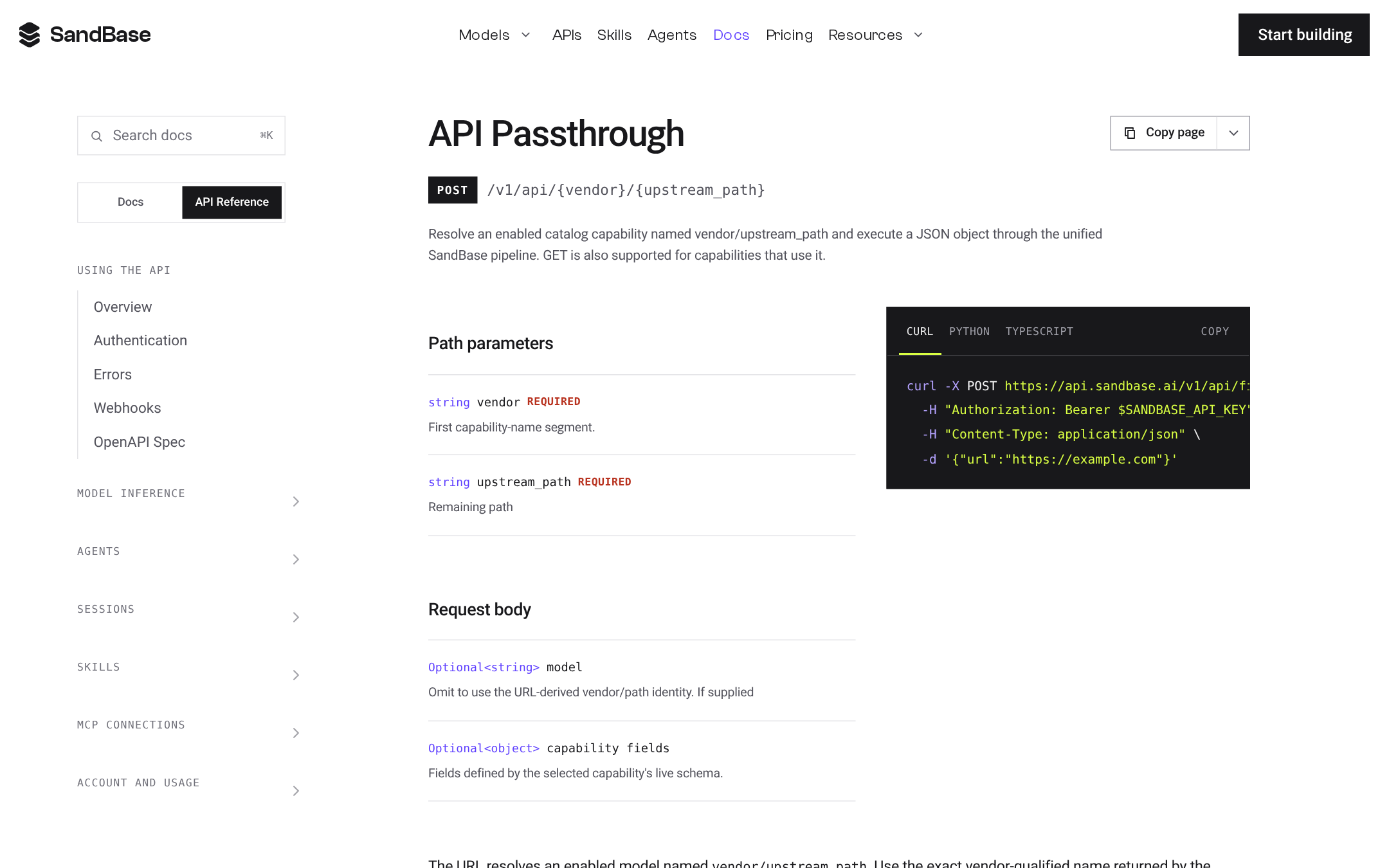
API passthrough page, logged out, 21 Nov 2026 (Asia/Shanghai). Title: “API Passthrough.” Documents POST /v1/api/{vendor}/{endpoint}. Poll GET /v1/run/{id} only after Reviews or Movies accepts that POST. Not a Google Play price.
What the daily allowance does and does not cover
Pricing and Pricing and Usage, checked 21 Nov 2026, give every organization 100 free data API calls per UTC day. The pool is shared across eligible data APIs and all org keys, resets at 00:00 UTC, and does not carry over. Language models and media models are not eligible. On this hub the visible row was confirmed on all six cards. They share the pool with every other eligible data API the organization calls that UTC day. After the 100th eligible call, requests still complete and are billed at the listed price. A zero balance can still spend remaining allowance. Failed calls are not charged. Catalog browsing is $0. Plans are Start ($0), Build (Metered), and Scale (Custom).
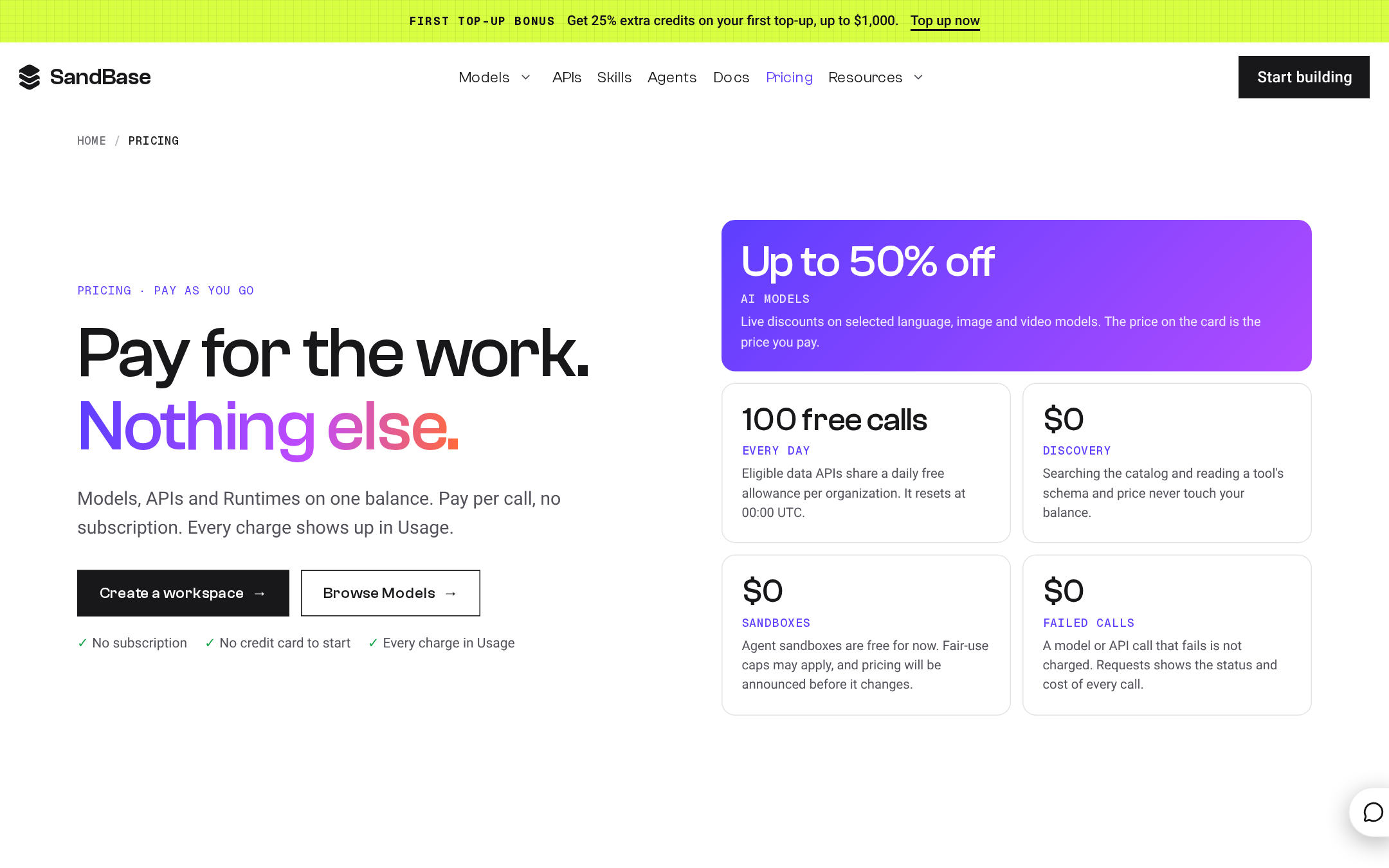
Pricing page, logged out, 21 Nov 2026 (Asia/Shanghai). Title: “SandBase Pricing: Models, APIs and Usage-Based Billing.” Pay per call. Not a Google Play rate card.
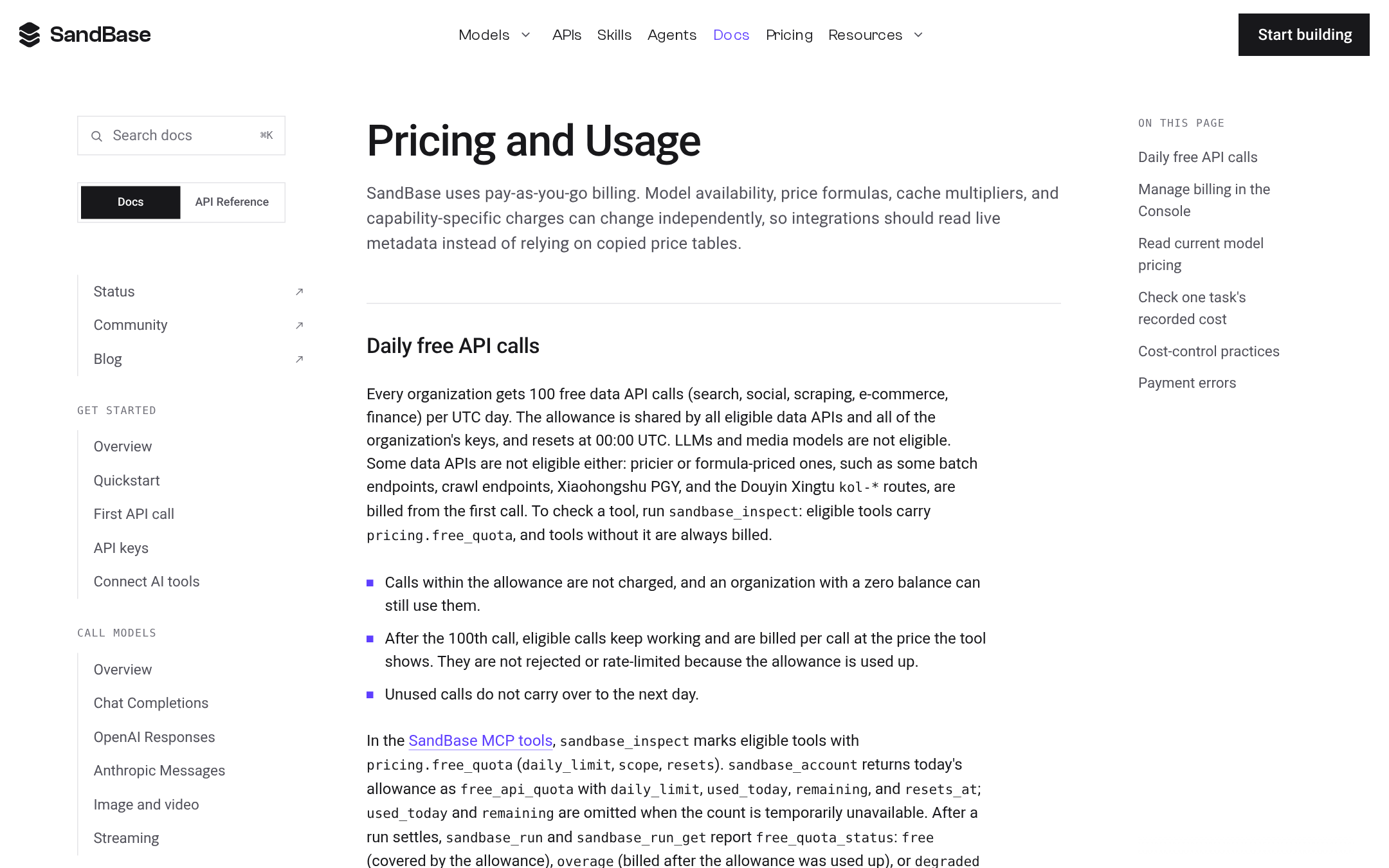
Pricing and Usage guide, logged out, 21 Nov 2026 (Asia/Shanghai). Title: “Pricing and Usage.” Eligible data APIs share 100 free calls per organization per UTC day. All six Google Play cards showed that row.
One thousand calls at $0.00015 are $0.15 only if every call bills at that price. Subtract the shared 100 only while the organization pool still has calls left, and only for calls on cards that showed the row. That subtraction is not 100 per card. This is list-price math, not an invoice. This article does not state a ceiling.
When not to use the SandBase Google Play hub
Stay on Google Play Console when the job is publishing your own app, in-app purchases, or enrollment in Play Catalog Access as a US third-party app store. A catalog row is not that enrollment, and $0.00015 is not the $5,000 fee. Official Google Play terms still apply. Stay on the App Store hub for iOS listings. Stay on the Google, Maps, and Shopping posts for those hubs. Stay put when the buying criterion is a measured accuracy or latency rank. This check did not produce that rank.
FAQ
What does “Google Play API” mean in this article?
The 6 SandBase cards on /apis/google-play, checked 21 Nov 2026. It is not a Google umbrella and not the App Store hub. /apis/google-play-store returned HTTP 404.
When is the SandBase hub a better fit than Play Catalog Access?
For a public app, game, book, movie, product, or review research read, billed per call on one key. For a US third-party app store that must poll Google’s catalog, start with Play Catalog Access. Official per-call search prices and accuracy ranks stay Unknown.
How much do the SandBase Google Play endpoints cost?
$0.00015 per call on all 6 cards, on the 21 Nov 2026 hub list. One thousand calls are $0.15 as list-price math only. The $5,000 figure is Play Catalog Access, not this price.
Are the first 100 Google Play calls free?
On these six cards, yes, inside one shared organization pool of 100 eligible data API calls per UTC day. The pool is not 100 per card. Other Google hubs are not covered by this sentence.
How do official Google Play prices compare with SandBase?
Official pages opened here price a developer publishing API and a $5,000 annual catalog-access program for US third-party stores. SandBase lists 6 research endpoints at $0.00015. Those official products are not a per-call search or review card. Latency and accuracy were not measured.
Do official Google Play terms still apply?
Yes. A catalog price is not Play Console enrollment and does not replace Google’s terms.
How do I start a call?
POST https://api.sandbase.ai/v1/api/google-play/apps (or games, books, product, movies, reviews) with a Bearer key. For reviews and movies, poll GET https://api.sandbase.ai/v1/run/{id} until status is completed. Do not POST /v1/run to start.
Related reading
Web, Maps, and Shopping pricing are Best Google API in 2026, Best Google Maps API in 2026, and Best Google Shopping API in 2026. Title metadata is Best IMDb API in 2026.
Open the Google Play hub, then App Search or Reviews beside the passthrough reference. Read pricing and Pricing and Usage, then sign up. Create a key in the Console, or start an agent from the skill file.
Found this useful? Share it